- M-floor, Al Makhawi Building. Umm Hurair Road, Oud Metha, Dubai – UAE
- advisor@noblehouseconsultants.com
- +971508759073 +971508758925


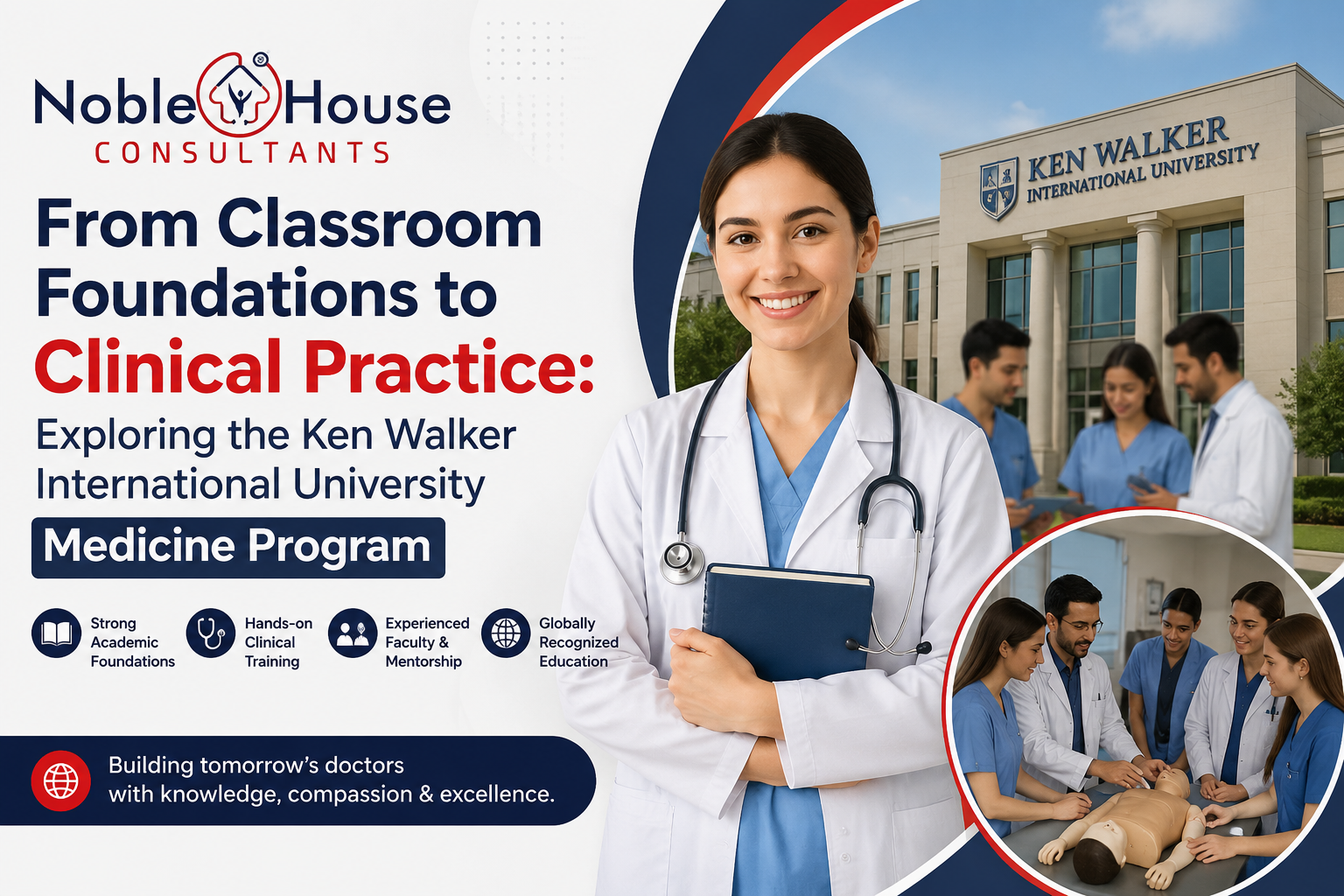
From Classroom Foundations to Clinical Practice: Exploring the Ken Walker International University Medicine Program
Choosing the right medical university is one of the most significant decisions for aspiring doctors. Beyond academic excellence, students often look for a curriculum that combines scientific knowledge with practical clinical experience, preparing them for the realities of modern healthcare. For those planning to study medicine in Georgia, understanding how a university structures its medical education can help determine whether it aligns with long-term career goals. Ken Walker International University has developed a medicine program that emphasizes a progressive learning journey, guiding students from foundational classroom education to real-world clinical practice through a structured and internationally aligned curriculum.
A Modern Approach to Medical Education
Medical education has undergone remarkable transformation over the years. Traditional teaching models often separated theoretical knowledge from patient interaction, delaying practical exposure until the later years of study. Today, many internationally recognized medical programs adopt an integrated learning approach where students gradually build both scientific understanding and clinical competence.
The medicine program at Ken Walker International University follows this educational philosophy by combining foundational sciences with practical experiences from the early stages of the curriculum. This balanced approach helps students understand not only the science behind medicine but also its practical application in patient care.
By introducing clinical concepts early, students become familiar with professional medical environments while strengthening their academic knowledge throughout the six-year program.
Building Strong Foundations During the Early Years
The first phase of any medical education is designed to establish a comprehensive understanding of human biology and medical science. During the initial years, students study essential subjects such as:
- Human Anatomy
- Physiology
- Biochemistry
- Histology
- Microbiology
- Pathology
- Pharmacology
These disciplines form the scientific backbone required for future clinical learning.
However, modern medical education extends beyond textbooks. Students are encouraged to develop practical competencies alongside theoretical knowledge. Clinical communication, patient interviewing techniques, interpretation of diagnostic imaging, and simulation-based learning become important components of early medical training.
For students who wish to study medicine in Georgia, this combination of academic instruction and practical skill development offers an engaging educational experience that supports both confidence and competence.
Transitioning from Theory to Clinical Practice
One of the defining characteristics of a well-designed medical curriculum is the smooth transition from classroom learning to direct patient care.
Rather than viewing clinical education as a completely separate phase, integrated medical programs gradually introduce students to hospital environments where they can observe healthcare professionals, understand patient management, and appreciate multidisciplinary collaboration.
As students advance through the curriculum, classroom concepts become directly connected to real medical cases. This progression helps learners understand how anatomy, physiology, pathology, and pharmacology interact in diagnosing and treating patients.
Clinical exposure allows students to develop:
- Clinical reasoning
- Professional communication
- Observation skills
- Ethical decision-making
- Patient-centered care approaches
These experiences contribute significantly to the development of future physicians who can confidently apply medical knowledge in diverse healthcare settings.
Extensive Clinical Rotations Across Multiple Specialties
The later years of the medicine program focus heavily on hospital-based education.
Students participate in clinical rotations across various specialties, enabling them to experience different branches of medicine while working alongside experienced healthcare professionals. Exposure to multiple departments broadens medical understanding and helps students discover areas of personal interest for future specialization.
Clinical rotations commonly include disciplines such as:
- Internal Medicine
- General Surgery
- Pediatrics
- Obstetrics and Gynecology
- Psychiatry
- Emergency Medicine
- Family Medicine
- Orthopedics
- Neurology
Access to multiple teaching hospitals provides opportunities to observe a wide variety of medical cases, clinical procedures, and patient management strategies. This practical environment supports the gradual development of diagnostic thinking and clinical confidence.
Students planning to study medicine in Georgia often value programs that combine classroom excellence with meaningful hospital experience, as this integration strengthens both academic learning and professional readiness.
Simulation-Based Medical Training
Simulation has become an essential component of contemporary medical education. Before interacting with real patients, students practice clinical scenarios using advanced simulation technologies and standardized patient exercises.
Simulation-based education allows learners to:
- Practice clinical examinations
- Improve communication skills
- Develop emergency response techniques
- Learn procedural skills safely
- Build confidence before entering clinical settings
These structured learning experiences create a supportive environment where mistakes become valuable learning opportunities without compromising patient safety.
Simulation also encourages teamwork, critical thinking, and effective decision-making—qualities that remain essential throughout a medical career.
Curriculum Designed for International Medical Standards
Medical education increasingly reflects global healthcare standards. Universities seek to prepare graduates who possess the knowledge and competencies expected across international healthcare systems.
The medicine curriculum at Ken Walker International University has been developed with reference to internationally recognized educational frameworks, incorporating both European and United States educational methodologies.
This internationally oriented curriculum emphasizes:
- Integrated medical sciences
- Clinical competency development
- Evidence-based medicine
- Professional ethics
- Communication skills
- Continuous assessment and practical learning
Such an approach prepares students to adapt to evolving healthcare systems while maintaining high standards of patient care.
Preparing for Medical Licensing Pathways
A quality medical education extends beyond graduation. Many students eventually pursue professional licensing examinations as part of their medical careers.
Modern medical programs increasingly integrate structured preparation for internationally recognized licensing pathways throughout the curriculum rather than treating examination preparation as an independent process.
Targeted academic support, clinical case discussions, practical assessments, and problem-solving exercises reinforce the competencies evaluated in licensing examinations. Continuous preparation enables students to strengthen their understanding while progressing through the medical program instead of relying solely on intensive revision after graduation.
For individuals seeking to study medicine in Georgia, selecting a curriculum that incorporates licensing preparation can provide additional academic support throughout the educational journey.
Admissions and Academic Eligibility
Understanding admission requirements is an important part of planning medical education abroad.
Students exploring admissions in ken walker international university should carefully review the university’s published eligibility criteria before beginning the application process. Generally, applicants are expected to have completed secondary education with a science background, including Biology, Chemistry, and Physics. Age requirements and other academic qualifications may also apply depending on institutional policies and regulatory guidelines.
Applicants should ensure that all academic documentation, identification records, and required eligibility certificates are prepared well in advance to facilitate a smooth admission process.
Understanding Tuition and Educational Investment
Medical education represents a long-term investment in professional development. When evaluating universities, students should consider tuition costs alongside accommodation, insurance, learning resources, and daily living expenses.
Prospective applicants frequently research Ken Walker International University fees to estimate the overall financial commitment associated with the six-year medicine program. Evaluating educational costs together with curriculum quality, clinical exposure, faculty expertise, and learning infrastructure allows students to make informed decisions based on both academic and financial considerations.
Careful financial planning enables students to focus more effectively on their studies throughout the duration of the program.
Recognition and Future Opportunities
Recognition remains an important factor when selecting a medical university. Internationally recognized medical programs provide graduates with broader opportunities for professional development, postgraduate education, and participation in various healthcare systems, subject to local licensing regulations.
Students should always verify institutional recognition, curriculum standards, and accreditation status through official regulatory authorities before making enrollment decisions. Choosing a recognized medical program contributes to greater academic credibility and enhances future educational and professional pathways.
Beyond academic qualifications, successful medical professionals require lifelong learning, adaptability, ethical practice, and compassion. A curriculum that combines scientific knowledge with practical clinical exposure helps students develop these qualities throughout their educational journey.
Get a Successful Study Abroad Journey with Noble House Consultants
Noble House Consultants is committed to supporting students at every stage of their international education journey. From helping you choose the right university and course to guiding you through admissions, visa documentation, travel planning, and onsite support, we ensure a smooth and stress-free experience. Our experienced team offers personalized guidance, cost-effective solutions, and continuous assistance, allowing you to focus on achieving your academic and career aspirations with confidence while we take care of the rest.
Conclusion
The transition from classroom learning to clinical practice represents one of the most important stages in becoming a physician. A curriculum that gradually integrates foundational sciences, simulation-based learning, hospital exposure, and clinical rotations allows students to build confidence while developing essential medical competencies. For aspiring healthcare professionals looking to study medicine in Georgia, understanding the structure of a university’s medicine program provides valuable insight into the educational experience that awaits. By choosing a curriculum that balances academic excellence with practical training, students can establish a strong foundation for lifelong learning and future success in the ever-evolving field of medicine.
Frequently Asked Questions
1. What is the duration of the medicine program at Ken Walker International University?
The medicine program is a six-year MD course that combines foundational sciences with clinical training.
2. When do students begin clinical training?
Students receive early clinical exposure during the preclinical years and participate in full clinical rotations from the third year onward.
3. What subjects are covered during the initial years of study?
The early years focus on anatomy, physiology, biochemistry, pathology, microbiology, pharmacology, and other core medical sciences.
4. Does the curriculum include practical learning?
Yes. The program integrates simulation-based training, patient interaction, hospital exposure, and clinical skill development throughout the course.
5. What are the basic admission requirements?
Applicants generally need a science background with Biology, Chemistry, and Physics, along with meeting the university’s age and academic eligibility criteria.
6. Is the medicine program internationally recognized?
The program follows internationally aligned medical education standards and is recognized by relevant global and regulatory medical bodies.
7. Why do students choose to study medicine in Georgia?
Students often choose Georgia for its internationally oriented medical education, English-taught programs, modern curriculum, and extensive clinical training opportunities.
About Author

Post a Comment