- M-floor, Al Makhawi Building. Umm Hurair Road, Oud Metha, Dubai – UAE
- advisor@noblehouseconsultants.com
- +971508759073 +971508758925


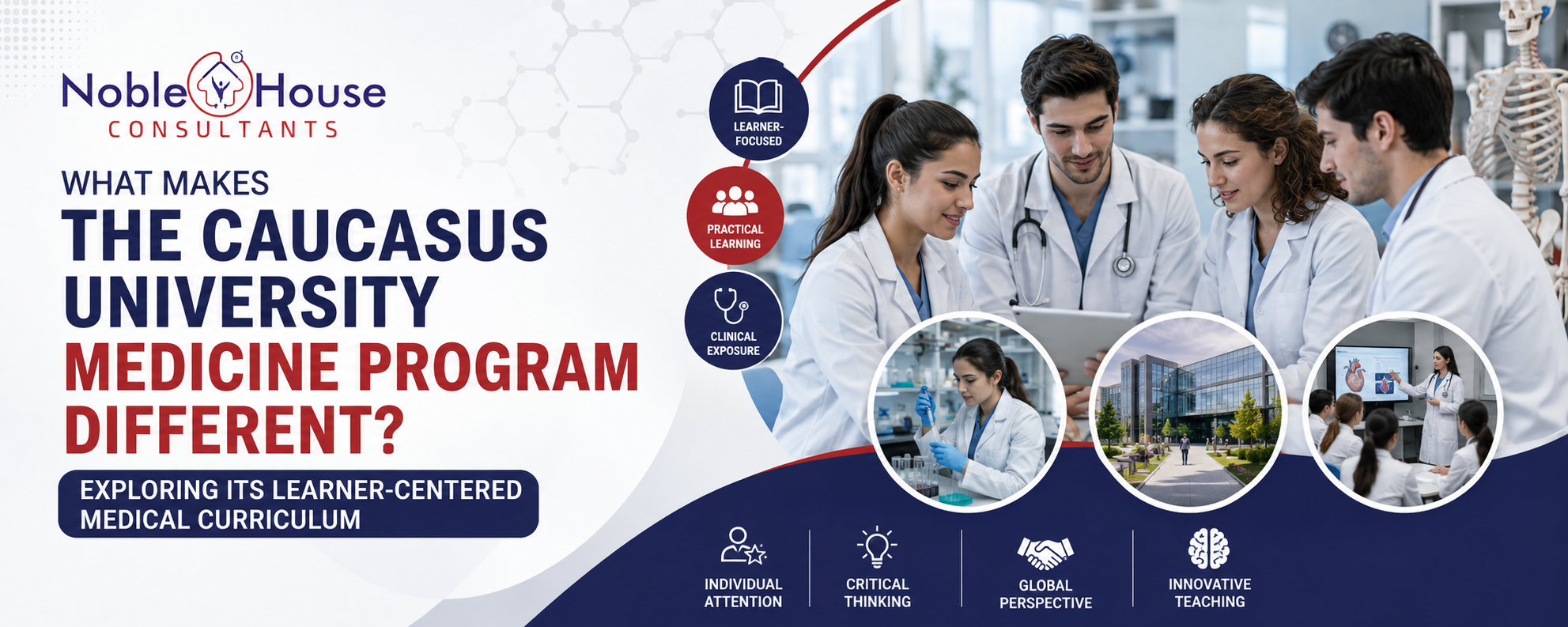
What Makes the Caucasus University Medicine Program Different? Exploring Its Learner-Centered Medical Curriculum
Choosing the right medical school is one of the most important decisions for any aspiring doctor. Beyond tuition fees and campus facilities, students should carefully evaluate the curriculum, teaching methods, clinical exposure, and career preparation offered by a program. A modern medical education should not only build a strong scientific foundation but also develop practical skills, ethical values, and confidence in patient care. For many international students looking to study medicine in Georgia, learner-centered medical programs have become increasingly attractive because they focus on developing competent and adaptable future physicians.
A Curriculum Designed Around Student Learning
One of the defining characteristics of this medicine program is its learner-centered approach. Instead of relying solely on traditional lectures and memorization, the curriculum encourages active participation, critical thinking, and problem-solving throughout the six-year course.
The program follows a structured 360-credit framework spread across six academic years. Students generally complete around 60 credits annually, while having the flexibility to increase their workload to as many as 75 credits when appropriate. This flexibility allows students to progress according to their academic strengths while ensuring they achieve the required learning outcomes.
Rather than simply preparing students to pass examinations, the curriculum emphasizes long-term knowledge retention and the practical application of medical concepts in real clinical settings.
Strong Integration of Theory and Practice
Many medical programs separate classroom learning from clinical training until the later years. This curriculum takes a different approach by integrating theoretical education with practical experiences from an early stage.
Students begin connecting classroom concepts with clinical observations much earlier than in many conventional programs. As they study anatomy, physiology, pathology, and other medical sciences, they simultaneously gain exposure to healthcare environments where they can observe how these subjects influence patient diagnosis and treatment.
This gradual transition from classroom to clinical practice helps students develop confidence while reinforcing their academic knowledge through real-life experiences.
Early Clinical Exposure Builds Confidence
One of the greatest advantages of a learner-centered curriculum is early clinical exposure. Instead of waiting until the final years to interact with patients, students gradually develop communication skills, clinical reasoning, and professional behavior throughout the program.
Training in modern clinical settings and laboratories allows students to become familiar with medical equipment, patient assessment techniques, and healthcare workflows. These experiences reduce the gap between theoretical education and professional practice.
For international applicants planning to study medicine in Georgia, early practical training can provide valuable confidence before entering internship or residency programs after graduation.
Flexible Learning That Supports Individual Growth
Every medical student learns differently. Some excel in laboratory sciences, while others develop stronger clinical reasoning through practical experiences. A learner-centered curriculum recognizes these differences by allowing flexibility within the academic structure.
Students are encouraged to take responsibility for their own learning. Faculty members act not only as instructors but also as academic mentors who guide students toward achieving specific learning objectives.
The emphasis on independent learning also helps students develop lifelong study habits that remain valuable throughout their medical careers.
Internationally Aligned Medical Education
Modern healthcare is becoming increasingly global. Medical graduates may choose to continue their education, pursue postgraduate training, or work in different countries during their careers.
This curriculum has therefore been designed according to internationally recognized medical education standards. Students receive training that emphasizes evidence-based medicine, clinical competence, patient safety, professionalism, and ethical decision-making.
As healthcare systems continue to evolve worldwide, graduates are expected to possess both scientific knowledge and practical abilities that meet international expectations.
These features make the program particularly appealing to students who hope to study medicine in Georgia while keeping future career opportunities open across different healthcare systems.
Comprehensive Preparation for Licensing Examinations
Graduating from medical school is only one step toward becoming a licensed physician. Many graduates later prepare for medical licensing examinations required by different countries.
The curriculum is structured to provide a strong foundation in both basic medical sciences and clinical medicine. Since subjects are integrated throughout the six-year program, students continuously reinforce previously learned concepts instead of studying them in isolation.
This educational approach helps students build the knowledge base necessary for future licensing examinations while also strengthening their clinical decision-making abilities.
Focus Beyond Medical Science
Today’s physicians need much more than scientific knowledge. Effective communication, empathy, professionalism, and ethical judgment are equally essential in delivering quality patient care.
For this reason, the program incorporates subjects such as medical ethics, patient communication, healthcare legislation, and professional responsibility alongside traditional medical sciences.
Students learn how to interact respectfully with patients from diverse cultural backgrounds, communicate difficult medical information compassionately, and understand the legal responsibilities associated with clinical practice.
These additional competencies contribute significantly to producing well-rounded healthcare professionals.
A Well-Structured Academic Journey
The Caucasus university medicine syllabus follows a logical progression that allows students to gradually build their knowledge from foundational sciences to advanced clinical medicine.
During the early years, students focus on subjects such as anatomy, physiology, biochemistry, and microbiology. As they progress, they move into pathology, pharmacology, internal medicine, surgery, pediatrics, obstetrics and gynecology, psychiatry, and other clinical disciplines.
Because practical learning is integrated throughout the curriculum, students continuously connect classroom knowledge with patient-centered clinical experiences instead of viewing them as separate stages of education.
Preparing Students for Modern Healthcare
Healthcare today requires adaptability. New diseases emerge, treatment guidelines evolve, and medical technologies continue to advance rapidly.
A learner-centered curriculum encourages students to become independent learners who can evaluate scientific evidence, update their knowledge regularly, and apply new information responsibly in clinical practice.
The emphasis on critical thinking also helps students approach complex medical problems with analytical reasoning rather than relying solely on memorized information.
For students who wish to study medicine in Georgia, developing these lifelong learning skills can become a significant advantage throughout their professional careers.
Why This Curriculum Stands Out
Several features distinguish this medical program from many traditional medical education models:
- A six-year learner-centered curriculum built around student development.
- Flexible credit structure that accommodates different learning needs.
- Early integration of classroom education with clinical experiences.
- Strong emphasis on practical skills alongside theoretical knowledge.
- Comprehensive preparation for future licensing examinations.
- Training in ethics, communication, and healthcare legislation.
- Internationally aligned educational standards that support global career opportunities.
- Continuous development of independent learning and critical thinking abilities.
Instead of producing graduates who only possess textbook knowledge, the curriculum aims to develop confident, competent, and compassionate future physicians who are prepared for the realities of modern healthcare.
Turn Your Medical Dream into Reality with Noble House Consultants
Choosing the right medical program is only the first step—navigating the admission process is equally important. Noble House Consultants is committed to making your study abroad journey simple, affordable, and stress-free. We guide you through every stage of the admission process, from selecting the right course and university to preparing your application, arranging direct interviews where applicable, assisting with visa documentation, and offering travel and onsite support.
With years of experience and a student-first approach, we work closely with you to ensure every step is handled with care and confidence. Our goal is to help you focus on your future while we take care of the complexities, making your dream of becoming a successful medical professional a reality.
Conclusion
Selecting a medical school involves much more than comparing tuition fees or campus facilities. Students should carefully examine how a curriculum supports academic growth, clinical competence, professional development, and future career goals. This learner-centered six-year medical program offers an educational experience that combines scientific knowledge with practical training, ethical education, and flexible learning pathways. For aspiring doctors planning to study medicine in Georgia, understanding these curriculum features can help them choose a program that prepares them not only to earn a medical degree but also to succeed as capable and compassionate healthcare professionals in an increasingly global medical landscape.
Frequently Asked Questions
1. What makes this medicine program learner-centered?
The program focuses on active learning, critical thinking, practical training, and continuous skill development rather than rote memorization.
2. How long is the MD program?
The program is six years long and follows a structured 360-credit academic framework.
3. When do students begin clinical training?
Students receive early clinical exposure, allowing them to connect classroom knowledge with practical medical experience from the initial years.
4. Is the curriculum suitable for international students?
Yes. The curriculum is designed to meet internationally recognized medical education standards and prepares students for global medical careers.
5. Does the program prepare students for medical licensing exams?
Yes. The curriculum builds strong foundations in basic and clinical sciences, helping students prepare for various international medical licensing examinations.
6. What subjects are included besides medical sciences?
In addition to core medical subjects, students study medical ethics, patient communication, healthcare legislation, and professional responsibility.
7. How can students simplify the admission process?
Students can seek professional admission guidance to receive support with university selection, documentation, visa assistance, and other application requirements.
About Author

Post a Comment