- M-floor, Al Makhawi Building. Umm Hurair Road, Oud Metha, Dubai – UAE
- advisor@noblehouseconsultants.com
- +971508759073 +971508758925


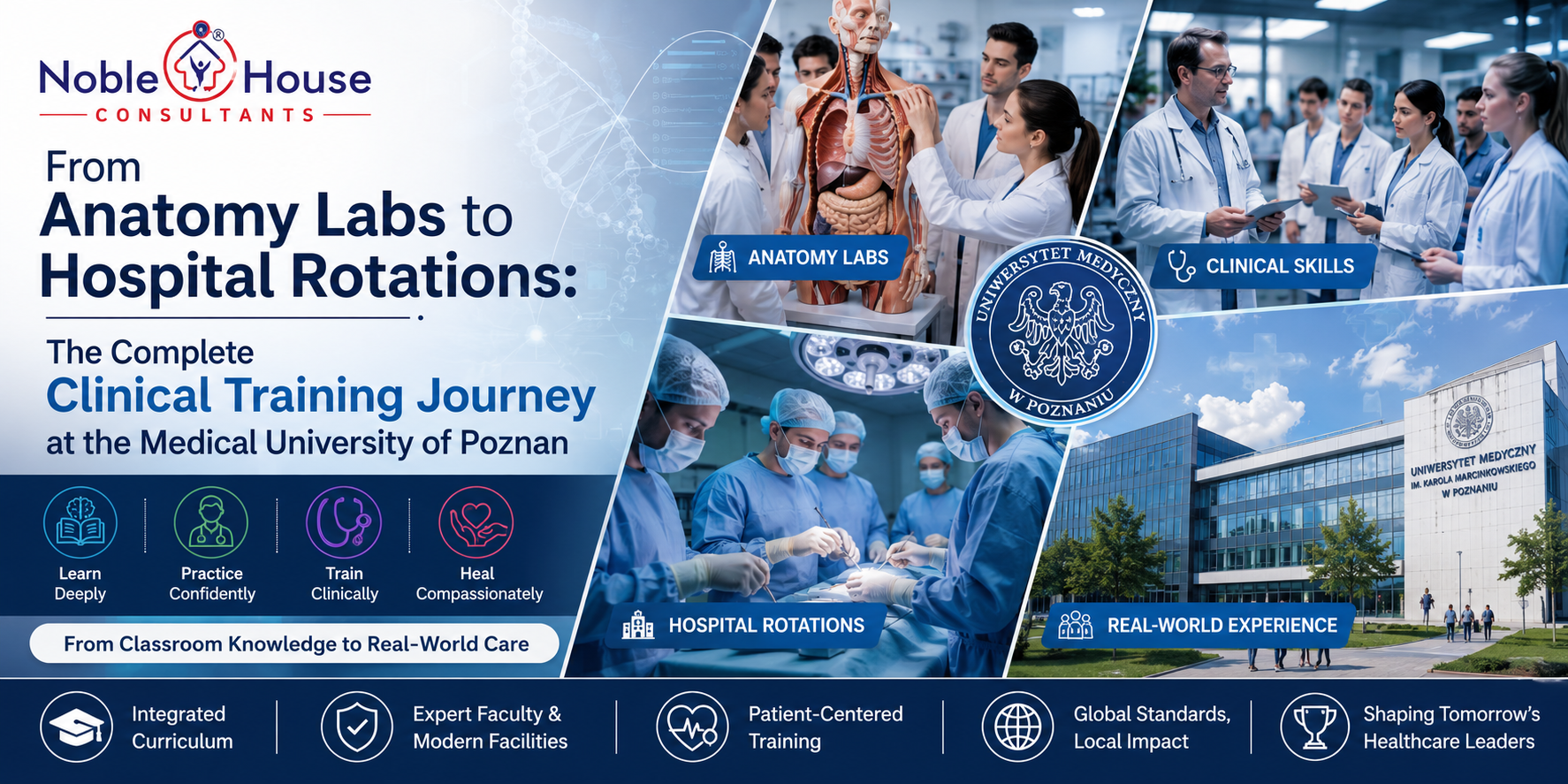
From Anatomy Labs to Hospital Rotations: The Complete Clinical Training Journey at the Medical University of Poznan
For students planning to study medicine in Poland, understanding how medical education progresses from basic sciences to real-world clinical practice is essential. The Medical University of Poznan offers a six-year English-language Medicine program designed to gradually develop students’ scientific knowledge, clinical reasoning, practical skills, and professional confidence. Rather than introducing students to hospital responsibilities immediately, the curriculum follows a structured journey: first building a strong understanding of the healthy human body, then exploring disease and treatment, and finally placing students in clinical environments where they can work with patients and healthcare professionals.
Building the Foundations: The First Year
The first year establishes the scientific foundation required for everything that follows. Students begin by studying subjects such as anatomy, physiology, genetics, and related biomedical disciplines. These subjects help students understand the structure of the human body and how its different systems function under normal conditions.
Anatomy is particularly important because it gives students the framework they will use throughout their medical careers. Understanding organs, tissues, anatomical relationships, and body systems becomes essential when students later learn physical examination techniques, diagnostic procedures, surgery, radiology, and other clinical disciplines.
Laboratory sessions complement theoretical teaching. Instead of relying exclusively on lectures and textbooks, students have opportunities to observe and work with scientific material in practical settings. This combination encourages students to connect biological concepts with their applications in medicine.
The first year therefore represents more than an introduction to medical school. It establishes the scientific vocabulary and conceptual understanding that students will repeatedly use throughout the following five years.
Moving Deeper Into Medical Science in Year Two
The second year expands upon the foundation established during the first year. Students encounter subjects including physiology, biochemistry, microbiology, behavioral sciences, pathology, and pharmacology.
This stage begins to answer a fundamental medical question: what happens when normal biological processes become abnormal?
Pathology introduces students to the mechanisms of disease, while microbiology examines microorganisms and their relationship with human illness. Pharmacology introduces the principles behind medicines and their effects on the body. Physiology and biochemistry continue to develop students’ understanding of how healthy systems function.
Emergency preparation also becomes part of the educational experience. Students receive CPR training and learn principles associated with rescue and disaster medicine. Such preparation is valuable because doctors may encounter emergencies regardless of their eventual specialty.
For students who study medicine in Poland, this progression demonstrates why medical education cannot be reduced to memorizing diseases. Clinical competence depends on understanding how anatomy, physiology, pathology, microbiology, and pharmacology interact.
From Disease Mechanisms to Treatment Decisions
The third year represents another major transition. Students continue completing foundational science courses while developing a stronger understanding of disease processes and therapeutic interventions.
At this stage, students examine what happens when healthy structures and physiological processes are disrupted. They learn how diseases develop, how symptoms arise, and how pharmacological and therapeutic interventions can influence patients’ conditions.
This knowledge provides an important bridge between basic science and clinical medicine. A physician needs to understand not only what a disease looks like but also why it occurs and how treatment decisions can affect the patient.
The program also includes a Comprehensive Basic Science Review course conducted in cooperation with Kaplan, followed by a comprehensive examination. This provides students with an opportunity to consolidate their knowledge before moving further into the clinical phase.
For students who plan to study medicine in Poland, this point in the curriculum is particularly significant because it marks the shift from primarily learning about medical science to preparing for the responsibilities of clinical education.
Entering the Hospital: The Fourth Year
The fourth year marks the beginning of the formal clinical part of the program. Students start rotations in areas including internal medicine, surgery, pediatrics, psychiatry, and radiology.
This is where knowledge acquired in classrooms and laboratories begins to take shape in real clinical situations. Students encounter patients, observe medical professionals, participate in clinical discussions, and begin developing practical skills.
The teaching structure is designed to support close interaction between students and doctors. Hospital groups generally consist of approximately five to six students working with one doctor-tutor. This smaller learning environment allows students to observe clinical decision-making and receive guidance while developing their own skills.
Students learn how to conduct patient interviews and take medical histories. They also practice procedures, review clinical cases, and assist with surgeries where appropriate. Theoretical knowledge continues to be important, but students now have to consider how that knowledge applies to individual patients.
This stage is one of the most important reasons students choose to study medicine in Poland. Clinical education is not simply about observing doctors; it is about gradually learning how to think and behave as a healthcare professional.
Developing Clinical Confidence in the Fifth Year
By the fifth year, students are already familiar with the basic structure of hospital work. Clinical rotations continue, while students face final examinations in major areas such as surgery, obstetrics and gynecology, internal medicine, pediatrics, and neurology.
The emphasis increasingly shifts toward practical competence and clinical responsibility. Students gain further experience with patient care, clinical procedures, professional communication, and the organization of hospital work.
At this stage, students can begin seeing how different specialties connect. A patient may present with symptoms that involve multiple organ systems, require diagnostic investigations, and need treatment involving several healthcare professionals. Learning to approach these situations systematically is an essential part of becoming a competent physician.
The fifth year also provides an opportunity to strengthen professional habits. Accurate documentation, effective communication, careful observation, teamwork, and respect for patients are all important components of clinical practice.
Completing the Clinical Journey in Year Six
The sixth year completes the transition from medical student toward professional practice. Students undertake remaining mandatory clinical rotations and gain exposure to additional areas of medicine.
The curriculum introduces students to fields such as forensic medicine, neurology, oncology, infectious diseases, and tropical medicine. This broad exposure helps students appreciate the diversity of modern healthcare and the different career paths available after graduation.
Students interested in pursuing medical careers in the United States or Canada can also undertake elective clinical rotations during this period. Such opportunities can help students gain experience in different healthcare environments and explore areas relevant to their future professional plans.
The final year is therefore not simply about completing the remaining subjects. It is a period in which students consolidate years of scientific and clinical learning and begin considering how they want to use their medical education after graduation.
Why the Clinical Environment Matters
Medical education becomes much more meaningful when students can connect academic knowledge with patient care. The university owns four clinical hospitals, a hospice, and a modern medical simulation center, providing an educational environment where theoretical and practical learning can complement one another.
Patient contact begins from the second year through opportunities in university clinics, while the later clinical years provide substantially greater exposure to hospital medicine. Students who volunteer may also have opportunities to assist lecturers with medical procedures or surgeries, depending on the circumstances and applicable supervision.
Simulation-based education can also help students practice clinical skills in a controlled environment before applying them with patients. This is particularly useful for developing confidence in procedures, communication, emergency response, and teamwork.
For international students who study medicine in Poland, access to structured clinical education can be an important part of adapting to the expectations of medical training in a European healthcare setting.
An International Perspective on Medical Education
The program is delivered in English and is designed with international students in mind. Its stated educational standards reflect American, European, and other international requirements, while the university’s graduates have pursued professional and research careers in countries including the United States, Canada, the United Kingdom, Norway, Ireland, and Thailand.
The Poznan University of Medical Sciences therefore provides an environment where students from different countries can complete their medical education while gaining exposure to a European academic and healthcare setting.
International students should nevertheless research licensing requirements carefully before selecting a medical school. Graduation from a university does not automatically mean that a graduate can practice medicine in every country. Licensing authorities may have their own examinations, documentation requirements, postgraduate training requirements, and other conditions.
Understanding the Overall Six-Year Progression
The complete journey can be understood as a gradual progression:
Years 1–2: Students build knowledge of anatomy, physiology, biochemistry, genetics, microbiology, pathology, pharmacology, and other foundational sciences.
Year 3: Students connect basic sciences with mechanisms of disease and treatment while consolidating their knowledge through comprehensive review.
Year 4: Students enter the clinical phase and begin rotations across major specialties while working with doctors and patients.
Year 5: Students deepen their clinical experience, complete major specialty examinations, and develop greater practical competence.
Year 6: Students complete mandatory rotations, explore additional specialties, undertake electives where appropriate, and consolidate their preparation for their future medical careers.
This structure illustrates the philosophy behind Poznan University of medical sciences medicine: medical education is a cumulative process in which each stage prepares students for the next.
What Students Should Expect From the Experience
Students considering this pathway should be prepared for a demanding academic environment. Medical education requires consistent study, practical participation, effective time management, and the ability to apply knowledge rather than simply memorize information.
They should also expect their learning style to change over time. Early medical school may involve considerable laboratory work, lectures, and independent study. Later years increasingly require patient interaction, clinical reasoning, teamwork, communication, and practical skills.
The transition can be challenging, particularly for international students adapting to a new country and healthcare environment. However, the gradual structure of the program allows students to build competence step by step instead of being expected to master clinical responsibilities immediately.
Noble House Consultants: Your Gateway to Medical Education in Poland
Noble House Consultants helps aspiring medical students turn their international education goals into a clear and achievable journey. We guide students through university selection, application preparation, documentation, admission procedures, and the transition to studying abroad. Our experienced team understands the challenges students and families face when choosing a medical program overseas. With us, you receive personalized guidance, practical support, and dependable assistance at every stage, helping you move confidently toward your medical education and future career.
Conclusion
The journey from anatomy laboratories to hospital wards represents the central progression of medical education at the Medical University of Poznan. Students begin by understanding the healthy human body, progress into the mechanisms of disease and treatment, and eventually apply their knowledge through supervised clinical training across multiple specialties.
For students planning to study medicine in Poland, this six-year pathway offers a clear combination of scientific education, practical preparation, patient contact, clinical rotations, and international exposure. The ultimate goal is not simply to complete examinations but to develop the knowledge, skills, judgment, and professional attitude needed for the responsibilities of modern medical practice.
Frequently Asked Questions
1. How long is the Medicine program at Poznan University of Medical Sciences?
The English-language Medicine program lasts six years and consists of 12 semesters.
2. When does clinical training begin?
The formal clinical phase begins in the fourth year, with rotations across major medical specialties.
3. Do students have patient contact before the clinical years?
Yes. Patient contact can begin from the second year through opportunities in university clinics.
4. Which specialties are included in clinical rotations?
Students rotate through areas such as internal medicine, surgery, pediatrics, psychiatry, radiology, neurology, and obstetrics and gynecology.
5. Is the Medicine program taught in English?
Yes. The Medicine program is taught in English and is designed for international students.
6. Can students complete electives in the US or Canada?
Students interested in practicing in the US or Canada can undertake elective clinical rotations during the sixth year.
7. What qualifications do graduates receive?
Graduates receive a Doctor of Medicine (M.D.) degree after successfully completing the six-year program.
About Author

Post a Comment