- M-floor, Al Makhawi Building. Umm Hurair Road, Oud Metha, Dubai – UAE
- advisor@noblehouseconsultants.com
- +971508759073 +971508758925


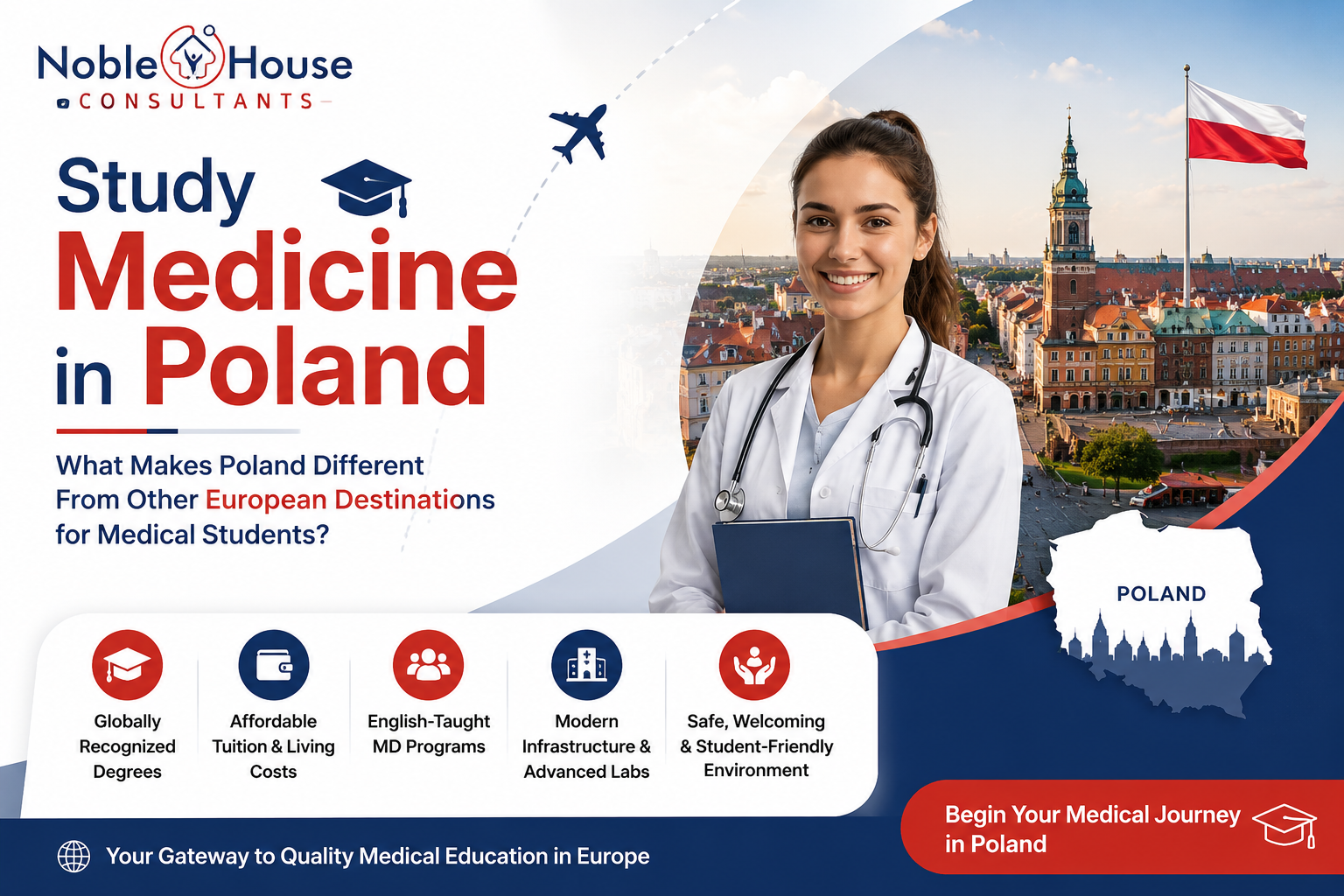
Study Medicine in Poland: What Makes Poland Different From Other European Destinations for Medical Students?
Choosing a country for medical education is a major decision, particularly for international students who want quality education, manageable expenses, international exposure, and a degree that can support future career opportunities. Among the growing number of European destinations, study medicine in Poland has become an increasingly considered option because of its combination of English-taught medical programs, established academic standards, comparatively affordable costs, and access to clinical education. However, Poland’s appeal is not based on one factor alone. Its overall academic environment and student experience make it distinct from several other European destinations.
English-Medium Medical Education
One of the most important advantages for international students is the availability of medical programs taught in English. Students from countries where English is commonly used in education can pursue their medical studies without having to learn an entirely new academic language from the beginning.
English-taught programs can cover lectures, examinations, laboratory work, and significant portions of clinical education. This creates a more accessible learning environment for international students and allows them to concentrate on medical subjects rather than facing an additional language barrier during their academic preparation.
However, students should understand an important distinction. Although the academic program may be delivered in English, learning some Polish can become valuable during clinical training because communication with local patients and healthcare staff may involve the local language.
A European Medical Education With International Orientation
Another factor that makes study medicine in Poland attractive is its position within the European higher-education environment. Poland is an EU member state, and its medical education operates within European academic and regulatory frameworks.
For international students, this European setting can provide exposure to healthcare practices, academic standards, and professional environments that extend beyond their home countries. A medical qualification can potentially support further education or professional pathways in different countries, but students must always check the licensing and registration requirements of the country where they eventually intend to practise.
This point is particularly important for students from countries such as India, the United States, Canada, or the Gulf region. Recognition of a degree does not automatically mean permission to practise medicine. Graduates generally need to satisfy the relevant authority’s examination, internship, registration, or licensing requirements.
A Six-Year Medical Education With Clinical Exposure
Medical education in Poland generally follows a six-year structure leading to a Doctor of Medicine qualification. The program combines foundational sciences with progressively more clinically focused subjects.
A significant distinction is the emphasis placed on practical and hospital-based learning. Students can encounter clinical subjects and patient-oriented training as they progress through their education rather than treating practical experience as something relevant only at the very end of the degree.
This can help students understand how theoretical knowledge translates into actual medical decision-making. Hospital exposure also allows them to become familiar with clinical environments, healthcare teams, patient interaction, and professional responsibilities.
For anyone planning to study medicine in Poland, it is therefore important to examine not only the curriculum but also the clinical training structure, affiliated hospitals, patient exposure, teaching facilities, and opportunities for practical learning.
More Manageable Costs Than Several Western European Options
Cost is another reason Poland attracts international medical aspirants. Medical education can be expensive across Europe, particularly in some Western European destinations. Poland can offer comparatively moderate tuition fees, with many English-taught medical programs falling broadly within the €10,000–€16,000 annual range, although the actual figure varies by institution and program.
The financial advantage does not end with tuition. Living expenses can also be relatively manageable compared with major Western European student destinations. Depending on the city and lifestyle, students may need approximately €500–€800 per month for accommodation, food, transportation, and everyday expenses.
This makes study medicine in Poland worth considering for students who are looking for a European medical education while keeping the overall cost of studying abroad under closer control.
Nevertheless, students should calculate the complete cost rather than looking only at advertised tuition. Accommodation, health insurance, residence-related expenses, books, travel, food, examination charges, and personal spending should all be included in the financial plan.
Admission Can Be More Academically Focused
Admission requirements are another area where Poland can differ from some destinations. Medical admissions commonly place substantial emphasis on secondary-school performance, particularly in relevant science subjects such as biology, chemistry, physics, or mathematics.
Depending on the institution, applicants may also face interviews, entrance assessments, or other selection procedures. Requirements can vary considerably, so students should never assume that one admission model applies to every medical program.
The emphasis on academic preparation can be particularly useful for students who have a strong science background but may not have extensive experience with standardized medical admission tests used in certain other countries.
Students considering study medicine in Poland should therefore prepare their academic documents carefully and verify the exact eligibility criteria, subject requirements, language requirements, application deadlines, and selection process for each program they are considering.
A Multicultural Environment
Poland has also become increasingly international as a higher-education destination. Medical classrooms can include students from Asia, North America, Scandinavia, the Middle East, and other parts of Europe.
This multicultural environment can be valuable beyond social interaction. Medicine is an increasingly international profession, and studying alongside people from different cultural and educational backgrounds can help students develop communication skills, adaptability, and broader perspectives on healthcare.
For international students, this can also make the transition to studying abroad less isolating. Living and studying with peers from different countries can create a diverse support network while exposing students to different healthcare systems and professional ambitions.
What About Students Planning to Study MBBS in Poland?
Students searching for opportunities to study MBBS in Poland should first understand that terminology can differ between countries. Polish medical programs commonly use the Doctor of Medicine or MD designation rather than the MBBS title used in several other education systems.
The more important issue is not the title alone but whether the program meets the academic and regulatory requirements relevant to the student’s intended career destination. Before applying, students should verify the institution’s current accreditation status, degree structure, clinical training, eligibility for registration, and the requirements imposed by the medical regulator in their home or intended country of practice.
This research can prevent an expensive mistake later in the career journey.
Poland vs Other European Destinations: Look Beyond the Headline
Poland should not be selected simply because it appears cheaper or because a program is taught in English. Every European medical destination has its own strengths and limitations.
The real difference lies in the combination of factors: relatively accessible tuition, moderate living expenses, English-medium education, European academic exposure, structured clinical training, and an increasingly international student population.
Students should compare countries using a broader checklist. Consider the total six-year cost, curriculum, teaching methods, hospital exposure, language requirements, accommodation, student support, admission conditions, and—most importantly—the licensing pathway after graduation.
A country that appears affordable at the admission stage may not necessarily be the most suitable choice if its post-graduation pathway does not align with a student’s career plans.
Things Students Should Check Before Applying
Before making a final decision, prospective medical students should investigate:
- The university’s current accreditation and regulatory status.
- Whether the entire academic program is available in English.
- The structure and duration of clinical training.
- The hospitals and healthcare facilities used for practical education.
- Tuition fees for every year rather than only the first year.
- Expected accommodation and living expenses.
- Admission and entrance requirements.
- Visa and residence requirements.
- The possibility and requirements for practising medicine in the student’s intended country.
- Language expectations during patient-facing clinical training.
These checks can provide a much clearer picture of what studying medicine abroad will actually involve.
Your Medical Career in Poland Starts With the Right Guidance
Planning to pursue medical education in Poland becomes easier with the right guidance at every stage. Noble House Consultants supports aspiring medical students throughout their journey—from understanding eligibility and selecting suitable programs to preparing documents, completing admissions, arranging visa assistance, and planning travel. With personalized counselling and step-by-step support, students can navigate the process with greater confidence and clarity. From the first consultation to reaching Poland, Noble House Consultants helps make the journey smoother, more organized, and stress-free.
Conclusion
Poland’s appeal as a medical education destination comes from the balance it offers rather than from a single advantage. English-taught programs, European academic exposure, practical clinical education, comparatively manageable tuition and living expenses, and a multicultural student environment can make it an interesting option for international aspirants. For students who want to study medicine in Poland, the best approach is to look beyond promotional claims and evaluate the complete academic and professional pathway. Careful comparison of costs, curriculum, clinical exposure, accreditation, admission requirements, and future licensing opportunities can help students determine whether Poland is the right destination for their medical ambitions.
Frequently Asked Questions
1. Is studying medicine in Poland a good option for international students?
Yes. Poland offers English-taught medical programs, European academic exposure, clinical training, and comparatively manageable tuition and living costs.
2. How long is a medical degree in Poland?
Most medical programs follow a six-year structure leading to a Doctor of Medicine (MD) qualification.
3. Can international students study medicine in English in Poland?
Yes. Several medical programs are designed for international students and are taught primarily in English.
4. How much does it cost to study medicine in Poland?
Tuition commonly ranges from around €10,000 to €16,000 per year, while living expenses vary by city and lifestyle.
5. Do medical students in Poland receive clinical training?
Yes. Medical education includes practical and hospital-based training, allowing students to develop clinical skills alongside theoretical knowledge.
6. Is a Polish medical degree recognized internationally?
Polish medical qualifications operate within the European higher-education framework, but graduates must meet the licensing and registration requirements of the country where they intend to practise.
7. What should students check before applying to a medical program in Poland?
Students should verify accreditation, admission requirements, tuition, clinical training, language requirements, living costs, visa rules, and post-graduation licensing pathways.
About Author

Post a Comment