- M-floor, Al Makhawi Building. Umm Hurair Road, Oud Metha, Dubai – UAE
- advisor@noblehouseconsultants.com
- +971508759073 +971508758925


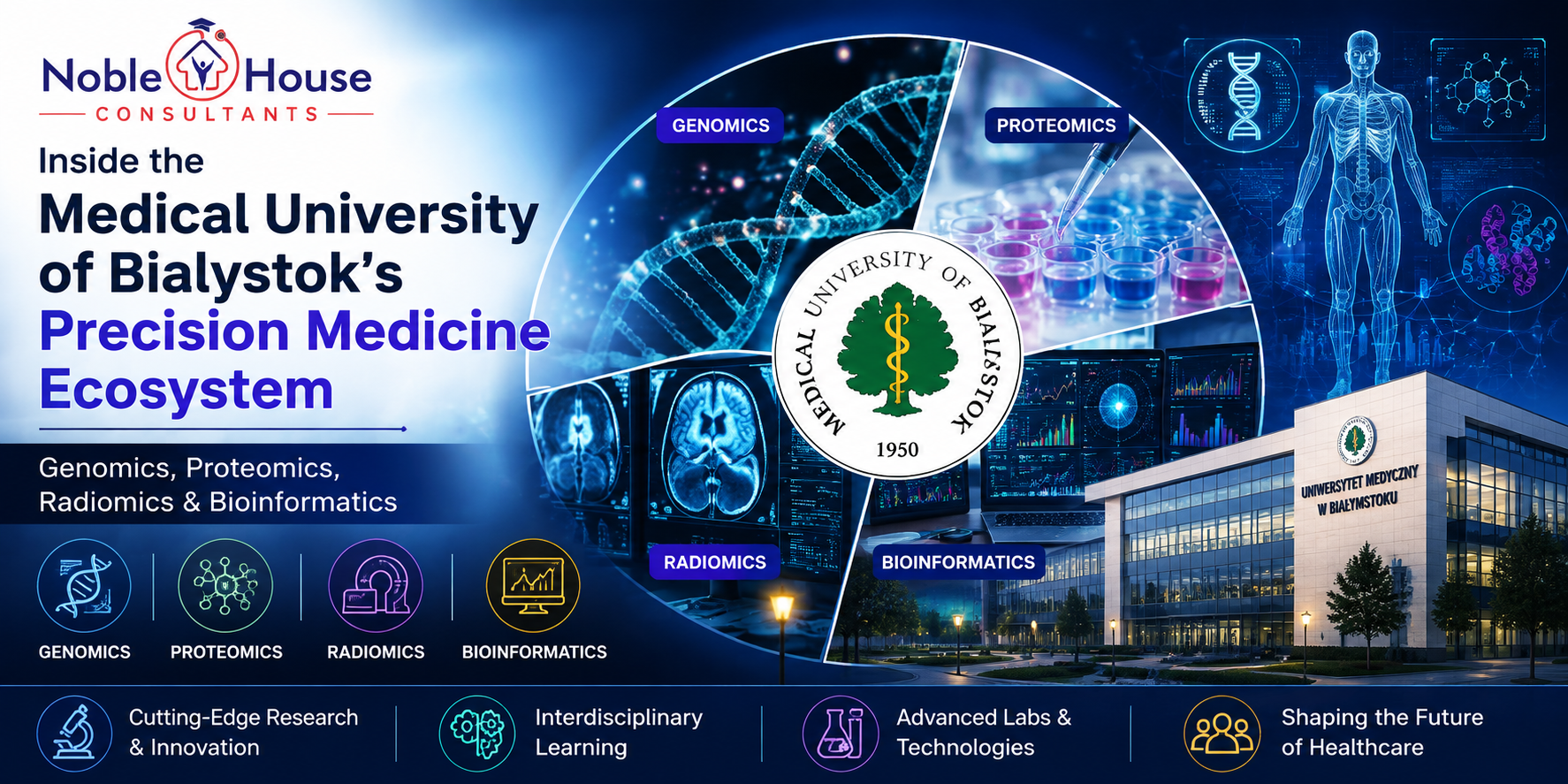
Inside the Medical University of Bialystok’s Precision Medicine Ecosystem: Genomics, Proteomics, Radiomics & Bioinformatics
Modern medicine is increasingly moving from a one-size-fits-all approach toward treatments and diagnostics tailored to individual patients. The Medical University of Bialystok (MUB) has developed a strong research environment around this transformation, combining advanced biomedical technologies, clinical research, biobanking, and international scientific collaboration. The Medical University of Bialystok precision medicine ecosystem brings together areas such as artificial intelligence, genomics, population studies, molecular research, and medical imaging to support more accurate understanding of diseases and their treatment.
A Research Environment Built Around Innovation
The Medical University of Bialystok has positioned research and innovation as important parts of its academic mission. Its scientific activities focus particularly on technologies connected with artificial intelligence in medicine, molecular research, biological data analysis, and personalised healthcare.
For students interested in modern medical science, this environment demonstrates how different disciplines can work together. Instead of studying diseases only from a clinical perspective, researchers can combine information from genetic material, biological samples, medical images, patient records, and population studies. This multidisciplinary approach is becoming increasingly important as healthcare generates larger and more complex datasets.
A notable feature of the university’s research infrastructure is its network of specialised facilities. These include the Artificial Intelligence Centre, Centre for Bioinformatics and Data, Biobank, Clinical Research Centre, Experimental Medicine Centre, Molecular Imaging and Technological Development Laboratory, and other research facilities.
Understanding the Role of Genomic Research
Genomic information can provide valuable insights into an individual’s susceptibility to particular diseases, biological characteristics, and potential responses to treatment. This makes genomic research an important component of personalised medicine.
MUB has undertaken research involving whole genome sequencing, including work connected with non-small-cell lung carcinoma. Through its research projects, the university developed a database containing whole genome sequencing results from several hundred patients affected by this form of cancer.
For students, such projects illustrate how laboratory science and clinical research can intersect. Genomic data can be analysed alongside clinical information to identify patterns that may contribute to earlier diagnosis, improved disease classification, and more personalised approaches to treatment.
Connecting Multiple Layers of Biological Information
The development of genomics proteomics radiomics bioinformatics reflects a broader change in how biomedical research is conducted. Each field provides a different perspective on human health. Genomics examines genetic information, proteomics focuses on proteins and their functions, radiomics extracts meaningful information from medical images, while bioinformatics provides computational methods for managing and interpreting complex biological datasets.
When these disciplines are considered together, researchers can obtain a more comprehensive picture of disease processes. This is particularly relevant for complex conditions where genetic, molecular, metabolic, and imaging characteristics may all influence diagnosis and treatment.
Artificial Intelligence in Medicine
Artificial intelligence is another important part of the university’s research ecosystem. MUB opened an Artificial Intelligence in Medicine Centre and has focused on developing large and comprehensive databases associated with lifestyle-related diseases.
The value of artificial intelligence in healthcare extends beyond automated diagnosis. Machine learning and data analysis can help researchers identify patterns across large datasets, support risk prediction, analyse medical images, and potentially improve clinical decision-making.
The university’s research environment also includes work on VAMP, or Voice Analysis for Medical Professionals. The project explores whether analysis of voice characteristics could contribute to computer-assisted diagnostics. Such research illustrates how everyday digital information, including speech, may potentially become an additional source of health-related data.
Biobanking and Translational Research
Biobanking provides another important foundation for personalised medicine. MUB has developed expertise in the quality biobanking of biological material obtained from patients with lifestyle-related diseases.
A well-organised biobank can support research by allowing scientists to study biological samples alongside relevant clinical information. This can help researchers investigate disease mechanisms, identify potential biomarkers, and evaluate possible therapeutic approaches.
The university has also participated in research concerning personalised medicine and civilisation diseases. One example is the MOBIT project, which focuses on developing a reference biobanking model and service for the early diagnosis and treatment of non-small-cell lung carcinoma.
This combination of biological samples, genomic information, clinical research, and computational analysis demonstrates how Medical University of Bialystok precision medicine extends beyond a single laboratory discipline. It represents an interconnected research model in which multiple forms of evidence can contribute to understanding individual health conditions.
Population Studies and Preventive Healthcare
Precision medicine does not only focus on individual genetic information. Population-level research can also help scientists understand how lifestyle, environment, genetics, and other factors influence health.
The Białystok Plus project is one example of this approach. The university has conducted population research involving approximately 10,000 inhabitants of Białystok. Such studies can generate valuable longitudinal information about health and disease patterns within a defined population.
For students, population studies offer an important lesson: personalised healthcare and public health are not separate areas. Information collected from large groups can help researchers identify risk factors and develop better strategies for prevention, screening, and early intervention.
Research Infrastructure for Students and Scientists
A strong research ecosystem depends not only on research ideas but also on access to appropriate infrastructure. MUB provides researchers with laboratories and specialised facilities supporting experimental medicine, clinical research, bioinformatics, imaging, artificial intelligence, and biobanking.
The university also highlights opportunities for academic staff to participate in study visits and training courses at leading research centres worldwide. Its international collaborations have included institutions such as Mayo Clinic, Harvard Medical School, the National Institutes of Health, and other international academic and research organisations.
This international orientation is valuable for students considering academic or research-oriented careers. Exposure to interdisciplinary and international research can help students understand how modern medical discoveries are developed through collaboration across institutions and countries.
The Broader Landscape of Precision Medicine in Poland
The development of advanced biomedical research at MUB forms part of the wider growth of precision medicine research in Poland. Polish universities and research institutions are increasingly using genomic technologies, computational biology, artificial intelligence, medical imaging, and clinical datasets to address complex health challenges.
MUB’s experience demonstrates how a medical university can integrate these technologies within a broader academic and clinical environment. Its work in cancer research, lifestyle diseases, population studies, artificial intelligence, and molecular investigation shows the potential of multidisciplinary research to address both common and complex medical problems.
From Research Discoveries to Real-World Applications
An important characteristic of MUB’s research activities is the emphasis on translating scientific discoveries into practical applications. Researchers at the university have obtained patents and worked on commercialisation of inventions emerging from their scientific activities.
Examples mentioned by the university include research involving medical honey based on propolis extract, synthetic saliva, and investigations into a fungus from the Białowieża Forest with potential relevance to colon cancer treatment.
Such examples demonstrate the pathway from laboratory research to potential healthcare applications. For students, this can provide insight into how scientific knowledge may eventually contribute to new diagnostic methods, therapeutic products, or healthcare technologies.
What Students Can Learn from This Ecosystem
The Medical University of Bialystok precision medicine model offers students a useful perspective on the future of healthcare. Modern medical professionals increasingly need to understand how clinical knowledge interacts with molecular biology, data science, artificial intelligence, imaging, and population research.
Students interested in medicine and biomedical science can therefore benefit from developing interdisciplinary knowledge. Understanding how data is generated, analysed, interpreted, and translated into clinical decisions is likely to become increasingly important across many healthcare professions.
The university’s research profile also highlights the importance of collaboration. Complex medical problems rarely fit within the boundaries of a single discipline, making teamwork among clinicians, laboratory scientists, statisticians, data specialists, and technology researchers increasingly valuable.
Your Journey to Medical Education Starts Here
Noble House Consultants helps students navigate their international education journey with personalised guidance. We support you with university selection, admission assistance, documentation, visa guidance, and travel support. Our experienced counsellors help you make informed decisions and stay prepared at every stage. With our ongoing support, your dream of studying medicine abroad can become a more organised and confident journey.
Conclusion
The Medical University of Bialystok precision medicine ecosystem illustrates how modern medical research can connect genomics, molecular science, medical imaging, artificial intelligence, biobanking, and clinical research. From whole genome sequencing and population studies to artificial intelligence and innovative diagnostic projects, the university has created a multidisciplinary environment focused on understanding disease more precisely.
For students, this ecosystem provides a valuable example of where healthcare is heading: toward data-driven, personalised, collaborative, and technology-supported medicine. As research continues to connect biological information with advanced computational and clinical methods, institutions such as MUB demonstrate how medical education and scientific discovery can contribute to the next generation of healthcare.
Frequently Asked Questions
1. What is the Medical University of Bialystok’s precision medicine ecosystem?
It is a multidisciplinary research environment combining genomics, proteomics, radiomics, bioinformatics, artificial intelligence, biobanking, and clinical research to support personalised healthcare.
2. What role does genomic research play at MUB?
Genomic research helps researchers understand disease susceptibility, biological characteristics, and potential treatment responses. MUB has conducted whole genome sequencing research, including studies of non-small-cell lung carcinoma.
3. How do genomics, proteomics, radiomics, and bioinformatics work together?
Genomics studies genetic information, proteomics examines proteins, radiomics analyses medical images, and bioinformatics provides computational tools to manage and interpret these datasets. Together, they provide a broader view of disease.
4. How is artificial intelligence used in medicine at MUB?
MUB’s research explores AI for analysing large healthcare datasets, risk prediction, medical imaging, and computer-assisted diagnostics, including its Voice Analysis for Medical Professionals (VAMP) project.
5. What is the role of biobanking in precision medicine?
Biobanking preserves biological samples alongside clinical information, helping researchers investigate disease mechanisms, discover biomarkers, and explore potential treatments.
6. Does MUB conduct population-level health research?
Yes. The Białystok Plus project involved approximately 10,000 inhabitants of Białystok, generating longitudinal data that can help researchers understand health risks, prevention, screening, and early intervention.
7. Why is MUB’s precision medicine ecosystem valuable for students?
It gives students insight into how modern healthcare combines clinical medicine with molecular biology, data science, AI, imaging, and population research, while providing exposure to interdisciplinary and international research.
About Author

Post a Comment