- M-floor, Al Makhawi Building. Umm Hurair Road, Oud Metha, Dubai – UAE
- advisor@noblehouseconsultants.com
- +971508759073 +971508758925


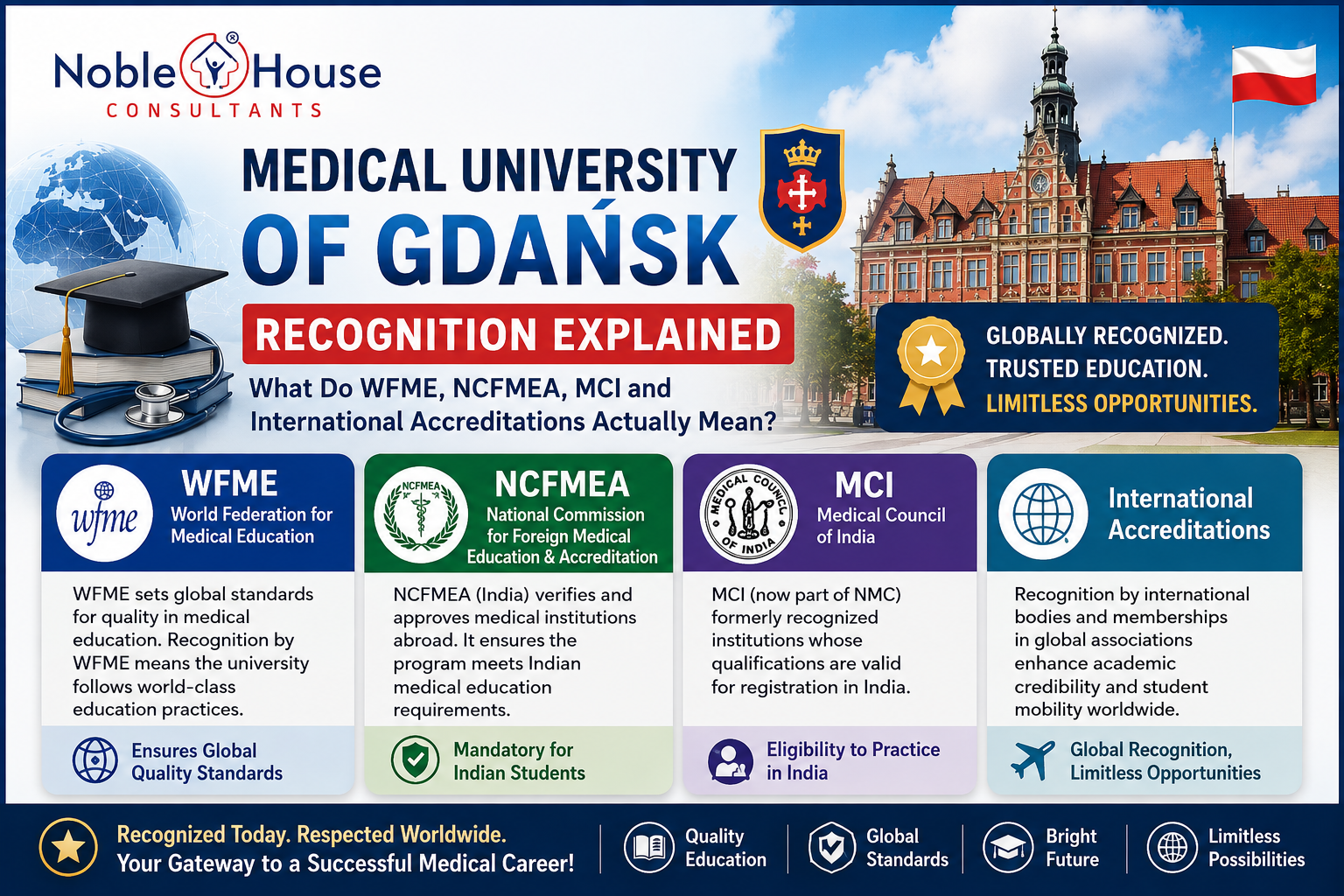
Medical University of Gdansk Recognition Explained: What Do WFME, NCFMEA, MCI and International Accreditations Actually Mean?
Choosing a medical university abroad involves much more than comparing tuition fees, course duration, or campus facilities. For students planning to study MBBS in Poland, one of the most important factors is whether the medical degree is recognised and whether the university meets international standards. The Medical University of Gdansk (MUG) has established an international profile through various accreditations, recognitions, listings, and quality assessments. However, terms such as WFME, NCFMEA, MCI, accreditation, recognition, and international ranking can be confusing. Understanding what each of these actually means can help prospective medical students make a more informed decision.
Why International Recognition Matters for Medical Students
A medical degree is a professional qualification, and its value depends not only on the education received but also on how the institution and qualification are treated by relevant authorities in different countries.
Students who intend to pursue medical careers outside Poland may eventually need to satisfy the licensing or registration requirements of the country where they want to work. These requirements can include verification of educational credentials, examinations, internship or clinical-training requirements, language requirements, and other regulatory conditions.
For this reason, students considering MUG should distinguish between university accreditation, recognition by medical-education organisations, country-specific recognition, and international rankings. These are related but they do not mean the same thing.
What Does WFME Recognition Mean?
WFME stands for the World Federation for Medical Education. It is an international organisation concerned with the quality and standards of medical education worldwide.
One important point is that WFME recognition should not automatically be interpreted as WFME directly accrediting every individual medical university. In the information provided by the Medical University of Gdansk, the Polish Accreditation Committee has obtained full recognition under the WFME recognition programme until September 30, 2035.
This is significant because WFME recognition relates to the quality-assurance system used to evaluate medical education. Medical schools accredited through a properly recognised national accreditation framework can therefore benefit from the international credibility associated with that framework.
For students who want to study MBBS in Poland, this distinction is important. WFME recognition is best understood as an indication that the relevant accreditation framework meets internationally recognised standards for evaluating medical education, rather than as a simple statement that WFME itself has individually accredited the university.
What Is NCFMEA and Why Is It Important?
NCFMEA stands for the National Committee on Foreign Medical Education and Accreditation. It operates within the United States Department of Education and deals with the comparability of accreditation standards for foreign medical education systems.
According to the information published by the Medical University of Gdansk, the accreditation system covering the Faculty of Medicine has received NCFMEA-related recognition and is valid until 2029.
This can be particularly relevant for students who are considering future medical education or professional opportunities connected with the United States. However, students should understand that NCFMEA recognition does not itself provide a medical licence in the United States.
Medical licensing is controlled by the relevant authorities and usually involves several additional requirements. Depending on the country and jurisdiction, graduates may need to complete examinations, credential verification, supervised training, language requirements, or other procedures.
Therefore, NCFMEA should be viewed as an important component of the international quality-recognition framework rather than as a guarantee of automatic professional registration.
What Does MCI Mean for Indian Students?
MCI stands for the Medical Council of India, the former national regulatory body for medical education and medical practitioners in India. It has since been replaced by the National Medical Commission (NMC).
The term MCI is still widely used by students and families when discussing the recognition of foreign medical degrees in India. This is why prospective Indian students may encounter references to MCI while researching medical education in Poland.
For students planning to study MBBS in Poland, it is essential to understand that recognition of a foreign medical qualification in India is governed by the applicable rules and regulations in force at the time of graduation and return to India.
Students should therefore check the latest requirements of the Indian medical regulator before admission and again before returning to India. Requirements can change over time and may include conditions concerning admission eligibility, duration of study, clinical training, examinations, internship, and licensing.
International accreditation is valuable, but it should not be confused with automatic eligibility to practise medicine in another country.
Accreditation and Recognition Are Not the Same Thing
The words “accredited” and “recognised” are often used interchangeably in everyday discussions, but they have different meanings.
Accreditation generally means that an authorised organisation has evaluated an institution, programme, or quality-assurance system against defined standards and has determined that the required criteria have been met.
Recognition, on the other hand, may mean that another organisation, regulator, ranking body, professional authority, or international institution acknowledges the institution, its accreditation framework, or its educational standing.
This distinction becomes especially important when researching medical degrees internationally. A university can have several different forms of recognition, each serving a different purpose.
Students should therefore ask a more precise question than simply, “Is the university recognised?” They should ask: Recognised by whom, for what purpose, under which standards, and for which country?
Medical University of Gdansk and International Accreditation
The Medical University of Gdansk reports several forms of international accreditation and recognition.
Its Faculty of Medicine is associated with recognition from the Medical Board of California, which is relevant to the regulatory assessment of medical education for purposes connected with physician licensing in California.
The university also reports recognition or recommendation from the Ministry of Health and Medical Education of Iran and accreditation from the Ministry of Higher Education and Scientific Research of Jordan. These country-specific recognitions demonstrate that different national authorities may assess foreign medical qualifications according to their own standards.
This is an important lesson for international applicants: there is no single global licence that automatically allows a medical graduate to practise everywhere. Every country has its own regulatory framework.
What About the World Directory of Medical Schools?
The World Directory of Medical Schools is another important reference point for students researching international medical schools.
The Medical University of Gdansk is included in the World Directory of Medical Schools. Being listed in such an international directory provides an important reference point for students and graduates because medical education institutions around the world can be identified and reviewed through an internationally recognised database.
However, directory listing should again be distinguished from professional licensing. Being listed does not mean that a graduate automatically receives permission to practise medicine in every country.
Students should always check the specific licensing requirements of their intended country of practice.
Do University Rankings Prove Recognition?
Rankings and accreditation serve different purposes.
The Medical University of Gdansk has appeared in several international ranking systems, including subject-based and global assessments. These rankings can provide information about areas such as research performance, citations, academic reputation, clinical medicine, and broader institutional performance.
However, a ranking position should not be interpreted as a professional accreditation.
For example, a university may perform strongly in research or academic indicators while a regulatory authority separately evaluates whether its medical education meets the standards required for professional recognition.
Therefore, when comparing medical schools, students should consider rankings as one source of information rather than treating them as proof of licensing eligibility.
How Should Students Evaluate Recognition Before Applying?
Students planning to study MBBS in Poland should create a checklist rather than relying on a single accreditation logo or statement.
First, verify whether the medical programme is officially recognised in Poland. Second, check the institution’s current accreditation status and the organisations responsible for quality assurance. Third, review the recognition requirements of the country where you ultimately intend to practise.
It is also useful to check whether the university is listed in relevant international medical-school directories and whether its accreditation status is current. Students should pay attention to validity dates because accreditation and recognition can be renewed, modified, or updated.
Most importantly, applicants should distinguish between eligibility to study medicine and eligibility to practise medicine after graduation. Admission to a recognised medical programme is only one part of a future medical career.
Why the Accreditation Framework Matters
A strong accreditation framework provides reassurance that medical education is being evaluated against established academic and professional standards.
For an international student who wants to study medicine in Poland, this can be particularly important because the student may eventually seek professional opportunities in another country. International recognition can make it easier to understand the quality-assurance environment surrounding the medical programme.
Nevertheless, recognition should always be evaluated in context. WFME recognition, NCFMEA recognition, national regulatory recognition, World Directory listing, and international rankings each answer different questions.
A sensible approach is therefore to consider them collectively rather than relying on any single term.
Noble House Consultants: Here to Support You at Every Step
Noble House Consultants supports aspiring medical students throughout their admission journey, from choosing the right programme to completing applications and preparing for enrolment. We help students understand important aspects such as university recognition, accreditation, eligibility requirements, documentation, and admission procedures. Our team assists you at every stage, helping simplify the process and reduce confusion. With our guidance, you can make informed decisions and confidently take the next step toward building your medical education journey in Poland with clarity and proper preparation.
Final Thoughts
The Medical University of Gdansk has a broad international recognition profile that includes accreditation, recognition, directory listing, and participation in international academic rankings. WFME recognition relates primarily to the international recognition of the relevant accreditation framework, while NCFMEA concerns the comparability of foreign medical-education accreditation systems. MCI is a historical term still commonly used by Indian students, although India’s medical regulatory framework is now administered by the National Medical Commission.
For students planning to study MBBS in Poland, these distinctions are extremely important. International accreditation can demonstrate that appropriate quality-assurance standards are being applied, but it does not automatically grant a graduate the right to practise medicine in every country.
Ultimately, students should examine the current accreditation status of the Medical University of Gdansk, understand what each recognition actually covers, and separately verify the medical licensing requirements of the country in which they plan to build their professional career. This approach provides a much clearer and more realistic understanding of what international recognition actually means.
Frequently Asked Questions
1. Is the Medical University of Gdansk internationally recognised?
Yes. It has various international accreditations, recognitions, and listings relevant to medical education.
2. What does WFME recognition mean for students?
WFME recognition relates to the international recognition of the medical education accreditation framework and its quality standards.
3. What is NCFMEA recognition?
NCFMEA evaluates the comparability of accreditation standards for foreign medical education systems in the United States.
4. Is MCI recognition still relevant for Indian students?
MCI was replaced by the National Medical Commission (NMC). Indian students should follow the current NMC rules for foreign medical graduates.
5. Does international accreditation guarantee a medical licence?
No. Graduates must meet the licensing and registration requirements of the country where they intend to practise.
6. Is the Medical University of Gdansk listed internationally?
Yes. The university is included in the World Directory of Medical Schools and has appeared in international academic rankings.
7. Why should students check accreditation before admission?
Checking accreditation helps students understand the university’s quality-assurance framework and assess whether it aligns with their future career plans.
About Author

Post a Comment