- M-floor, Al Makhawi Building. Umm Hurair Road, Oud Metha, Dubai – UAE
- advisor@noblehouseconsultants.com
- +971508759073 +971508758925


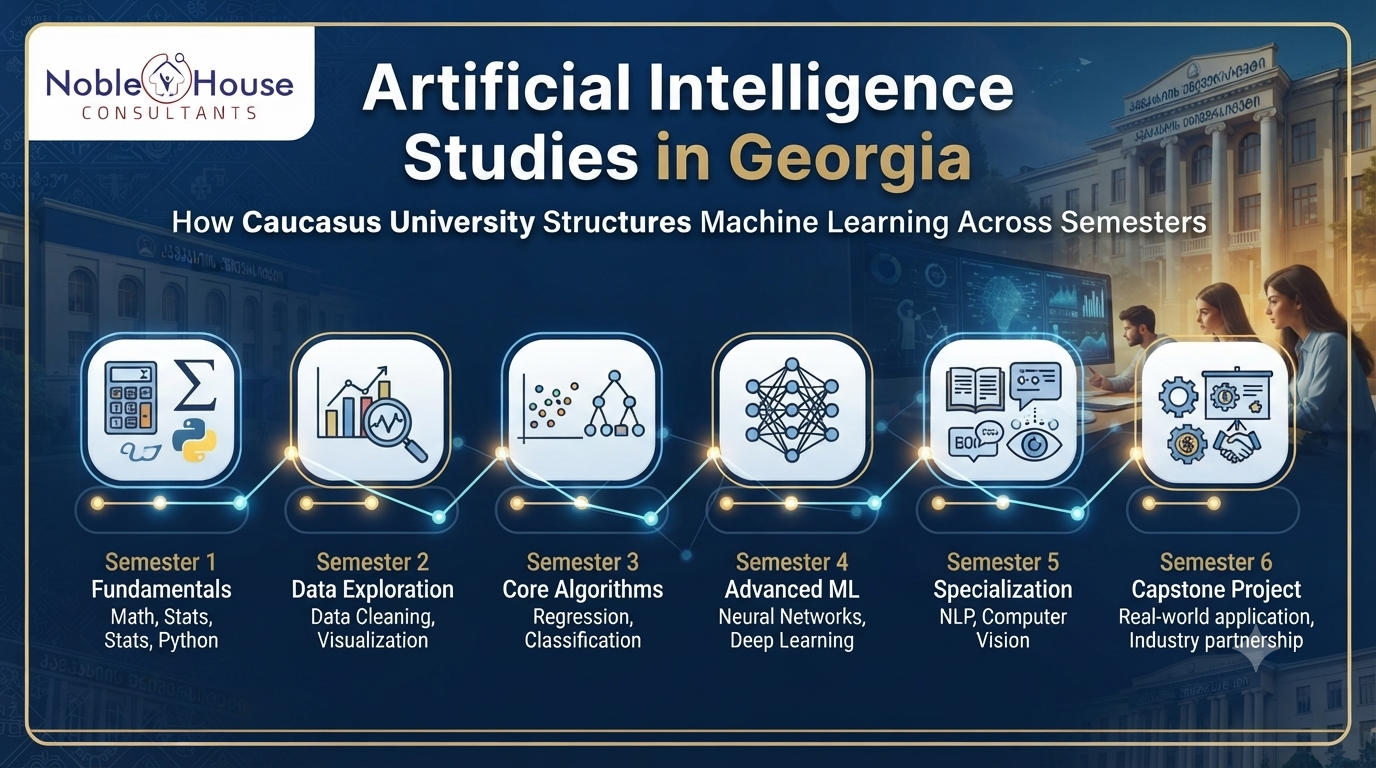
Artificial Intelligence Studies in Georgia: How Caucasus University Structures Machine Learning Learning Across Semesters
Artificial intelligence has become one of the most influential technologies of the modern era, transforming industries ranging from healthcare and finance to transportation and education. As demand for AI professionals continues to grow worldwide, students are increasingly looking for academic programs that provide both strong theoretical foundations and practical technical skills. For those exploring Artificial Intelligence Studies in Georgia, understanding how a university structures its curriculum is essential in evaluating the quality and depth of education offered.
Caucasus University has developed its Computer Science and Artificial Intelligence bachelor’s program to guide students through a carefully designed academic journey. Rather than introducing complex machine learning models immediately, the curriculum follows a progressive structure that builds knowledge step by step.
This systematic approach helps learners gain a deep understanding of how intelligent systems work while preparing them to solve real-world challenges through technology.
Building the Foundation: The First Year
A successful career in artificial intelligence begins with a strong foundation in mathematics and programming. During the first two semesters, students focus on acquiring the fundamental knowledge required for advanced computing studies.
Core subjects typically include:
- Calculus
- Linear Algebra
- Probability and Statistics
- Programming Fundamentals
- Problem-Solving Techniques
- Introduction to Computer Science
Many students are eager to start working with machine learning algorithms immediately. However, understanding concepts such as vectors, matrices, optimization, probability distributions, and mathematical modeling is essential before studying advanced AI systems.
Programming skills are equally important. Students learn how to write efficient code, analyze computational problems, and develop logical thinking abilities. These early courses establish the technical confidence needed for future AI-related coursework.
By the end of the first year, students possess the mathematical reasoning and coding capabilities necessary to explore more sophisticated computer science topics.
Transitioning into Core Computer Science
The second stage of the curriculum focuses on strengthening students’ understanding of computing systems and algorithmic thinking.
During semesters three and four, learners are introduced to:
- Algorithms and Data Structures
- Discrete Mathematics
- Database Systems
- Software Development Principles
- Computational Problem Solving
- Introduction to Artificial Intelligence
This phase is particularly important because it bridges foundational knowledge and specialized AI studies.
Students learn how data is organized, stored, processed, and retrieved. They also study algorithm efficiency and computational complexity, which are critical concepts when building machine learning systems that must process large volumes of information.
The introduction to artificial intelligence at this stage provides students with an overview of intelligent systems, search methods, reasoning techniques, and decision-making processes. Instead of focusing solely on tools, the curriculum emphasizes understanding the principles that make AI systems effective.
For students interested in long-term careers in data science, machine learning engineering, or AI research, this stage establishes the conceptual framework necessary for future specialization.
Machine Learning Takes Center Stage
The most exciting stage for many students begins during semesters five and six. This is where machine learning becomes a major focus of academic study.
As part of Artificial Intelligence Studies in Georgia, students are introduced to modern machine learning methodologies and practical applications that are widely used across industries.
Key learning areas include:
- Supervised Learning
- Unsupervised Learning
- Predictive Analytics
- Model Evaluation Techniques
- Data Preprocessing
- Feature Engineering
- Neural Networks
- Deep Learning Fundamentals
Students learn how machines identify patterns in data and use those patterns to make predictions or decisions. They explore classification models, regression techniques, clustering algorithms, and various optimization methods.
Neural networks represent another important area of study. These systems form the basis of many modern AI applications, including image recognition, recommendation engines, and speech processing technologies.
The curriculum ensures that students not only understand the theory behind machine learning models but also gain practical experience working with datasets and implementing solutions.
This balance between theory and application helps learners develop industry-relevant skills while maintaining a strong academic foundation.
The Role of Data Science and Big Data
Artificial intelligence cannot function effectively without quality data. Recognizing this reality, the program integrates data science and big data concepts into the learning pathway.
Students study:
- Data Collection Methods
- Data Cleaning and Preparation
- Statistical Analysis
- Data Visualization
- Big Data Processing
- Information Management Techniques
The inclusion of these subjects reflects the growing importance of data-driven decision-making in modern organizations.
Within the broader landscape of Artificial Intelligence Studies in Georgia, exposure to data science allows students to understand how raw information is transformed into actionable insights. This knowledge is particularly valuable because many AI professionals spend a significant portion of their work preparing and managing data before model development begins.
Students also gain experience handling larger datasets, preparing them for professional environments where scalability and efficiency are critical considerations.
Advanced AI Applications and Specialized Learning
The final year of study brings together everything students have learned throughout the program.
Semesters seven and eight focus on advanced applications of artificial intelligence and specialized computing disciplines.
Key areas include:
- Natural Language Processing (NLP)
- Big Data Analytics
- Software Engineering
- IT Project Management
- Advanced Computing Topics
- Emerging AI Technologies
Natural Language Processing is especially relevant in today’s technology landscape. It powers virtual assistants, language translation systems, chatbots, sentiment analysis tools, and many other intelligent applications.
Students also examine how AI solutions are designed, managed, and deployed within professional environments. Project management and software engineering courses help bridge the gap between technical development and organizational implementation.
This advanced stage enables learners to move beyond theoretical understanding and begin thinking like technology professionals responsible for creating practical solutions.
Learning Through Research and the Bachelor’s Thesis
One of the most valuable components of the program is the bachelor’s thesis.
The thesis serves as a capstone project where students apply accumulated knowledge to design, develop, and present a substantial software or artificial intelligence solution.
As part of Artificial Intelligence Studies in Georgia, this research-oriented experience allows students to:
- Investigate real-world challenges
- Develop independent research skills
- Apply machine learning concepts
- Create innovative software systems
- Present technical findings professionally
The thesis demonstrates a student’s ability to combine theoretical knowledge, technical skills, and analytical thinking into a meaningful project.
For many graduates, this experience becomes an important portfolio piece when pursuing employment opportunities or advanced academic studies.
Beyond Technical Skills: Professional and Ethical Development
Modern AI professionals require more than programming expertise.
The Computer Science and Artificial Intelligence program emphasizes several transferable skills that are increasingly valued by employers worldwide.
These include:
- Critical Thinking
- Team Collaboration
- Communication Skills
- Problem Solving
- Adaptability
- Ethical Decision-Making
Students are encouraged to consider the societal impact of technology and the ethical responsibilities associated with artificial intelligence development.
Topics such as fairness, accountability, transparency, and responsible innovation help prepare graduates to make informed decisions when creating technology that affects people and communities.
These competencies complement technical knowledge and contribute to long-term professional success.
Why the Curriculum Structure Matters
One of the strengths of the curriculum is its progressive design. Each academic stage builds upon previous learning outcomes, reducing knowledge gaps and helping students develop confidence as they advance.
This structure reflects the educational philosophy behind many successful Caucasus university programs, where foundational knowledge is viewed as the basis for future specialization.
Instead of rushing students into advanced AI topics, the program ensures they first understand the mathematics, programming principles, algorithms, and data management techniques that support modern machine learning systems.
As a result, graduates are better prepared to adapt to evolving technologies and industry requirements.
The program also creates opportunities for Caucasus University International students who seek a comprehensive education that combines theoretical depth with practical application in one of the world’s fastest-growing technological fields.
Noble House Consultants: Your Trusted Partner for a Successful Study Abroad Journey
Noble House Consultants supports students throughout their entire admission journey, from selecting the right course and university to application guidance, documentation, visa assistance, and ongoing support. With years of experience helping aspiring students pursue international education, we focus on making the process simple, transparent, and stress-free. Our dedicated team provides personalized guidance, cost-effective solutions, and reliable assistance at every stage, ensuring that your path to studying abroad is smooth, confident, and successful.
Conclusion
Artificial intelligence education requires more than simply learning how to use algorithms. It demands a structured progression through mathematics, computer science, data analysis, machine learning, and advanced AI applications. Caucasus University follows this educational philosophy by guiding students through each stage of development in a logical and comprehensive manner.
From foundational mathematical concepts and programming skills to machine learning, neural networks, data science, natural language processing, and research-based projects, the curriculum provides a complete pathway for aspiring AI professionals. For students evaluating opportunities in Artificial Intelligence Studies in Georgia, understanding this structured learning journey can help them appreciate how a carefully designed curriculum prepares graduates for both academic advancement and successful careers in the global technology sector.
Frequently Asked Questions
1: What does the Computer Science and Artificial Intelligence program at Caucasus University focus on?
The program combines core computer science concepts with specialized artificial intelligence studies, helping students develop skills in programming, machine learning, data science, and intelligent systems.
2: When do students start learning machine learning in the program?
Students typically begin focused machine learning studies during semesters five and six after building strong foundations in mathematics, programming, algorithms, and data structures.
3: What mathematical subjects are important for studying artificial intelligence?
Key mathematical subjects include Calculus, Linear Algebra, Probability, and Statistics, as these form the foundation for understanding machine learning models and AI algorithms.
4: Does the program include practical experience in artificial intelligence?
Yes. Students gain hands-on experience through projects, data analysis exercises, machine learning applications, software development, and a final bachelor’s thesis.
5: What advanced AI topics are covered in the final years?
Advanced topics include Natural Language Processing (NLP), Big Data Analytics, Neural Networks, Deep Learning concepts, Software Engineering, and emerging AI technologies.
6: What career opportunities can graduates pursue after completing the program?
Graduates may pursue careers in artificial intelligence, machine learning, data science, software engineering, business analytics, research, or continue with postgraduate studies.
About Author

Post a Comment