- M-floor, Al Makhawi Building. Umm Hurair Road, Oud Metha, Dubai – UAE
- advisor@noblehouseconsultants.com
- +971508759073 +971508758925


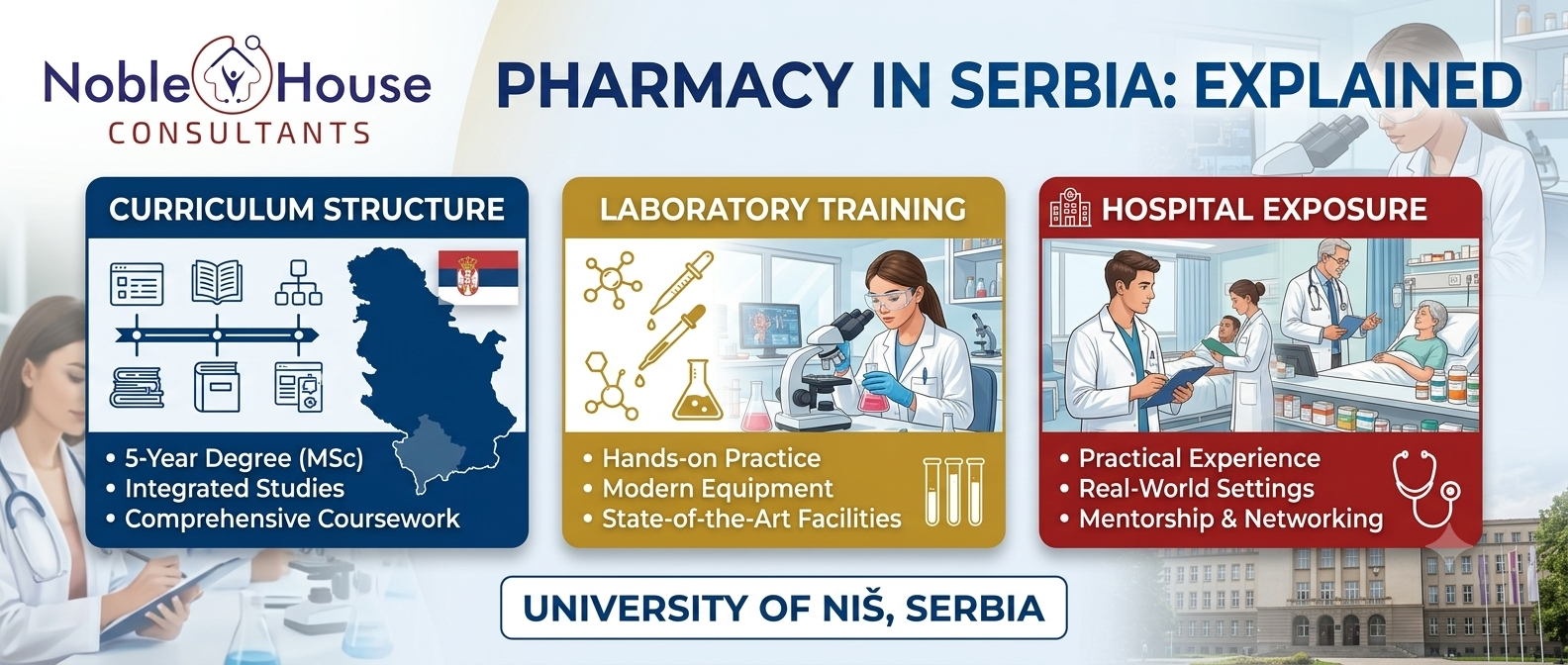
Pharmacy in Serbia Explained: Curriculum Structure, Laboratory Training & Hospital Exposure at University of Niš
Pharmacy education in Serbia is designed as a structured, research-oriented, and practice-driven academic pathway that prepares students for both clinical and industrial roles in healthcare. Among the various institutions offering this program, the University of Niš stands out for its integrated approach that aligns closely with European educational standards. For students aiming to study Pharmacy in Serbia, the program offers a balanced combination of theoretical knowledge, laboratory skills, and real-world healthcare exposure, making it a comprehensive route into the pharmaceutical profession.
Overview of Pharmacy Education in Serbia
Pharmacy in Serbia is structured as a five-year integrated academic program equivalent to 300 ECTS credits. This program leads to a Master of Pharmacy degree and follows the Bologna process, ensuring compatibility with other European higher education systems. The structure is designed to progressively develop students’ knowledge from fundamental sciences to advanced pharmaceutical applications.
Students who choose to study Pharmacy in Serbia benefit from a curriculum that emphasizes scientific depth, clinical relevance, and hands-on training. The program is carefully organized to ensure that graduates are equipped with both academic expertise and professional competence needed in modern healthcare environments.
Curriculum Structure of Pharmacy Program
The curriculum is divided into two major phases: pre-clinical education and clinical/professional education. Over the course of 10 semesters, students complete more than 4,300 hours of active instruction, which includes lectures, seminars, laboratory work, and practical training.
Pre-Clinical Years (1st to 3rd Year)
The initial phase of the program focuses on building a strong foundation in basic sciences. Students are introduced to subjects such as biology, general chemistry, organic chemistry, analytical chemistry, mathematics, and human anatomy. These subjects form the backbone of pharmaceutical understanding and prepare students for more advanced studies in later years.
At this stage, students who study Pharmacy in Serbia begin to develop analytical thinking skills and scientific reasoning abilities that are essential for future clinical and industrial work. The emphasis is placed on understanding how biological systems interact with chemical compounds and how these interactions form the basis of pharmacological action.
Clinical and Professional Years (4th to 5th Year)
The final years of the program focus on specialized pharmaceutical sciences and clinical applications. Key subjects include pharmacology, pharmacotherapy, pharmaceutical technology, and pharmaceutical legislation. These subjects help students understand drug mechanisms, therapeutic uses, formulation design, and regulatory frameworks governing medicines.
During this phase, students who study Pharmacy in Serbia are trained to apply theoretical knowledge in practical healthcare scenarios, ensuring they are prepared for professional responsibilities upon graduation.
Elective Modules and Academic Flexibility
The program also offers elective modules that allow students to tailor their education according to their interests. These modules cover specialized topics within pharmaceutical sciences and provide opportunities for deeper academic exploration.
Students are also required to complete a final diploma paper, which involves independent research under academic supervision. This research component strengthens critical thinking, scientific writing, and problem-solving skills.
The flexibility of the curriculum ensures that learners gain both breadth and depth in pharmaceutical education while preparing for diverse career paths in healthcare and industry.
Laboratory Training and Practical Learning
A defining feature of pharmaceutical education at the University of Niš is its strong emphasis on laboratory training. Practical sessions form a significant part of the academic structure and are essential for developing technical competence.
Core Laboratory Disciplines
Students undergo extensive training in pharmaceutical chemistry, pharmacognosy, and biochemistry. These disciplines help them understand drug composition, natural medicinal sources, and biological processes at a molecular level.
In pharmacognosy, for example, students study medicines derived from plants and natural sources, learning how bioactive compounds are extracted and utilized in drug development.
Pharmaceutical Technology Labs
Laboratory training in pharmaceutical technology focuses on the formulation and manufacturing of medicinal products. Students learn how to prepare dosage forms such as tablets, syrups, creams, and capsules. This practical knowledge is essential for careers in pharmaceutical production and quality assurance.
Students who study Pharmacy in Serbia also gain experience in quality control processes, including qualitative and quantitative analysis, instrumental testing methods, and stability evaluation of pharmaceutical products.
Skill Development Through Labs
The laboratory environment helps students build critical technical skills such as precision, analytical thinking, and problem-solving. These skills are crucial for ensuring the safety, effectiveness, and quality of pharmaceutical products.
Hospital Exposure and Professional Practice
Clinical exposure is an essential component of the pharmacy curriculum in Serbia. In the later stages of the program, students are introduced to real-world healthcare environments through hospital and community pharmacy training.
Hospital Pharmacy Training
Students participate in rotations at hospital pharmacies where they learn about drug dispensing, procurement systems, unit-dose drug distribution, and preparation of specialized nutritional solutions such as total parenteral nutrition (TPN). This exposure helps students understand how pharmaceutical care is integrated into hospital settings.
Community and Professional Practice
In addition to hospital training, students are required to complete structured internships in community pharmacies. These internships provide direct interaction with patients and help students develop communication skills, ethical awareness, and professional responsibility.
Students who study Pharmacy in Serbia gain valuable insight into how pharmacists contribute to patient care, medication safety, and public health systems.
Academic Environment and Institutional Framework
The University of Niš offers a structured academic environment that supports both theoretical learning and practical application. The program is aligned with European higher education standards, ensuring that graduates can pursue opportunities across various countries and healthcare systems.
Those who are exploring study Pharmacy in Serbia often consider institutions like the Nis medical university Serbia, which is known for its integrated curriculum and strong emphasis on clinical and laboratory training.
Understanding financial planning is also important for international students. Information regarding Serbia medical university fees is often considered during the decision-making process, as it helps students evaluate the affordability of pursuing medical and pharmaceutical education in the country.
Career Opportunities After Graduation
Graduates of pharmacy programs in Serbia are well-prepared for a wide range of career paths. The comprehensive training enables them to work in community pharmacies, hospitals, pharmaceutical industries, research institutions, and regulatory agencies.
The strong foundation in both science and clinical practice ensures that graduates are capable of contributing effectively to healthcare systems. Whether involved in patient care or drug development, they play a critical role in improving public health outcomes.
Students who study Pharmacy in Serbia often find that the combination of theoretical knowledge and practical exposure gives them a competitive advantage in the global job market.
Noble House Consultants: Your Trusted Partner for a Seamless Study Abroad Journey
At Noble House Consultants, we are dedicated to guiding students through every step of their journey to pursue international education with confidence and clarity. We understand how important it is to choose the right path when you decide to study abroad, and we are here to make the entire process smooth, structured, and stress-free. From helping us understand your academic goals to assisting in university selection, application processing, documentation, and pre-departure support, our team works closely with you at every stage. We believe in building a strong foundation for your future, ensuring that our students are well-prepared not just for admission but for success in their academic and professional journey ahead.
Conclusion
Pharmacy education in Serbia, particularly at the University of Niš, offers a well-structured and internationally aligned academic pathway that combines scientific learning, laboratory training, and clinical exposure. The program is designed to produce highly skilled pharmacists who are capable of working in diverse healthcare and pharmaceutical environments.
For students aiming to build a strong foundation in pharmaceutical sciences, choosing to study Pharmacy in Serbia provides an excellent opportunity to gain both academic knowledge and practical experience. The integrated curriculum, hands-on laboratory work, and hospital exposure collectively ensure that graduates are fully prepared for professional success in the pharmaceutical field.
Frequently Asked Questions
1. What is the duration of Pharmacy in Serbia?
Pharmacy in Serbia is a 5-year integrated program (300 ECTS) leading to a Master of Pharmacy degree.
2. Is the Pharmacy program in Serbia aligned with European standards?
Yes, it follows the Bologna Process and is aligned with European higher education standards.
3. What subjects are taught in the early years?
Students study biology, chemistry, anatomy, mathematics, and other basic medical sciences in the first three years.
4. What practical training is included in the program?
Students receive extensive lab training in pharmaceutical chemistry, biochemistry, and pharmaceutical technology.
5. Do students get hospital exposure during the course?
Yes, students undergo hospital pharmacy rotations and community pharmacy internships in later years.
6. What career options are available after graduation?
Graduates can work in hospitals, community pharmacies, pharmaceutical industries, research, and regulatory sectors.
7. Why do students choose to study Pharmacy in Serbia?
Students choose it for its affordable education, European-standard curriculum, and strong practical training exposure.
About Author

Post a Comment