- M-floor, Al Makhawi Building. Umm Hurair Road, Oud Metha, Dubai – UAE
- advisor@noblehouseconsultants.com
- +971508759073 +971508758925


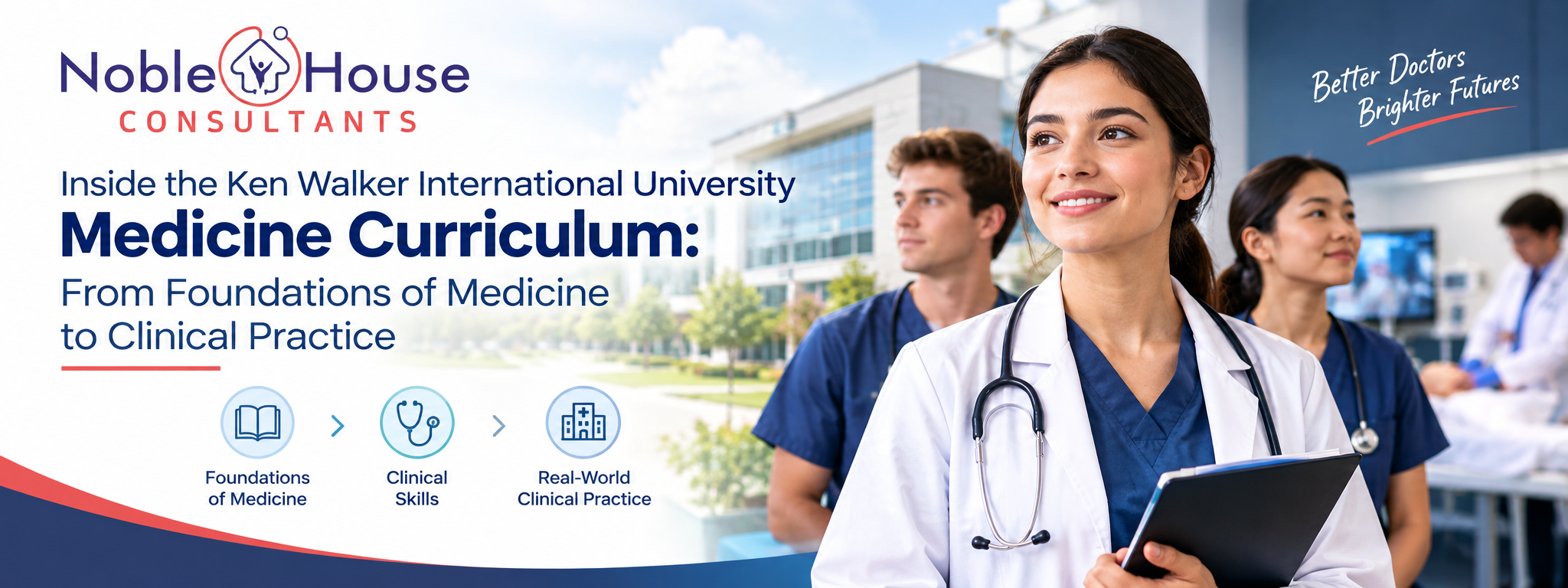
Inside the Ken Walker International University Medicine Curriculum: From Foundations of Medicine to Clinical Practice
Choosing a medical degree is a major academic and career decision, particularly for students looking beyond their home country for an English-medium education. For students considering study medicine in Georgia, understanding what a medical curriculum offers is just as important as looking at tuition fees, study duration, and language of instruction. Ken Walker International University in Georgia offers a six-year, one-step Medicine educational program designed to lead students toward the qualification of Medical Doctor. The program carries 360 ECTS credits, with each ECTS credit representing 30 hours of learning, and is delivered in English.
Understanding the Structure of the Medicine Program
The Medicine program at Ken Walker International University follows a six-year format. Its one-step structure means that students undertake medical education as a continuous academic pathway rather than completing a separate undergraduate degree before entering professional medical studies. This structure allows learners to progressively develop their knowledge, skills, and understanding of medicine throughout the program.
The curriculum can broadly be understood as a progression from foundational scientific knowledge to medical sciences and, ultimately, clinical practice. Such progression is essential because doctors need to understand not only the structure and functioning of the human body but also how diseases develop, how they can be diagnosed, and how patients can be managed appropriately.
For students interested in Study MBBS in Georgia, the English-language format is another important consideration. Studying medicine in English can make academic resources, medical terminology, lectures, and professional communication more accessible to international students while also supporting learning in an increasingly international healthcare environment.
Building the Foundations of Medical Knowledge
The early stage of a medical curriculum generally establishes the scientific foundation required for later clinical learning. Students need a strong understanding of subjects related to the human body before they can effectively interpret symptoms, diagnose diseases, or understand treatment options.
Foundational medical education commonly introduces areas such as anatomy, physiology, biochemistry, cell biology, histology, genetics, and related biomedical sciences. Anatomy helps students understand the physical organization of the body, while physiology explains how organs and systems function. Biochemistry provides insight into the chemical processes underlying normal and abnormal biological activity.
These subjects are not isolated areas of study. Instead, they provide interconnected knowledge that becomes increasingly relevant as students move into more advanced medical subjects. Understanding the cardiovascular system, for example, requires knowledge of its anatomical structure as well as the physiological mechanisms responsible for circulation.
This foundation is particularly important for students who plan to study medicine in Georgia, because a strong grasp of basic medical sciences provides the platform for understanding pathology, pharmacology, diagnostics, and patient management in later stages of medical education.
Moving From Basic Sciences to Medical Sciences
After establishing the fundamentals, medical education typically becomes increasingly focused on disease processes and the application of scientific knowledge to medicine. Students begin connecting what they have learned about normal human biology with what happens when the body is affected by disease or injury.
Subjects such as pathology, microbiology, immunology, pharmacology, and medical genetics can help students understand the causes and mechanisms of illness. Pathology focuses on changes associated with disease, while microbiology examines microorganisms that can cause infections. Pharmacology introduces students to medicines, their mechanisms of action, therapeutic uses, and potential adverse effects.
This transition is one of the most important stages in medical education. Instead of simply memorizing facts about individual organs or diseases, students gradually learn to connect clinical signs and symptoms with underlying biological processes.
The broad academic structure of a six-year Medicine program also gives learners sufficient time to revisit concepts at increasing levels of complexity. Students can move from learning what happens in the body to understanding why it happens and, eventually, how a physician should respond.
Developing Clinical Thinking
Medical education becomes increasingly practical as students progress toward clinical training. Clinical learning is where theoretical knowledge begins to take shape in the context of real patients and healthcare situations.
Students are expected to develop the ability to gather patient histories, understand presenting symptoms, perform appropriate examinations, interpret clinical information, and consider possible diagnoses. They also learn that effective medical practice involves more than identifying a disease. Doctors must consider the individual patient, available evidence, risks and benefits of treatment, and appropriate follow-up.
For students planning to study medicine in Georgia, the transition from classroom-based learning to clinical practice is an important part of evaluating a medical program. Clinical education provides opportunities to understand how medical knowledge is applied in professional healthcare settings and how different areas of medicine work together.
Exposure to Different Areas of Clinical Medicine
As students advance through medical training, clinical education generally introduces them to major medical disciplines. These may include internal medicine, surgery, pediatrics, obstetrics and gynecology, psychiatry, emergency medicine, family medicine, and other important areas of healthcare.
Each discipline provides a different perspective on patient care. Internal medicine emphasizes the diagnosis and management of diseases affecting adults, while surgery focuses on conditions that may require operative intervention. Pediatrics addresses healthcare needs during childhood, and obstetrics and gynecology focus on reproductive health and pregnancy-related care.
Clinical exposure also helps students appreciate the relationship between different specialties. A patient may present with symptoms that involve several body systems, requiring physicians to draw upon knowledge from multiple fields. This interdisciplinary approach is an important part of developing mature clinical reasoning.
From Classroom Learning to Patient-Centred Care
One of the defining transitions in medical education is the movement from studying diseases as academic subjects to understanding patients as individuals. Clinical practice requires communication, professionalism, empathy, teamwork, and ethical decision-making alongside scientific knowledge.
A competent physician needs to communicate clearly with patients and colleagues, explain medical information in an understandable manner, respect confidentiality, and make decisions responsibly. These professional competencies complement the scientific and clinical knowledge acquired throughout the program.
The six-year Medicine program at Ken Walker International University is therefore more than a sequence of theoretical subjects. The overall educational journey is intended to progressively prepare students for the responsibilities associated with the Medical Doctor qualification. The allocation of 360 ECTS credits reflects the substantial volume of learning expected throughout the program.
Why Curriculum Structure Matters to International Students
International students evaluating admissions in ken walker international university should look beyond a program’s duration and tuition fee and examine how the educational pathway is structured. A medical degree represents a long-term academic commitment, so students should understand what they will study, how learning progresses, and how theoretical education connects with clinical practice.
The Medicine program is six years in duration, taught in English, and carries a stated annual tuition fee of USD 7,000. The university also lists a tuition fee of 10,000 GEL per year for citizens of Georgia. These details provide prospective students with a basic framework for considering the financial and academic commitment involved.
The English-medium format can also be relevant to students from different countries who want to pursue their medical education in an international academic environment. At the same time, prospective students should independently review the university’s current academic regulations, curriculum documentation, clinical training arrangements, and recognition requirements before making an enrollment decision.
A Progressive Journey Toward Medical Practice
A medical curriculum is ultimately designed to transform students from learners of basic science into future healthcare professionals. The progression from anatomy and physiology to pathology and pharmacology, followed by clinical exposure and practical application, reflects the increasing responsibility students assume as they advance through their studies.
This progression also demonstrates why students should evaluate medical education as a complete journey rather than focusing on one individual subject. Strong foundations support clinical reasoning, medical sciences explain disease mechanisms, and clinical training provides the setting in which students learn how that knowledge can be applied to patient care.
For international students, the opportunity to study medicine in Georgia can therefore be viewed within the broader context of academic development, clinical exposure, English-medium instruction, and preparation for a Medical Doctor qualification.
Turn Your Medical Dream into a Global Career
Noble House Consultants is a UAE-based education support consultancy dedicated to helping aspiring students pursue their higher education goals abroad. We offer tailored guidance for university selection, admissions, documentation, visa assistance, and travel planning. Our approachable counsellors can assist with direct interviews, while our cost-effective services are designed around individual requirements. We also provide onsite support, helping students feel more confident in a foreign land. With us, your journey toward becoming a doctor can begin with informed choices and dependable support.
Final Thoughts
The Medicine program at Ken Walker International University offers a six-year educational pathway leading to the Medical Doctor qualification, with 360 ECTS credits and English as the instructional language. Its overall progression can be understood as a journey from foundational medical sciences through increasingly advanced medical knowledge and toward clinical practice.
For students considering study medicine in Georgia, understanding this progression is essential. A successful medical education requires sustained commitment to scientific learning, clinical reasoning, practical skills, communication, and professional development. By examining the curriculum as a complete six-year journey rather than simply a degree title, prospective students can make a more informed decision about whether the program aligns with their academic goals and aspirations in medicine.
Frequently Asked Questions
1. How long is the Medicine program at Ken Walker International University?
The Medicine program is six years long and awards a Medical Doctor qualification.
2. How many ECTS credits does the Medicine program carry?
The program carries 360 ECTS credits, with each ECTS credit representing 30 hours of learning.
3. Is the Medicine program taught in English?
Yes, the Medicine program is delivered in English, making it suitable for international students.
4. What does the Medicine curriculum cover?
The curriculum progresses from foundational medical sciences to advanced medical subjects and clinical practice.
5. Does the program include clinical training?
Yes. The curriculum progresses toward clinical learning, helping students apply theoretical medical knowledge in practical healthcare settings.
6. What is the annual tuition fee for the Medicine program?
The stated annual tuition fee is USD 7,000, while Georgian citizens are listed at 10,000 GEL per year.
7. Why is the curriculum structure important for international students?
It helps students understand how their education progresses from basic medical knowledge to clinical reasoning, practical skills, and professional medical practice.
About Author

Post a Comment