- M-floor, Al Makhawi Building. Umm Hurair Road, Oud Metha, Dubai – UAE
- advisor@noblehouseconsultants.com
- +971508759073 +971508758925


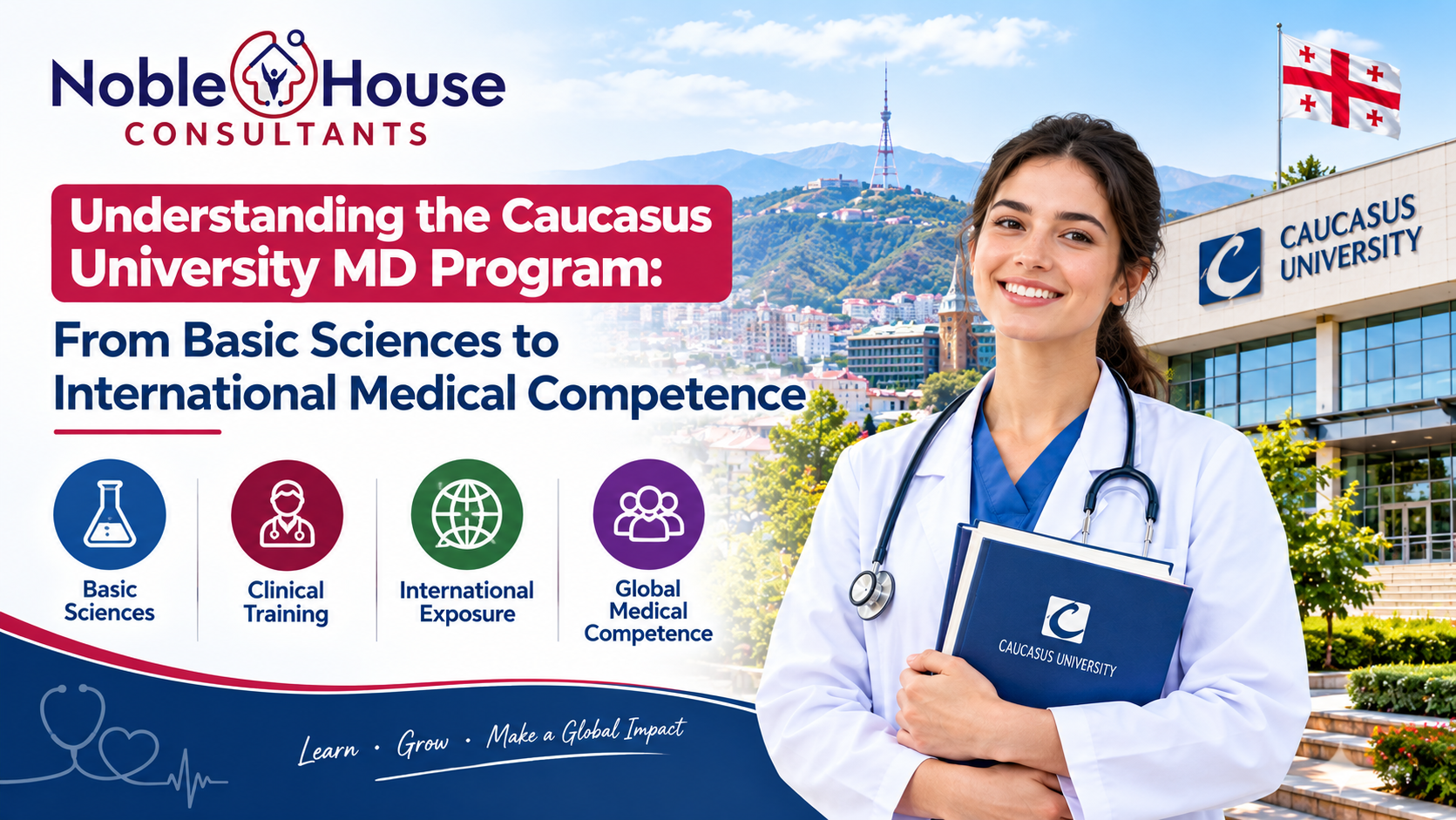
Understanding the Caucasus University MD Program: From Basic Sciences to International Medical Competence
Choosing a medical degree is a major decision, particularly for students who want an education that can support a future career in an increasingly international healthcare environment. A well-structured medical programme needs to go beyond theoretical knowledge. It should build scientific understanding, clinical competence, communication skills, ethical awareness, and the ability to continue learning throughout a professional career. For students considering options abroad, the opportunity to study medicine in Georgia can be particularly relevant because medical education in the country is designed around internationally oriented academic and clinical standards.
Building a Strong Foundation Through Basic Sciences
Medical education begins with understanding how the human body works. Basic and biomedical sciences provide the foundation upon which later clinical learning is developed. Subjects related to areas such as anatomy, physiology, biochemistry, pathology, pharmacology, and other foundational disciplines help students understand the scientific principles behind health and disease.
A strong foundation in basic sciences is essential because clinical medicine depends on the ability to connect scientific knowledge with real patient situations. Instead of treating individual subjects as isolated areas of study, an integrated medical curriculum can help students understand how different systems and processes interact.
This approach becomes especially valuable when students progress towards clinical subjects. Knowledge gained during the early stages of education provides the framework needed to understand symptoms, diagnostic findings, disease mechanisms, and treatment strategies.
Moving From Theory to Clinical Understanding
The transition from basic sciences to clinical medicine represents one of the most important stages of medical education. Students gradually begin applying scientific concepts to practical healthcare situations. This is where the goal of study medicine in Georgia can appeal to students seeking an education that combines academic learning with practical and clinical development.
Clinical education focuses on developing the ability to assess patients, identify problems, interpret information, and participate in appropriate healthcare decisions. Students are expected to develop practical abilities alongside theoretical knowledge rather than relying exclusively on classroom-based learning.
An effective medical programme also encourages students to develop a particular way of thinking. Medical professionals regularly encounter patients whose symptoms may have several possible explanations. Therefore, students need to learn how to collect information, analyse evidence, consider alternatives, and reach clinically appropriate conclusions.
Evidence-Based Medicine and Professional Development
Modern healthcare depends heavily on evidence. Medical professionals must be able to understand scientific information and use reliable evidence when making clinical decisions. For this reason, education in evidence-based medicine is an important component of internationally oriented medical training.
Students who study medicine in Georgia can develop an understanding of how scientific evidence supports practical medical work. Evidence-based learning encourages future doctors to combine clinical knowledge, research evidence, and professional judgement when approaching healthcare problems.
Medical education should also prepare graduates for lifelong learning. Medicine continues to evolve as new research, technologies, treatments, and diagnostic approaches emerge. A qualification therefore should not represent the end of education. Instead, it should provide students with the motivation and skills required for continuous professional development.
Developing Communication and Patient-Centred Skills
Being a competent doctor involves much more than knowing diseases and treatments. Communication is an essential part of safe and effective healthcare. Doctors need to communicate clearly with patients, family members, colleagues, nurses, and other healthcare professionals.
A patient-centred approach places the individual at the heart of the healthcare process. Students learn to listen carefully, understand patient concerns, explain medical information clearly, and communicate respectfully.
For international medical students, these skills can be particularly important. Patients may come from different cultural, social, linguistic, or religious backgrounds. Medical education therefore needs to encourage respect for individual differences and help future doctors provide care without prejudice or discrimination.
Medical Ethics and Professional Responsibility
Ethics is another fundamental element of medical competence. Doctors regularly make decisions that involve privacy, dignity, informed choices, professional responsibility, and patient interests. Academic knowledge alone cannot prepare students for these situations.
A comprehensive programme introduces students to the values of medical ethics and professional conduct. Respect for patients should remain central regardless of their social, cultural, religious, or ethnic background.
This ethical foundation contributes to the development of responsible professionals who understand that medicine is not simply a technical occupation. It is a profession built on trust, responsibility, compassion, and respect.
Understanding Healthcare Systems and Legislation
Doctors also work within established healthcare systems and legal frameworks. Understanding the basic legislative principles governing healthcare can help students recognise their professional responsibilities and the boundaries within which medical practice takes place.
This dimension of medical education complements clinical and scientific training. A doctor must understand not only what can be done medically but also how healthcare is organised, regulated, and delivered responsibly.
Students planning to study medicine in Georgia should therefore consider the wider educational experience rather than focusing only on individual subjects or examinations. Understanding healthcare systems, professional ethics, communication, and legislation can contribute significantly to long-term professional readiness.
International Standards and Global Medical Competence
Medical education is increasingly international. Graduates may seek postgraduate training, professional opportunities, or further education in different countries, depending on applicable recognition and licensing requirements.
Programmes aligned with internationally recognised medical education principles can help students develop competencies relevant to a global healthcare environment. A curriculum focused on scientific knowledge, clinical skills, communication, ethics, evidence-based medicine, and continuous learning can provide a broad foundation for future professional development.
An internationally oriented medical programme may therefore be attractive to students who want to build transferable knowledge and competencies. However, students should always independently check the recognition, accreditation, licensing, and postgraduate eligibility requirements of the country where they ultimately intend to practise.
A Long-Term Approach to Medical Education
A comprehensive MD pathway can involve substantial academic work and a significant commitment of time. A 360-ECTS medical qualification represents an extensive programme designed to cover the broad range of competencies expected from a medical graduate.
The structure of such a programme is not limited to memorising medical facts. Students progressively develop scientific understanding, clinical reasoning, practical abilities, communication skills, ethical judgement, and professional responsibility.
For students who want to study medicine in Georgia, understanding this broader educational structure can help them evaluate whether an MD programme matches their academic interests and long-term career plans.
Preparing for the Future of Medicine
Healthcare is continuously changing. Digital technologies, medical research, new therapies, global health challenges, and evolving patient expectations are transforming the role of doctors.
Future medical professionals therefore need adaptability as well as knowledge. They should be prepared to evaluate new evidence, communicate effectively, work within multidisciplinary teams, and continue developing their skills after graduation.
The strongest medical education is consequently one that prepares students not only for their first professional role but also for decades of learning and development. A curriculum combining basic sciences, clinical education, evidence-based practice, communication, ethics, healthcare legislation, and lifelong learning can provide a balanced foundation for that journey.
Noble House Consultants: Your Trusted Partner for a Successful Medical Admission Journey
Planning to study medicine abroad can feel overwhelming, but Noble House Consultants helps students navigate every stage with confidence. From choosing the right course and institution to admission guidance, documentation, direct interviews, visa assistance, and travel preparation, their experienced counsellors provide personalised support throughout the journey. With cost-effective services and onsite assistance, students can feel supported even after reaching their destination. For aspiring medical professionals, Noble House Consultants aims to make the journey toward an international medical education simpler, clearer, and more accessible.
Conclusion
Understanding an MD programme requires looking beyond its degree title. The real value of medical education lies in how effectively it develops scientific knowledge, clinical competence, communication abilities, ethical responsibility, and a commitment to lifelong professional learning.
For aspiring international medical students, the decision to study medicine in Georgia should therefore be based on a careful evaluation of curriculum structure, clinical exposure, academic standards, recognition, future licensing requirements, and personal career goals. A broad, internationally focused medical education can provide the foundation students need to progress from learning the basic sciences to developing the competence, judgement, and professional values expected of a modern medical doctor.
Frequently Asked Questions
1. What does an MD programme typically cover?
It covers basic sciences, clinical medicine, evidence-based practice, communication, ethics, and healthcare systems.
2. Why are basic sciences important in medical education?
They provide the scientific foundation needed to understand diseases, diagnosis, treatment, and clinical decision-making.
3. Does an MD programme include clinical training?
Yes. Medical education combines theoretical learning with practical and clinical skill development.
4. Why is evidence-based medicine important for future doctors?
It helps doctors use reliable scientific evidence alongside clinical knowledge and professional judgement.
5. What communication skills do medical students develop?
Students learn to communicate effectively with patients, families, colleagues, and other healthcare professionals.
6. Why is medical ethics part of an MD programme?
Ethics helps future doctors understand patient dignity, respect, professional responsibility, and patient-centred care.
7. What should students consider before studying medicine abroad?
Students should review curriculum structure, clinical exposure, accreditation, recognition, licensing requirements, costs, and career plans.
About Author

Post a Comment