- M-floor, Al Makhawi Building. Umm Hurair Road, Oud Metha, Dubai – UAE
- advisor@noblehouseconsultants.com
- +971508759073 +971508758925


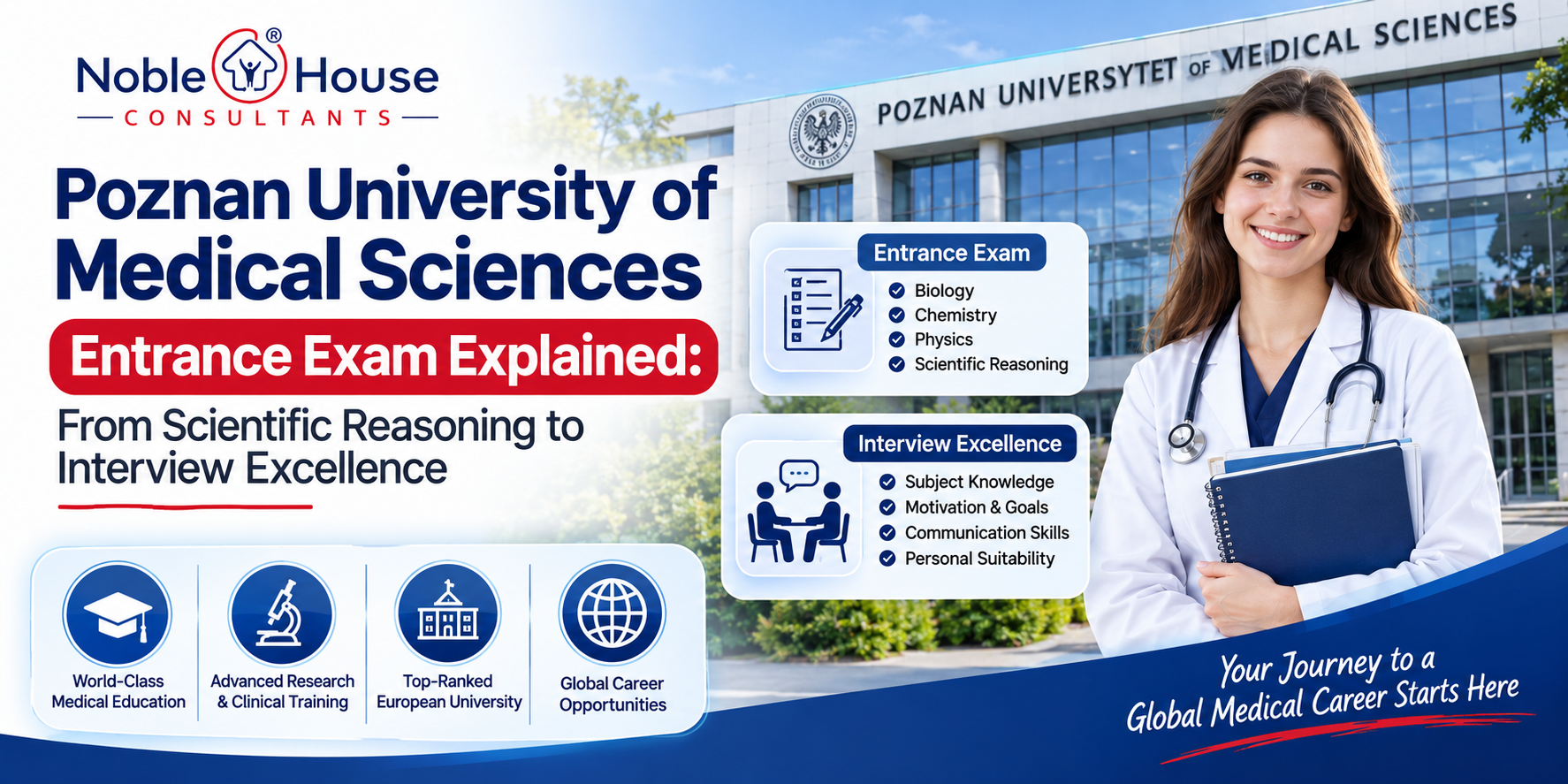
Poznan University of Medical Sciences Entrance Exam Explained: From Scientific Reasoning to Interview Excellence
Choosing to pursue a medical degree abroad is an exciting step, but understanding the admission process is equally important. For students planning to study medicine in Poland, the entrance assessment at Poznan University of Medical Sciences (PUMS) is designed to evaluate much more than academic knowledge. It measures scientific reasoning, communication skills, motivation, and readiness for a demanding medical education. Instead of relying solely on previous grades, the university looks for applicants who demonstrate critical thinking, problem-solving abilities, and a genuine passion for healthcare. This guide explains every stage of the entrance process, helping prospective students prepare with confidence and approach the assessment strategically.
Understanding the PUMS Admission Assessment
The admission process at Poznan University of Medical Sciences consists of two important stages:
- A written scientific reasoning examination
- An oral interview conducted by a faculty panel
Applicants must successfully complete the written assessment before progressing to the interview stage. Together, these evaluations help the university identify candidates who possess both academic capability and the personal qualities expected of future healthcare professionals.
Understanding each component in advance allows applicants to prepare effectively rather than relying on last-minute revision.
The Written Scientific Reasoning Examination
The first stage is the PUMS entrance exam, which focuses on evaluating scientific understanding and logical reasoning.
Exam Format
The written examination consists of:
- 60 multiple-choice questions
- One best answer for each question
- 60 minutes to complete the examination
Time management plays an important role. With only one minute available for each question, applicants should practice answering questions quickly while maintaining accuracy.
Subject Distribution
The examination is divided equally among three core science subjects:
Biology
Twenty questions assess the applicant’s understanding of biological principles. Students should be familiar with topics such as:
- Cell structure and function
- DNA and genetics
- Cellular respiration
- Human physiology
- Basic microbiology
- Evolution and inheritance
A solid understanding of biological processes helps applicants answer both direct knowledge-based questions and scientific reasoning problems.
Chemistry
Another twenty questions focus on chemistry concepts commonly studied during secondary education.
Important areas include:
- Atomic structure
- Chemical bonding
- Organic chemistry
- Acids and bases
- Chemical reactions
- Stoichiometry
- Periodic trends
Rather than memorizing isolated facts, applicants benefit from understanding how different chemical concepts relate to one another.
Physics
The final twenty questions examine knowledge of physics, including:
- Motion and kinematics
- Forces
- Energy
- Electricity
- Waves
- Basic mechanics
Medical education frequently incorporates physics principles, making this section an important part of the assessment.
Passing Score
Applicants must achieve at least 30% on the written examination to qualify for the interview stage.
Although this is the minimum passing requirement, aiming for a significantly higher score increases confidence before moving to the next phase of the admission process. Students planning to study medicine in Poland should therefore prepare thoroughly across all three scientific disciplines rather than focusing on only one subject.
Preparing for the Scientific Reasoning Test
Preparation is much more effective when it follows a structured plan.
Successful applicants often:
- Review biology, chemistry, and physics systematically
- Practice multiple-choice questions regularly
- Revise important scientific definitions
- Strengthen logical reasoning skills
- Develop time-management techniques through mock examinations
The university also provides an Entrance Examination and Interview Topics Guide outlining the scientific concepts expected from applicants. Using this guide as a study framework helps ensure that preparation remains focused on relevant material.
The Oral Interview
After passing the written examination, candidates move to the interview stage.
The interview usually lasts between 20 and 40 minutes and is conducted by university faculty members. Depending on the admission cycle, interviews may also take place online.
Unlike traditional academic examinations, the interview evaluates several different qualities that contribute to success in medicine.
Scientific Understanding
Faculty members may ask applicants to explain scientific concepts related to biology or human health.
Rather than testing memorization alone, interviewers often assess how well students can explain ideas logically and communicate scientific information clearly.
Candidates should be comfortable discussing:
- Human body systems
- Basic medical science concepts
- Scientific reasoning
- Problem-solving approaches
Being able to organize thoughts and explain concepts confidently is just as important as knowing the correct answer.
Discussing Your Experience
Interviewers frequently ask questions about activities listed in the applicant’s CV.
Topics may include:
- Volunteering
- Clinical observation
- Community service
- Healthcare exposure
- Leadership activities
- Academic achievements
Applicants should be prepared to describe what they learned from these experiences instead of simply listing participation.
Real-life examples demonstrating teamwork, empathy, responsibility, and commitment often leave a stronger impression than generic responses. Students hoping to study medicine in Poland should reflect carefully on how their experiences have influenced their decision to pursue a medical career.
Motivation to Study Medicine
One of the most important interview topics involves understanding why an applicant wants to become a doctor.
Interviewers may ask questions such as:
- Why have you chosen medicine?
- Why do you want to study at PUMS?
- What qualities make a good physician?
- What challenges do doctors face?
- How do you plan to contribute to healthcare?
Authentic, thoughtful answers generally perform better than rehearsed speeches. Applicants should explain their motivations honestly while demonstrating realistic expectations about the demands of medical education.
Communication and Professionalism
Medicine requires excellent communication with patients, colleagues, and healthcare teams.
During the interview, assessors observe:
- Confidence
- Listening skills
- Clarity of speech
- Professional behaviour
- Critical thinking
- Ability to remain calm under pressure
Practicing mock interviews with teachers, mentors, or family members can significantly improve confidence before the actual assessment.
English Language Proficiency
Since medical education is delivered in English, the interview also helps assess spoken English ability.
Applicants should communicate naturally, answer questions clearly, and avoid memorized responses whenever possible.
In addition, candidates may need to submit recognized English proficiency test scores such as IELTS (minimum 6.5), TOEFL iBT (minimum 94), or another accepted equivalent if required by the university.
Important Admission Information
Students should also remain aware of key administrative requirements.
Some of the important points include:
- Application deadline: July 31, 2026
- Application processing fee: 85 PLN
- Entrance examination and interview fee: 600 PLN
- Application documents are submitted through the university’s online application portal
Reviewing the Poznan university of medical sciences admission requirements well before the deadline helps applicants gather the necessary documents and avoid unnecessary delays during the application process. Students planning to study medicine in Poland should also keep track of application timelines and prepare supporting documents early to ensure a smooth submission process.
Final Preparation Tips
Preparing for the entrance assessment is about building confidence rather than simply memorizing facts.
A balanced preparation strategy should include:
- Daily revision of biology, chemistry, and physics
- Regular practice with timed multiple-choice questions
- Reviewing scientific concepts from the university’s recommended topics
- Improving spoken English through conversation practice
- Participating in mock interviews
- Reflecting on personal motivation for pursuing medicine
- Staying informed about application deadlines and required documentation
Consistent preparation over several weeks is generally far more effective than intensive study immediately before the examination.
Turn Your Medical Dream into Reality with Expert Guidance
Noble House Consultants is committed to helping aspiring medical students confidently navigate every stage of the admission journey. We provide personalized university selection guidance, application support, document preparation, visa assistance, and ongoing student support to make studying abroad a smooth experience. Our experienced counsellors work closely with you to identify the right opportunities and simplify every step, allowing you to focus on achieving your academic goals and building a successful future in medicine.
Conclusion
The admission assessment at Poznan University of Medical Sciences is designed to identify applicants who combine scientific knowledge with strong communication skills, professionalism, and genuine motivation to pursue medicine. By understanding the written scientific reasoning examination, preparing carefully for the interview, and organizing all required documentation well in advance, applicants can approach the process with greater confidence. For students who aspire to study medicine in Poland, thoughtful preparation, consistent practice, and a clear understanding of the university’s expectations can make the journey toward medical education both successful and rewarding.
Frequently Asked Questions
1. What does the PUMS entrance exam consist of?
The entrance assessment includes a 60-question written scientific reasoning test followed by an oral interview for shortlisted applicants.
2. Which subjects are covered in the written examination?
The written test includes Biology, Chemistry, and Physics, with 20 multiple-choice questions from each subject.
3. What is the minimum passing score for the written test?
Applicants must score at least 30% in the written examination to qualify for the interview stage.
4. What is evaluated during the interview?
The interview assesses scientific knowledge, communication skills, motivation for studying medicine, English proficiency, and relevant academic or extracurricular experiences.
5. How long does the interview usually last?
The interview generally lasts between 20 and 40 minutes and may be conducted online by a faculty panel.
6. Is proof of English language proficiency required?
Yes. Applicants may need to submit accepted English proficiency scores such as IELTS, TOEFL iBT, or an equivalent qualification, depending on the admission requirements.
7. How can students prepare effectively for the admission process?
Students should revise Biology, Chemistry, and Physics, practice timed multiple-choice questions, improve spoken English, and prepare confidently for common interview questions.
About Author

Post a Comment