- M-floor, Al Makhawi Building. Umm Hurair Road, Oud Metha, Dubai – UAE
- advisor@noblehouseconsultants.com
- +971508759073 +971508758925


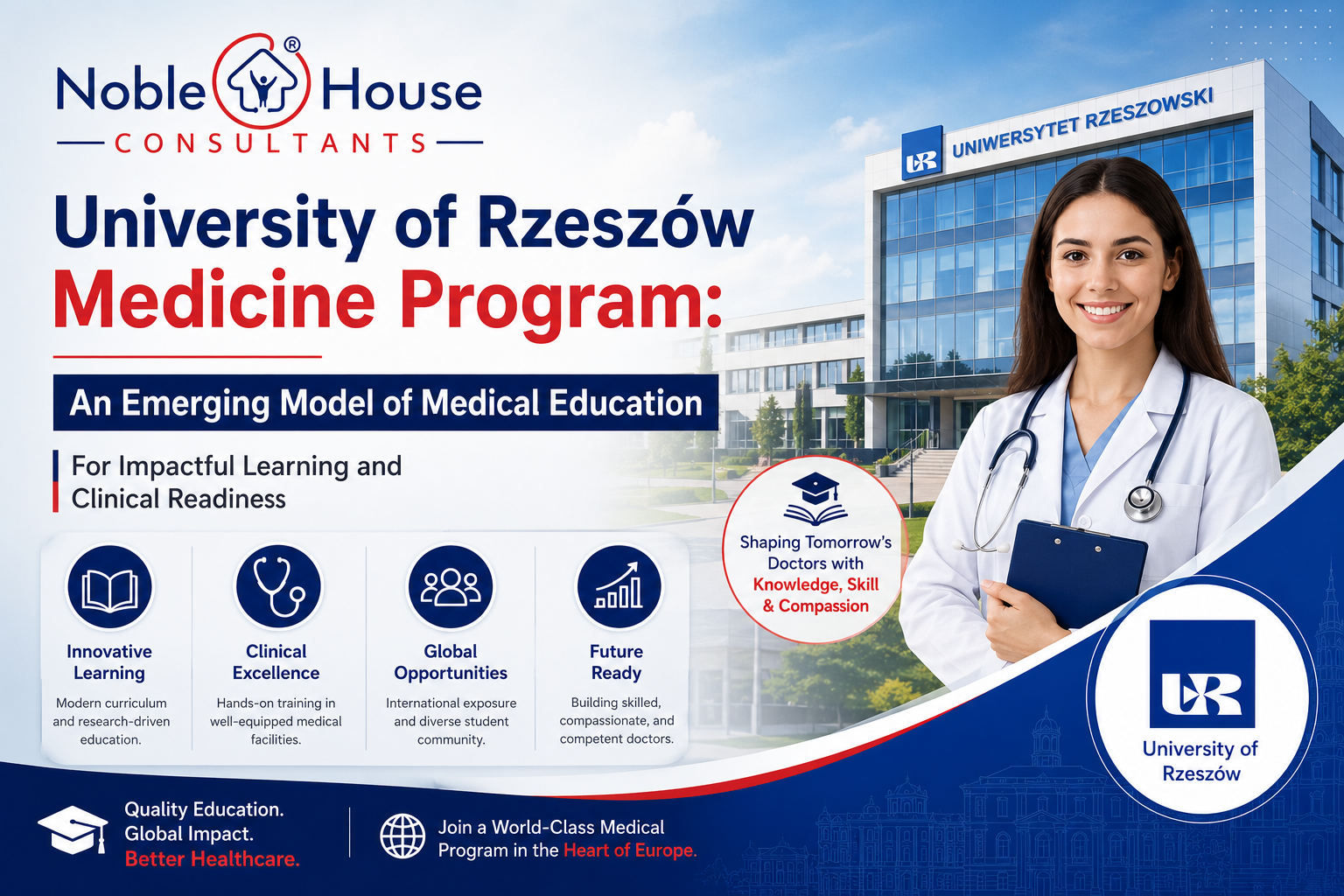
University of Rzeszów Medicine Program: An Emerging Model of Medical Education For Impactful Learning and Clinical Readiness
Choosing the right medical university is one of the most important decisions for aspiring doctors. Today’s medical education extends beyond textbooks and lecture halls, emphasizing practical experience, technological innovation, and patient-centered learning. Students looking to study medicine in Poland are increasingly drawn to institutions that combine strong academic foundations with extensive clinical exposure. Among these institutions, the University of Rzeszów has established a modern Doctor of Medicine (MD) program that prepares students for the realities of contemporary healthcare through an integrated and practice-oriented approach.
A Modern Six-Year Medical Curriculum
The Medicine Programme in English at the University of Rzeszów is a six-year Doctor of Medicine (MD) curriculum introduced in 2018. It has been designed to equip students with the scientific knowledge, clinical competencies, and professional skills required to succeed in an evolving healthcare environment.
Rather than separating theoretical instruction from clinical practice, the curriculum creates a gradual transition from foundational sciences to patient care. Students begin by building a solid understanding of biomedical principles before applying their knowledge in hospitals and clinical settings. This balanced educational structure allows learners to develop confidence as they progress through each academic year.
The program reflects modern educational standards by emphasizing continuous learning, practical application, and professional development throughout the entire course.
Building Strong Foundations During the Pre-Clinical Years
Every successful physician begins with a comprehensive understanding of the human body and the biological sciences that govern health and disease. During the pre-clinical phase, students study core subjects such as anatomy, physiology, biochemistry, and histology.
These disciplines provide the essential framework needed to understand complex medical conditions and clinical decision-making later in the program. Instead of memorizing isolated facts, students learn how different biological systems interact, preparing them to interpret symptoms, laboratory findings, and diagnostic information effectively.
This structured approach allows learners to develop analytical thinking while creating a strong academic base for future clinical responsibilities.
Early Clinical Exposure Enhances Practical Understanding
One of the distinguishing characteristics of the program is its emphasis on introducing clinical learning at an early stage. Rather than waiting until the later years of medical school, students gradually experience patient-centered education alongside their theoretical studies.
For many students who wish to study medicine in Poland, early clinical exposure offers valuable opportunities to understand how classroom concepts translate into real healthcare situations. Observing patient interactions, participating in supervised clinical activities, and learning professional communication skills help students develop confidence from the beginning of their medical education.
This gradual integration of practical learning reduces the gap between academic theory and everyday clinical practice while strengthening diagnostic reasoning and patient management skills.
Progressive Clinical Training Across Modern Teaching Hospitals
As students enter the clinical phase of the curriculum, learning increasingly takes place within affiliated teaching hospitals and healthcare facilities. These clinical rotations expose future doctors to multiple specialties while allowing them to observe experienced physicians managing a wide variety of medical conditions.
Students participate in bedside learning, diagnostic procedures, therapeutic planning, and multidisciplinary healthcare delivery. This hands-on experience strengthens both technical knowledge and interpersonal communication, helping students appreciate the collaborative nature of modern medicine.
The curriculum also includes advanced clinical rotations during the final year, enabling students to refine their practical competencies and prepare for independent medical practice.
Advanced Simulation Supports Safe Skill Development
Medical simulation has become an essential component of healthcare education worldwide. The University’s Medical Simulation Centre allows students to practice clinical procedures within controlled environments before working directly with patients.
Simulation-based education enables learners to develop procedural accuracy, improve decision-making under pressure, and strengthen teamwork without exposing patients to unnecessary risks.
Students gain experience managing emergency situations, performing acute interventions, and practicing essential procedural techniques using advanced simulation technologies. These exercises reinforce classroom knowledge while building confidence in real-world clinical settings.
Such innovative educational resources demonstrate how modern medical training increasingly combines technology with experiential learning to improve student preparedness.
Specialized Surgical Exposure Broadens Clinical Perspectives
Modern healthcare continues to evolve with the introduction of advanced surgical technologies and multidisciplinary treatment approaches. The program enhances students’ clinical education through collaboration with specialized surgical facilities, including advanced robotic surgery centers.
Students interested in studying medicine in Poland often seek programs that expose them to emerging medical technologies alongside traditional clinical education. Exposure to specialized surgical environments helps learners understand how innovation is transforming patient care across multiple disciplines.
Observing modern surgical practices broadens clinical perspectives while encouraging future physicians to remain adaptable as medical technologies continue to advance throughout their careers.
Small-Group Learning Encourages Individual Growth
Medical education benefits significantly from individualized instruction. The program utilizes small-group learning environments that encourage greater interaction between students and faculty members.
Lower student-to-instructor ratios provide opportunities for personalized feedback, active discussion, and immediate clarification of complex concepts. Students can ask questions freely, participate in case-based learning, and receive constructive guidance during practical sessions.
This collaborative educational environment strengthens diagnostic confidence while promoting critical thinking and clinical reasoning—skills that remain essential throughout every stage of a medical career.
Admission Standards Reflect Academic Commitment
Admission into the medical program is designed to identify applicants who possess both strong academic preparation and genuine motivation to pursue medicine.
Candidates are expected to demonstrate excellent performance in secondary school science subjects. Biology serves as the compulsory core subject, while Chemistry or Physics is typically selected as the second science requirement. Mathematics or related life science subjects may also be considered depending on eligibility criteria.
Advanced-level examination results receive greater weighting during the evaluation process, recognizing students who have undertaken more rigorous academic preparation.
Beyond academic records, applicants participate in interviews that assess scientific understanding in Biology, Chemistry, and Physics while also evaluating their motivation and readiness for medical education.
Certain international applicants may additionally complete a written entrance examination covering Biology and Chemistry, ensuring consistent academic standards across diverse educational backgrounds.
Language Requirements and International Accessibility
Since the program is delivered in English, applicants whose first language is not English must demonstrate appropriate language proficiency. Recognized English language examinations generally require a minimum B2 level, ensuring students can fully engage with lectures, clinical communication, and academic coursework.
Applicants must also submit properly legalized educational documents, including translated high school certificates where applicable. Depending on the country of origin, diplomas may require Apostille certification or legalization through diplomatic channels before enrollment.
These standardized admission procedures help create a transparent and academically prepared student community.
The growing presence of University of Rzeszów international students reflects the increasing appeal of English-medium medical education for learners from diverse educational and cultural backgrounds. An international classroom also enriches peer learning by encouraging collaboration across different healthcare perspectives and experiences.
Preparing Future Doctors for Modern Healthcare
The program’s greatest strength lies in its balanced integration of scientific knowledge, practical skills, technological innovation, and patient-centered education. Students gradually progress from foundational biomedical sciences to increasingly advanced clinical responsibilities within supervised healthcare environments.
Those seeking to study medicine in Poland often value educational models that emphasize clinical readiness rather than theoretical learning alone. Through simulation-based instruction, early patient exposure, advanced clinical rotations, and individualized teaching, students develop competencies that support lifelong professional growth.
The curriculum encourages adaptability, ethical practice, collaborative healthcare, and evidence-based decision-making—all qualities expected of modern physicians working within increasingly complex healthcare systems.
The emphasis on University of Rzeszów Medicine illustrates how contemporary medical education continues to evolve by integrating technology, practical experience, and academic excellence into a unified learning journey.
Turn Your Medical Aspirations into Global Success with Noble House Consultants
Noble House Consultants is dedicated to helping aspiring medical students confidently begin their international education journey. We provide personalized guidance for university selection, admissions, documentation, visa assistance, and pre-departure preparation, making every step more manageable. Our experienced counsellors work closely with students to identify suitable programs while offering reliable support even after arrival abroad. With our student-focused approach and commitment to affordable guidance, we strive to help you pursue your medical career with confidence and clarity.
Conclusion
Medical education today demands much more than academic excellence. Future physicians must develop practical competence, sound clinical judgment, effective communication skills, and the ability to adapt to rapidly changing healthcare environments. The University of Rzeszów addresses these expectations through a thoughtfully designed six-year MD curriculum that combines foundational sciences, early clinical exposure, advanced simulation, specialized surgical learning opportunities, and comprehensive hospital-based training.
For students planning to study medicine in Poland, the program represents an educational pathway focused on impactful learning, clinical confidence, and professional readiness. By integrating academic rigor with meaningful hands-on experience, it prepares future doctors to enter the medical profession with the knowledge, skills, and adaptability required to deliver high-quality patient care in an increasingly dynamic global healthcare landscape.
Frequently Asked Questions
1. How long is the Medicine Programme at the University of Rzeszów?
The program is a six-year Doctor of Medicine (MD) degree taught in English.
2. What subjects are required for admission?
Applicants should have strong academic performance in Biology along with Chemistry or Physics. Mathematics or related life science subjects may also be accepted in certain cases.
3. Does the program offer early clinical exposure?
Yes. Students begin gaining clinical experience early in their studies, helping them connect theoretical knowledge with real patient care.
4. What practical training facilities are available?
Students benefit from a Medical Simulation Centre, modern teaching hospitals, and specialized surgical training opportunities.
5. Is an English language certificate required?
Yes. Non-native English speakers generally need to demonstrate B2-level English proficiency through an accepted language qualification.
6. Are international students eligible to apply?
Yes. The English-medium program welcomes international applicants who meet the academic, language, and documentation requirements.
7. What makes the University of Rzeszów Medicine Programme distinctive?
Its combination of strong biomedical education, simulation-based learning, early clinical exposure, advanced hospital rotations, and small-group teaching prepares students for modern medical practice.
About Author

Post a Comment