- M-floor, Al Makhawi Building. Umm Hurair Road, Oud Metha, Dubai – UAE
- advisor@noblehouseconsultants.com
- +971508759073 +971508758925


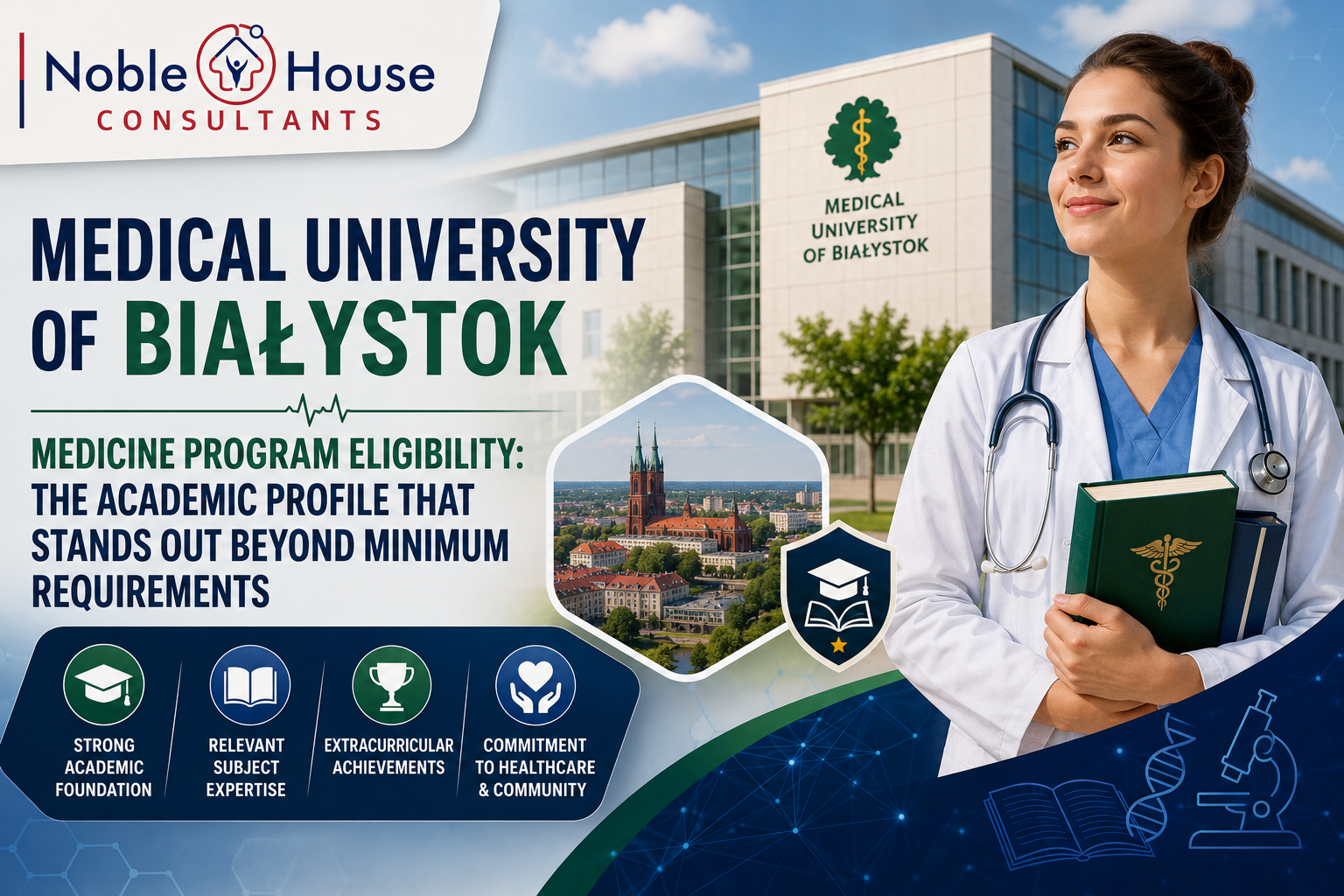
Medical University of Białystok Medicine Program Eligibility: The Academic Profile That Stands Out Beyond Minimum Requirements
For many international students, understanding admission requirements is only the first step toward building a successful medical career. While meeting the official criteria is essential, the strongest applicants often demonstrate qualities that go beyond the minimum academic standards. The Medical university of Bialystok faculty of medicine evaluates candidates through a structured admission process that considers both academic preparation and readiness for medical education. If your goal is to study medicine in a prestigious country like Poland, understanding what makes an application truly competitive can help you prepare more effectively and improve your chances of success.
Eligibility Is More Than Meeting the Minimum Requirements
The university has clearly defined eligibility criteria for applicants to its 6-year English-language MD program. Candidates are expected to possess a valid secondary school qualification that allows them to apply for higher education in their home country. In addition, their academic record should include positive grades in at least two of the following subjects:
- Biology
- Chemistry
- Physics
- Mathematics
Applicants are assessed using a ranking system that combines academic performance with an admission interview. This means that simply satisfying the minimum eligibility criteria does not automatically guarantee admission. Since candidates compete for available seats, building a stronger academic profile can significantly improve ranking and overall competitiveness.
Build a Strong Foundation in Science
Medicine is one of the most academically demanding fields of study. Students who perform well in Biology, Chemistry, Physics, and Mathematics during high school often adapt more easily to the university curriculum.
Although only two science subjects are required for eligibility, applicants who perform consistently well across multiple science disciplines demonstrate a broader understanding of scientific concepts. This balanced preparation becomes particularly valuable once the medical program begins, where different scientific subjects are closely interconnected.
Instead of focusing only on passing examinations, aspiring medical students should aim to understand concepts thoroughly. Strong analytical thinking, problem-solving abilities, and scientific reasoning are qualities that benefit students throughout medical school.
Academic Consistency Matters
Admission committees often appreciate consistency in academic performance rather than isolated high scores.
A steady record of good grades throughout secondary education indicates:
- Strong study habits
- Self-discipline
- Long-term commitment
- Ability to manage academic pressure
The Medical university of Bialystok faculty of medicine evaluates academic records as part of its ranking process. Maintaining consistent performance over several years reflects a student’s readiness for the demanding pace of medical education.
Students who are still completing their final year of school should continue working hard because updated transcripts and final examination results remain an important part of the admission process.
Prepare Thoroughly for the Admission Interview
Academic achievements represent only one component of the selection process. Applicants are also required to participate in an interview that assesses their knowledge of Biology, Chemistry, Mathematics, Physics, and English language skills relevant to medical studies.
Preparing early for this interview provides several advantages.
Candidates should review core scientific concepts instead of memorizing isolated facts. Interviewers often look for logical thinking, conceptual understanding, and the ability to communicate scientific ideas clearly.
English communication is equally important because the entire MD program is taught in English. Students should become comfortable discussing scientific topics confidently while using accurate medical and academic vocabulary.
Developing these communication skills before applying can make a significant difference during the interview.
English Proficiency Supports Academic Success
For many international applicants, English language proficiency is an important admission requirement. Students from countries outside the EU and EEA generally need to provide an accepted English language certificate demonstrating at least B2-level proficiency.
However, strong English skills offer benefits far beyond satisfying documentation requirements.
Medical education involves:
- Reading extensive textbooks
- Understanding research articles
- Participating in laboratory sessions
- Communicating during clinical training
- Writing assignments and reports
Students with stronger English proficiency usually adjust more comfortably to the academic environment and classroom discussions.
Submit Complete and Accurate Documentation
One of the most overlooked aspects of university admission is documentation.
Many qualified applicants experience delays because documents are incomplete, improperly certified, or missing required legal authentication.
Depending on the country where the secondary school certificate was issued, applicants may need either:
- An Apostille
- Legalization
Some candidates may also need:
- Eligibility declarations
- Certified translations
- Recognition statements for foreign school certificates
- Health certificates
- Passport copies
- Medical insurance documentation
- English language certificates
Preparing these documents early reduces unnecessary stress and allows applicants to focus on interview preparation and academic readiness.
Understand the Importance of Ranking
Unlike admissions systems that rely solely on meeting minimum requirements, the selection process uses a ranking list.
The ranking is based primarily on:
- Academic grades
- Performance during the admission interview
This means every additional improvement in academic performance can positively influence an applicant’s overall standing.
Students who aim beyond the minimum requirements generally place themselves in a stronger competitive position.
The Medical university of Bialystok faculty of medicine seeks students who demonstrate both academic capability and genuine readiness for rigorous medical education rather than those who simply satisfy baseline eligibility.
Develop the Qualities of a Future Doctor
Excellent medical students are not defined by grades alone.
Future physicians should gradually develop qualities such as:
- Curiosity
- Compassion
- Critical thinking
- Integrity
- Responsibility
- Time management
- Effective communication
These characteristics help students perform well during medical training and later in clinical practice.
Reading scientific literature, participating in school science activities, volunteering where appropriate, and maintaining a genuine interest in healthcare can all contribute to personal growth before entering medical school.
Although these experiences may not replace academic qualifications, they help shape the mindset required for a successful medical career.
Stay Organized Throughout the Admission Process
Medical school applications involve several stages.
Successful applicants usually prepare months in advance by creating a checklist of important tasks, including:
- Completing the online application
- Uploading required documents
- Verifying certifications
- Preparing for the interview
- Monitoring application status
- Responding promptly to university communications
Missing a deadline or failing to submit complete documentation can prevent an otherwise qualified application from being considered.
Organization demonstrates professionalism and reduces avoidable complications during the admission process.
Focus on Genuine Academic Preparation
Many applicants search for shortcuts to improve their chances of admission. However, lasting success comes from genuine preparation rather than temporary strategies.
Students planning to study MBBS in Poland should focus on strengthening their science knowledge, improving English communication, and understanding the responsibilities associated with becoming a doctor.
A realistic understanding of the medical profession helps students enter university with the right expectations and motivation.
The transition from secondary school to medical education is demanding, but students who prepare thoroughly often adapt more confidently to the challenges ahead.
Think Beyond Admission
Receiving an admission offer is only the beginning of the journey.
Medical education requires continuous learning, resilience, and dedication over several years. Students who cultivate disciplined study habits before university often find it easier to manage the rigorous curriculum once classes begin.
Developing healthy learning routines, improving note-taking skills, practicing scientific reasoning, and strengthening problem-solving abilities can all contribute to long-term academic success.
Rather than preparing only to gain admission, aspiring medical students should prepare to thrive throughout their entire medical education.
Your Trusted Partner for a Smooth Medical Admission Journey
Noble House Consultants is committed to helping aspiring medical students turn their study abroad goals into reality with personalized guidance at every stage. We assist you in choosing the right university, preparing a strong application, organizing essential documents, and navigating the admission process with confidence. Our experienced team also provides visa assistance, travel guidance, and ongoing student support, ensuring you have reliable help before departure and even after you begin your academic journey overseas. If you want to study medicine in poland, you can contact us.
Conclusion
Meeting the published eligibility requirements is an essential first step, but the most competitive applicants often distinguish themselves through strong academic consistency, excellent science preparation, confident English communication, organized documentation, and thoughtful interview performance. These qualities not only improve admission prospects but also lay the foundation for success throughout medical school. The Medical university of Bialystok faculty of medicine offers aspiring doctors the opportunity to begin a comprehensive medical education, and applicants who invest in building a well-rounded academic profile place themselves in the strongest possible position for both admission and future achievement.
Frequently Asked Questions
1. What are the basic eligibility requirements for the Medical University of Białystok Medicine program?
Applicants must have a valid secondary school certificate that qualifies them for higher education and positive grades in at least two of these subjects: Biology, Chemistry, Physics, or Mathematics.
2. Does meeting the minimum eligibility guarantee admission?
No. Admission is competitive and based on a ranking system that considers both academic performance and the admission interview.
3. What does the admission interview assess?
The interview evaluates a candidate’s knowledge of Biology, Chemistry, Mathematics, Physics, and English language proficiency required for medical studies.
4. Is an English language certificate required?
Yes. Most applicants from outside the EU and EEA must provide an accepted English language certificate at a minimum B2 level.
5. What documents should applicants prepare for admission?
Applicants generally need an application form, school leaving certificate, passport copy, health certificate, medical insurance, and other required documents such as Apostille, legalization, or certificate recognition where applicable.
6. How can students improve their chances of admission?
Maintaining strong academic performance, preparing thoroughly for the interview, improving English proficiency, and submitting complete documentation can significantly strengthen an application.
7. Why is early preparation important for medical school admission?
Starting early gives applicants enough time to gather documents, meet certification requirements, prepare for the interview, and avoid missing important admission deadlines.
About Author

Post a Comment