- M-floor, Al Makhawi Building. Umm Hurair Road, Oud Metha, Dubai – UAE
- advisor@noblehouseconsultants.com
- +971508759073 +971508758925


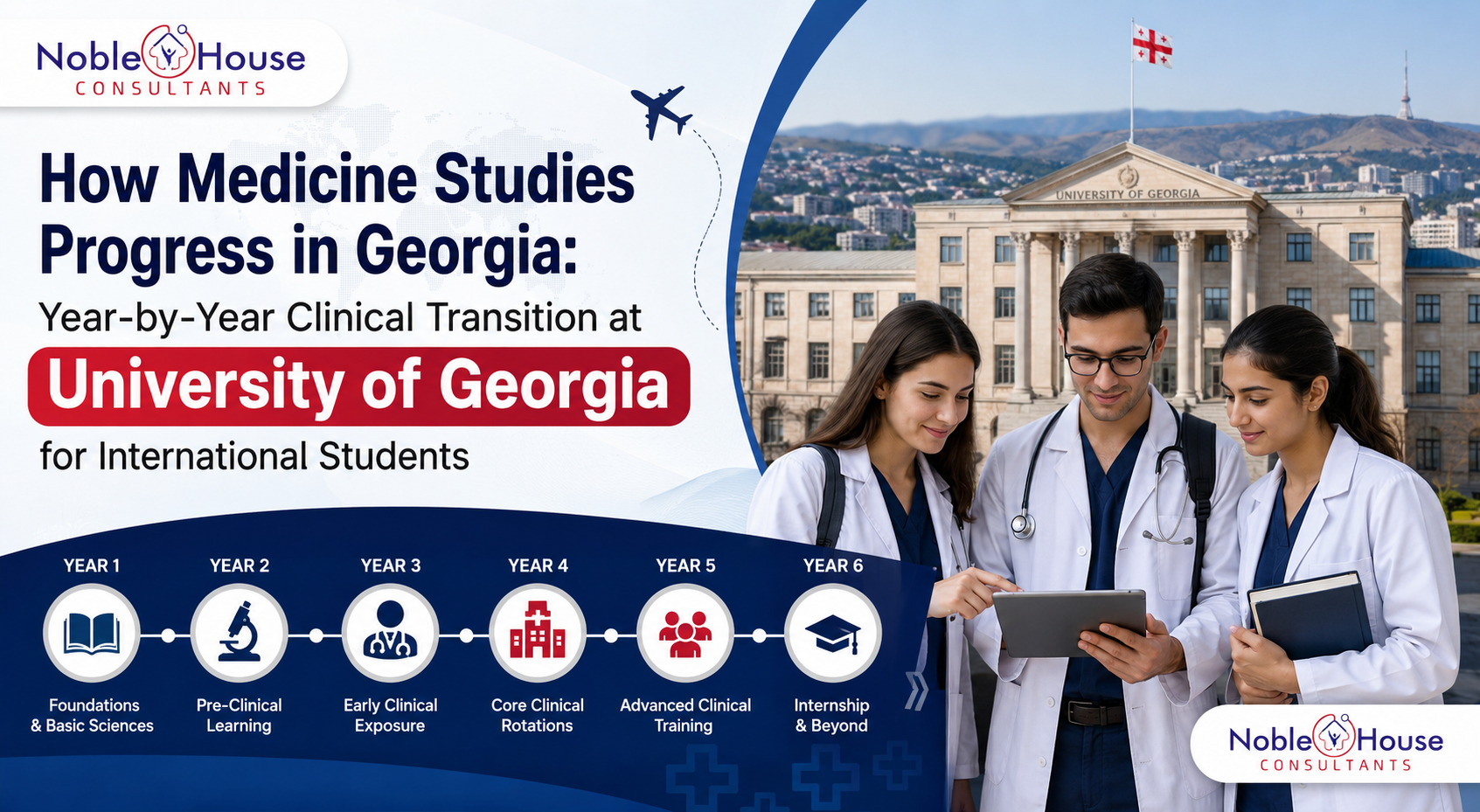
How Medicine Studies Progress in Georgia: Year-by-Year Clinical Transition at University of Georgia for International Students
For aspiring doctors seeking an internationally oriented medical education, understanding how a medical curriculum progresses from basic sciences to clinical practice is essential. One of the most attractive aspects of medical education in Georgia is the structured transition that helps students gradually build knowledge, confidence, and practical skills throughout their academic journey. Students who choose to study medicine in Georgia often appreciate the step-by-step approach that begins with foundational sciences and steadily advances toward real-world patient care.
The six-year medical curriculum follows a carefully designed pathway that allows international students to develop both theoretical understanding and clinical competence. From learning human anatomy and physiology in the early years to participating in hospital-based rotations and internships in the later years, students experience a progressive educational model that prepares them for global medical careers.
This article explores how medical studies advance year by year, highlighting the transition from classroom learning to hands-on clinical training.
Understanding the Structure of the Six-Year Medical Program
The medical program is divided into two major phases:
- Pre-Clinical Phase (Years 1–3)
- Clinical Phase (Years 4–6)
This structure ensures that students first develop a strong scientific foundation before applying their knowledge in real healthcare settings. The progression is designed to help students understand not only how the human body functions but also how diseases develop, how they are treated, and how patient care is delivered in clinical environments.
The curriculum comprises 360 ECTS credits and is taught entirely in English, making it accessible to international students from diverse backgrounds.
Year 1: Establishing the Foundations of Medicine
The first year serves as the cornerstone of medical education. Students are introduced to the fundamental biomedical sciences that form the basis of all future medical learning.
Core subjects typically include:
- Histology
- Human Anatomy
- Biochemistry
- Medical Genetics
At this stage, students spend considerable time understanding the structure and function of the human body at both microscopic and macroscopic levels. Anatomy laboratories, histological studies, and biochemical concepts help build the scientific mindset required for medical practice.
An additional feature of the first year is language training. Students are introduced to Georgian or other relevant languages to facilitate future communication with local patients. This early preparation helps international students become more comfortable interacting within the healthcare environment during later clinical rotations.
The first year may feel academically demanding, but it creates the essential knowledge base upon which all future medical learning depends.
Year 2: Exploring Human Function and Disease Processes
As students move into the second year, the curriculum becomes more focused on understanding how the body functions and how diseases emerge.
Key subjects generally include:
- Physiology
- Microbiology
- Immunology
- Pathology
Physiology helps students understand normal bodily functions, while pathology introduces the mechanisms behind disease development. Microbiology and immunology provide valuable insights into infectious diseases and the body’s defense systems.
For many students, this is the year when medical concepts begin to connect more clearly. Instead of studying individual structures in isolation, learners start understanding how various systems interact and respond to health challenges.
Students who study medicine in Georgia often find this stage particularly important because it bridges the gap between pure scientific theory and medical reasoning. The knowledge gained during this year becomes crucial when diagnosing and treating patients in later clinical settings.
Year 3: Connecting Science with Clinical Medicine
The third year marks a significant transition toward clinical thinking. Students begin integrating their understanding of disease mechanisms with treatment strategies and patient presentations.
Major areas of study include:
- Systems-Based Pathophysiology
- Pharmacology
Pathophysiology helps students understand how diseases affect different body systems, while pharmacology focuses on medications, their mechanisms, therapeutic uses, and potential side effects.
This year is often described as the bridge between pre-clinical and clinical education. Students start learning how symptoms, diagnoses, and treatments are interconnected. Medical cases become increasingly relevant, and theoretical concepts begin to mirror real-life patient scenarios.
For those planning to study medicine in Georgia, the third year represents an exciting phase where textbook knowledge starts evolving into practical clinical understanding.
Year 4: Entering the Clinical Environment
The fourth year marks the beginning of direct clinical exposure. After spending three years developing scientific knowledge, students enter hospitals and healthcare settings where they begin interacting with patients under supervision.
Core clinical rotations often include:
- Internal Medicine
- General Surgery
- Pediatrics
Students learn essential clinical skills such as:
- Taking patient histories
- Performing physical examinations
- Developing communication skills
- Understanding hospital workflows
This transition from classroom learning to hospital practice is one of the most transformative experiences in medical education. Students begin observing real medical cases and applying their theoretical knowledge to actual patient situations.
The experience also helps learners develop professionalism, empathy, and confidence while working within multidisciplinary healthcare teams.
Year 5: Advancing Through Specialized Clinical Rotations
The fifth year introduces students to a broader range of medical specialties. By this stage, students have gained basic clinical competence and are ready to explore more specialized fields of medicine.
Common clinical rotations include:
- Obstetrics and Gynecology
- Neurology
- Psychiatry
- Emergency Medicine
- Intensive Care
These experiences expose students to different patient populations, disease conditions, and treatment approaches.
Emergency Medicine rotations, for example, teach rapid decision-making under pressure, while Psychiatry introduces students to the complexities of mental health care. Neurology develops advanced diagnostic reasoning, and Obstetrics and Gynecology provides insight into women’s health and reproductive medicine.
Students who study medicine in Georgia often value this stage because it offers a comprehensive view of medical practice and helps them identify potential future specialties.
The fifth year is also important for refining clinical judgment and improving patient management skills across diverse healthcare settings.
Year 6: Clinical Clerkships and Internship Preparation
The final year focuses heavily on practical training through extensive clinical clerkships and mandatory internship experiences.
Under close supervision from experienced medical professionals, students take on greater responsibility in patient care activities. They are encouraged to:
- Assess patients independently
- Develop diagnostic approaches
- Participate in treatment planning
- Improve clinical decision-making skills
This final stage is designed to help students transition from medical students to future physicians.
The emphasis shifts toward real-world readiness, ensuring graduates are prepared to work within healthcare systems or pursue postgraduate training opportunities.
In addition, many students use this period to prepare for international licensing examinations such as FMGE, USMLE, or PLAB. The combination of theoretical knowledge and practical clinical exposure provides valuable preparation for these assessments.
The Role of Simulation-Based Medical Training
An important feature of modern medical education is simulation-based learning.
Before performing procedures on real patients, students have opportunities to practice within simulated clinical environments using advanced training technologies. High-fidelity mannequins and realistic clinical scenarios allow learners to develop technical skills, improve decision-making, and build confidence in a safe setting.
Simulation training offers several advantages:
- Risk-free learning opportunities
- Improved procedural competence
- Better communication skills
- Enhanced teamwork and crisis management
- Increased confidence before entering clinical practice
These experiences help bridge the gap between theory and patient care while reducing anxiety associated with first-time clinical procedures.
Why the Year-by-Year Progression Matters
A structured medical curriculum is essential because medicine requires gradual skill development. Students cannot move directly into patient care without first understanding anatomy, physiology, pathology, and pharmacology.
The year-by-year progression ensures that every stage builds logically upon the previous one:
- Foundational sciences create understanding.
- Disease mechanisms develop clinical reasoning.
- Pharmacology introduces treatment concepts.
- Clinical rotations build practical competence.
- Clerkships prepare students for professional practice.
This systematic approach helps students gain confidence while minimizing gaps in knowledge and clinical skills.
Turn Your Medical Dream into Reality with Noble House Consultants
Noble House Consultants is dedicated to helping aspiring students achieve their international education goals through personalized guidance and dependable support. Whether you plan to Study MBBS in Georgia or explore opportunities in medicine, engineering, management, or other professional fields, we provide tailored counseling, direct interview assistance, visa support, and ongoing guidance throughout your journey. With years of experience and a student-focused approach, we strive to make overseas education accessible, affordable, and rewarding while supporting you every step of the way toward a successful future.
Conclusion
Medical education is most effective when it combines strong scientific foundations with progressive clinical exposure. The six-year structure discussed above demonstrates how students move steadily from learning about cells, tissues, and body systems to managing real patients in clinical environments.
For international students seeking a comprehensive medical education, the year-by-year transition offers a clear pathway toward becoming a competent healthcare professional. Those who choose to study medicine in Georgia benefit from a curriculum that carefully integrates theory, simulation-based learning, hospital training, and internship experience, ensuring they are well prepared for future medical practice and international licensing opportunities.
Frequently Asked Questions
1. How long does the medical program in Georgia take to complete?
The medical program typically lasts 6 years and is divided into pre-clinical and clinical phases, allowing students to progress from foundational sciences to practical hospital training.
2. When do students begin clinical training?
Students usually begin direct clinical training in the fourth year, where they participate in hospital rotations and learn essential patient-care skills under supervision.
3. What subjects are covered during the pre-clinical years?
The pre-clinical phase includes subjects such as Anatomy, Histology, Biochemistry, Medical Genetics, Physiology, Microbiology, Immunology, Pathology, Pharmacology, and Pathophysiology.
4. Why is language training included in the curriculum?
Language training helps international students communicate more effectively with local patients during clinical rotations and enhances their overall hospital experience.
5. What clinical specialties are covered during the later years?
Students gain exposure to specialties such as Internal Medicine, Surgery, Pediatrics, Obstetrics and Gynecology, Neurology, Psychiatry, Emergency Medicine, and Intensive Care.
6. What is simulation-based medical training?
Simulation-based training allows students to practice medical procedures and clinical decision-making using advanced mannequins and realistic healthcare scenarios before working with real patients.
7. Does the curriculum help students prepare for international licensing exams?
Yes. The combination of theoretical learning, clinical rotations, and internship experience helps students prepare for international medical licensing examinations such as FMGE, USMLE, and PLAB.
About Author

Post a Comment