- M-floor, Al Makhawi Building. Umm Hurair Road, Oud Metha, Dubai – UAE
- advisor@noblehouseconsultants.com
- +971508759073 +971508758925


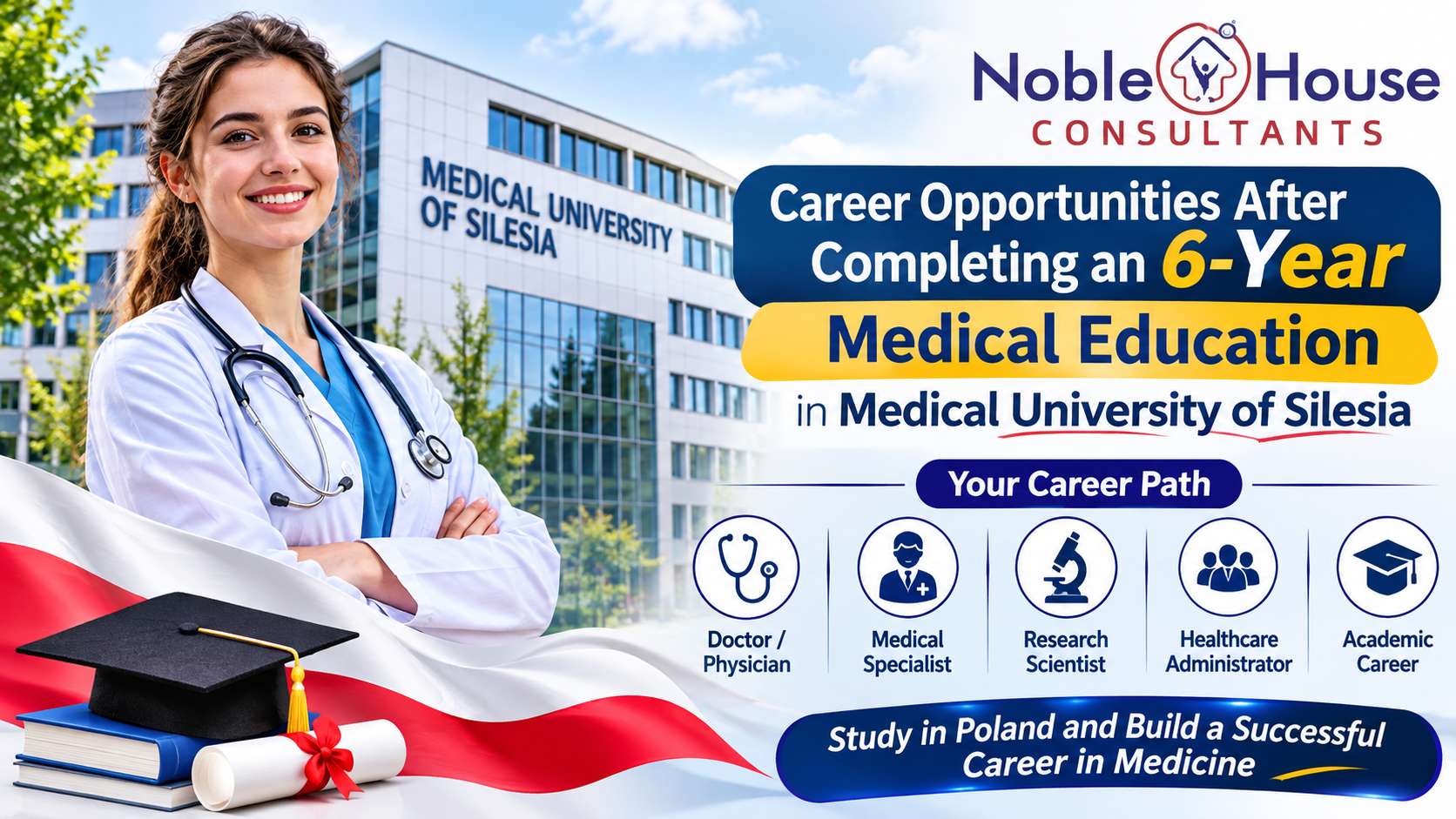
Career Opportunities After Completing an 6-Year Medical Education in Medical University of Silesia
Choosing medicine as a career opens doors to numerous professional opportunities across the world. For students aspiring to become internationally recognised medical professionals, pursuing a six-year medical degree in Europe can be an important step towards achieving their goals. The Medical University of Silesia in Poland offers a six-year Doctor of Medicine (MD) programme designed to provide students with foundational medical knowledge, clinical exposure, and practical skills. After graduation, students can explore several career pathways depending on their professional interests, licensing eligibility, and preferred country of practice.
Students who plan to Study Medicine in Poland often consider more than just the quality of education. They also want to understand what happens after graduation, where they can practise, and whether they can pursue postgraduate specialisations or alternative healthcare careers. Fortunately, completing a six-year medical education can create opportunities in clinical practice, academic medicine, research, healthcare management, and the growing medical technology sector.
Let’s explore the different career opportunities available after completing the six-year medical programme.
1. Practising Medicine Across European Countries
One of the major career pathways after completing a medical degree in Poland is exploring professional opportunities across European countries. Medical graduates may consider practising medicine or pursuing postgraduate medical training in different European Union member states, subject to the applicable professional recognition and registration requirements.
The European medical education framework provides a structured approach to medical qualifications. However, obtaining a medical degree does not automatically grant permission to practise in every European country. Graduates must fulfil the registration requirements of the country where they intend to work.
Some important considerations include:
- Professional Registration: Graduates must apply to the relevant medical regulatory authority in their preferred country.
- Language Proficiency: Many countries require doctors to demonstrate proficiency in the local language to communicate effectively with patients and healthcare professionals.
- Clinical Competency: Applicants may need to fulfil additional professional or clinical requirements depending on the country’s regulations.
- Postgraduate Training: Eligible graduates can explore specialist training programmes and residency opportunities.
For students who wish to Study Medicine in Poland, the possibility of exploring different European career destinations can make the degree an attractive academic choice.
2. Building a Medical Career in the United Kingdom
The United Kingdom is another destination that attracts international medical graduates interested in clinical practice and postgraduate training.
After completing their six-year MD degree, graduates may explore opportunities to obtain medical registration and pursue further training in the UK. However, they must meet the applicable requirements for international medical graduates.
The licensing pathway generally involves the following considerations:
Medical Licensing Assessment (MLA) and PLAB: Depending on the applicable registration route and examination transition arrangements, graduates may need to fulfil the relevant licensing assessment requirements. PLAB remains an important examination pathway for eligible international medical graduates.
English Language Proficiency: Applicants generally need to demonstrate sufficient English language skills through an accepted assessment or other approved evidence.
Medical Registration: Graduates must satisfy the professional registration requirements before practising medicine.
Foundation and Postgraduate Training: Depending on their eligibility and experience, graduates can explore foundation-level training or other postgraduate medical opportunities.
The UK offers different medical specialisations, including internal medicine, surgery, paediatrics, psychiatry, radiology, and emergency medicine.
3. Returning to India and Pursuing Medical Practice
For Indian students studying medicine abroad, returning to India and building a medical career is an important consideration.
After completing the six-year MD programme, graduates who wish to practise in India must satisfy the applicable foreign medical graduate regulations. These requirements include eligibility conditions relating to the university, course duration, clinical training, internship, and other prescribed academic criteria.
The licensing process generally involves:
- Foreign Medical Graduate Examination (FMGE): Eligible foreign medical graduates must clear the required screening examination under the applicable regulations.
- Internship Requirements: Graduates must complete the prescribed internship or fulfil applicable internship-related conditions.
- Medical Registration: After satisfying the licensing requirements, graduates can apply for registration with the appropriate medical authority.
- Postgraduate Entrance Examinations: Eligible doctors can prepare for NEET-PG or INI-CET to pursue postgraduate specialisations in India.
Students planning to Study Medicine in Poland should understand the Indian licensing requirements before selecting a medical university. Checking the latest eligibility criteria can help prevent complications after graduation.
4. Pursuing a Medical Career in the United States
The United States is another popular destination for international medical graduates who wish to pursue advanced clinical training and specialise in different medical fields.
Graduates from the Medical University of Silesia may explore the US medical licensing and residency pathway, provided they meet the applicable eligibility requirements.
The process generally includes several important stages.
USMLE Step 1: This examination evaluates the candidate’s understanding of foundational medical sciences and their application to clinical practice.
USMLE Step 2 CK: This assesses clinical knowledge and the ability to apply medical concepts to patient care.
US Clinical Experience: Clinical electives and other appropriate supervised experiences can help international graduates understand the American healthcare environment and strengthen their residency applications.
Residency Matching: Eligible candidates can apply for postgraduate residency programmes through the established residency application and matching process.
USMLE Step 3: This examination is generally completed as part of the licensing pathway, subject to applicable eligibility requirements.
Medical graduates can explore specialisations such as family medicine, internal medicine, paediatrics, surgery, neurology, and psychiatry.
It is important to remember that completing an MD degree does not guarantee residency placement. Examination performance, clinical experience, application strength, and programme eligibility all influence the outcome.
5. Academic Medicine, Teaching, and Research Opportunities
Not every medical graduate wants to spend their entire professional life in direct patient care. Some students develop an interest in medical research, academic teaching, and scientific discoveries.
A six-year medical education can provide a foundation for pursuing these alternative academic pathways.
Graduates interested in research can explore:
- PhD Programmes: Pursuing doctoral studies in medical sciences, clinical research, pharmacology, neuroscience, or related disciplines.
- Clinical Research: Participating in research projects that investigate diseases, treatments, diagnostic methods, and patient outcomes.
- Medical Teaching: Working towards academic positions after fulfilling the required postgraduate and institutional qualifications.
- Laboratory Research: Exploring scientific research involving genetics, microbiology, immunology, and molecular medicine.
- Publications and Scientific Studies: Contributing to medical journals, academic conferences, and evidence-based healthcare research.
For students who enjoy scientific investigation and continuous learning, academic medicine can provide a rewarding long-term career direction.
6. Opportunities in the Pharmaceutical and Medical Technology Industries
The healthcare industry extends beyond hospitals and traditional clinical practice. Pharmaceutical research, medical technology, and healthcare innovation require professionals who understand human biology, diseases, treatment methods, and patient needs.
Medical graduates can explore several non-clinical career opportunities in these sectors.
Some potential professional roles include:
- Medical Advisor: Providing scientific and medical knowledge to support healthcare-related activities.
- Medical Science Liaison: Communicating scientific information and research developments to healthcare professionals.
- Clinical Research Associate: Supporting clinical research activities and monitoring clinical trial processes, subject to role-specific qualifications.
- Pharmacovigilance Specialist: Contributing to the monitoring and assessment of medication safety.
- Medical Affairs Professional: Supporting medical information, scientific communication, and evidence-based healthcare initiatives.
These positions may require additional training, relevant experience, or specialised qualifications. Nevertheless, a medical degree can provide a valuable foundation for entering the healthcare industry.
7. Exploring Healthcare Management and Administration
Healthcare organisations require skilled professionals who understand both medical practices and administrative operations. Medical graduates with an interest in leadership and management can explore opportunities in healthcare administration.
Some potential career directions include hospital administration, clinical operations management, healthcare quality management, patient safety coordination, and public health administration.
Graduates may also consider pursuing postgraduate qualifications in healthcare management, hospital administration, or public health.
These programmes can help develop skills in healthcare planning, financial management, medical ethics, organisational leadership, and healthcare policy.
This career pathway may be particularly suitable for individuals who enjoy managing healthcare systems, improving patient experiences, and developing efficient medical services.
8. Digital Health, Artificial Intelligence, and Telemedicine
Technology is transforming modern healthcare. Artificial intelligence, digital medical records, remote consultations, and advanced diagnostic systems are changing how medical professionals interact with patients.
Medical graduates who have an interest in technology can explore emerging opportunities in digital healthcare.
Potential areas include:
- Telemedicine: Supporting remote healthcare consultations and digital patient services.
- Artificial Intelligence in Healthcare: Contributing clinical knowledge to the development and evaluation of AI-based medical applications.
- Health Informatics: Working with healthcare information systems and electronic medical records.
- Digital Diagnostics: Exploring technology-assisted diagnostic tools and medical imaging solutions.
- Healthcare Technology Research: Participating in research involving medical software, digital monitoring, and patient-care innovation.
These career options may require additional technical knowledge, but they demonstrate how a medical education can create opportunities beyond conventional clinical practice.
9. Global Health and Humanitarian Careers
Medical graduates who want to contribute to society can also explore opportunities in global health, community medicine, and humanitarian healthcare.
These professional pathways involve improving healthcare access, supporting disease prevention programmes, and addressing public health challenges.
Graduates may work towards careers in community health initiatives, vaccination programmes, maternal and child healthcare, epidemiological research, health education, and humanitarian medical missions.
Additional qualifications or relevant field experience may be required for specialised positions.
Turn Your Medical Dreams into a Global Career with Noble House Consultants!
Planning to pursue a medical career abroad? Noble House Consultants helps aspiring medical students move closer to their dreams through personalised university selection, admission guidance, visa assistance, and onsite support. With our cost-effective services and experienced counsellors, we guide you at every step. Let us help you explore international medical education opportunities and build a brighter future.
Conclusion
Completing a six-year MD programme at the Medical University of Silesia can provide a foundation for exploring diverse professional opportunities across international healthcare systems. Graduates can consider clinical practice in Europe, the UK, India, or the United States, depending on their eligibility and licensing requirements. They can also explore academic research, pharmaceutical industries, healthcare administration, digital health, and global health initiatives.
For aspiring medical professionals, choosing to study Medicine in Poland can be the beginning of a broader professional journey. The most suitable career pathway ultimately depends on individual interests, academic performance, licensing eligibility, and long-term ambitions. With proper planning, continuous learning, and the necessary professional qualifications, medical graduates can build meaningful careers in different areas of the global healthcare sector.
Frequently Asked Questions
1. What career opportunities are available after completing a 6-year MD degree from the Medical University of Silesia?
Graduates can explore clinical practice, postgraduate medical training, academic research, healthcare administration, pharmaceutical industries, and digital healthcare.
2. Can graduates from the Medical University of Silesia practise medicine in European countries?
Yes, eligible graduates can apply for medical registration and pursue clinical practice or postgraduate training in European countries, subject to local licensing and language requirements.
3. Can Indian students return to India after completing their medical degree in Poland?
Yes. Eligible Indian graduates can return to India after fulfilling the applicable foreign medical graduate requirements, including the required licensing examination and internship conditions.
4. Can graduates from the Medical University of Silesia pursue medical careers in the United States?
Yes. Graduates may pursue the USMLE pathway, fulfil the applicable eligibility requirements, gain relevant clinical experience, and apply for residency programmes.
5. What postgraduate specialisations can medical graduates pursue after completing their MD degree?
Depending on their eligibility and admission requirements, graduates can pursue specialisations such as surgery, internal medicine, paediatrics, neurology, psychiatry, and radiology.
6. Are there non-clinical career opportunities after completing a medical degree?
Yes. Graduates can explore medical research, pharmaceutical industries, pharmacovigilance, healthcare management, medical affairs, telemedicine, and health technology.
7. How can students get guidance for studying medicine abroad?
Students can approach Noble House Consultants for guidance regarding university selection, admission procedures, visa documentation, travel information, and onsite student support.
About Author

Post a Comment