- M-floor, Al Makhawi Building. Umm Hurair Road, Oud Metha, Dubai – UAE
- advisor@noblehouseconsultants.com
- +971508759073 +971508758925


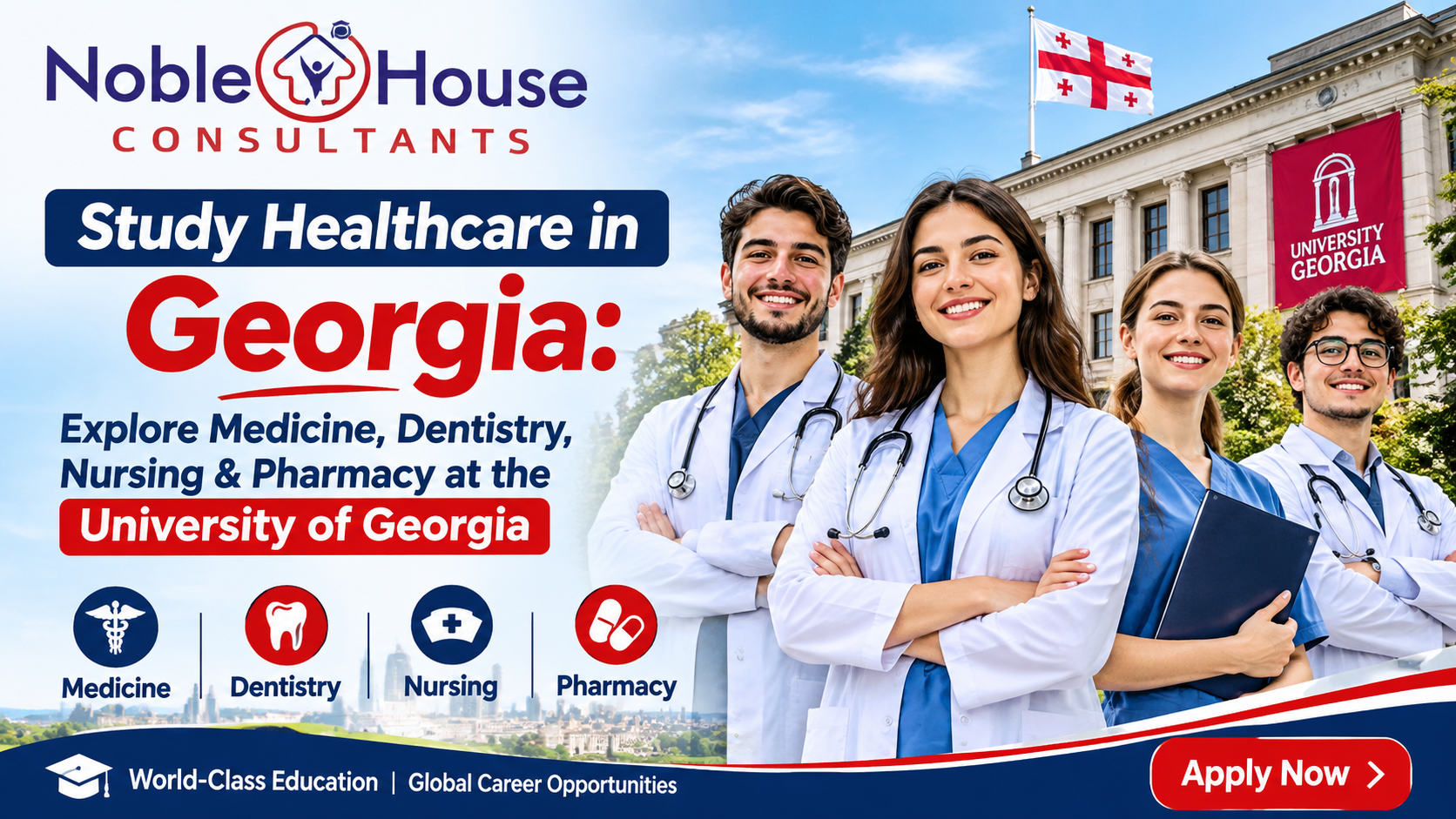
Study Healthcare in Georgia: Explore Medicine, Dentistry, Nursing & Pharmacy at the University of Georgia
Choosing the right destination for higher education is one of the most important decisions for aspiring healthcare professionals. With growing opportunities in international education, Georgia has emerged as an attractive destination for students looking to pursue healthcare-related degrees in an international academic environment. For those planning to study healthcare in Georgia, the University of Georgia (UG) in Tbilisi offers several academic pathways, including Medicine, Dentistry, Nursing, and Pharmacy. With English-medium education, structured academic programmes, and opportunities for practical learning, the university provides students with different routes to build a foundation for a future in healthcare.
Among these options, Medicine and Dentistry are particularly appealing to students who aspire to become doctors and dental professionals. Nursing and Pharmacy also provide valuable alternatives for those interested in patient care, medication management, and the broader healthcare sector.
Why Choose Georgia for Healthcare Education?
Georgia, located in the Caucasus region between Eastern Europe and Western Asia, has increasingly attracted international students seeking higher education opportunities. Its multicultural environment, developing education sector, and international student community contribute to its appeal.
Tbilisi, the country’s capital, offers a combination of modern urban infrastructure, cultural experiences, and access to educational institutions. International students can experience a different academic and cultural environment while pursuing their professional ambitions.
Another important consideration is the availability of English-medium programmes. Students who wish to pursue healthcare education without initially studying in another language may find English-taught courses particularly convenient. However, learning the local language can be beneficial when interacting with patients during clinical placements.
The University of Georgia provides a range of healthcare-related academic programmes, allowing students to explore different professional directions within the medical and pharmaceutical fields.
1. Medical Doctor (MD): Build a Future in Medicine
Medicine remains one of the most sought-after academic disciplines among students interested in healthcare. The University of Georgia offers a six-year Medical Doctor (MD) programme designed to develop the theoretical knowledge, clinical understanding, and practical competencies required for a medical career.
The programme follows a 360-ECTS structure and combines foundational medical sciences with laboratory education and clinical exposure. During the initial stages, students develop an understanding of subjects such as anatomy, physiology, biochemistry, pathology, and other essential biomedical disciplines.
As they progress, the curriculum introduces more advanced medical subjects and opportunities to understand different aspects of patient care. Clinical education and hospital rotations help students connect classroom learning with real-world medical practice.
The six-year structure provides a comprehensive academic pathway for students interested in becoming medical professionals.
Why consider the MD programme?
- Six-year academic duration.
- 360 ECTS credits.
- English-medium instruction for international students.
- A combination of theoretical and practical learning.
- Clinical exposure and hospital-based training.
- Opportunities to develop foundational diagnostic and patient-care skills.
For students aspiring to pursue an international medical education, the opportunity to study medicine in Georgia can be an important step towards their long-term professional goals.
The programme is particularly relevant for students who are passionate about understanding the human body, identifying medical conditions, supporting patients, and contributing to healthcare delivery.
2. Dentistry (DMD): Develop Expertise in Oral Healthcare
Dentistry is another important academic pathway at the University of Georgia. The Doctor of Dental Medicine (DMD) programme is generally structured as a five-year course designed to prepare students for careers in oral healthcare.
Dental professionals play a significant role in maintaining overall health by preventing, diagnosing, and treating conditions affecting the teeth, gums, and oral cavity. With increasing awareness of preventive dental care, oral hygiene, and restorative treatments, dentistry continues to be an important part of modern healthcare.
The programme focuses on developing both scientific knowledge and practical dental skills. Students study subjects related to oral anatomy, dental materials, pathology, preventive dentistry, and different clinical aspects of dental treatment.
Practical training is particularly important in dentistry. Students need to develop precision, manual coordination, patient communication skills, and an understanding of modern dental procedures. Structured clinical learning helps them gradually become familiar with the professional responsibilities of dental practitioners.
Key highlights of the Dentistry programme:
- Five-year academic duration.
- Doctor of Dental Medicine qualification.
- English-medium educational opportunities.
- Focus on oral healthcare and dental sciences.
- Practical learning and clinical skill development.
- Exposure to modern dental treatment concepts.
Students looking to study Dentistry University of Georgia can explore this programme as an academic pathway towards a professional future in dental healthcare.
Dentistry may be particularly suitable for students who enjoy combining medical science with practical procedures, patient interaction, and detailed clinical work.
3. Nursing: Make a Difference Through Patient Care
While Medicine and Dentistry remain the primary choices for many aspiring healthcare professionals, Nursing offers another meaningful route into the healthcare industry.
The University of Georgia also offers a Bachelor of Science in Nursing programme, generally structured over four years and comprising 240 ECTS credits.
Nursing education focuses on developing the knowledge and practical abilities required to provide quality patient care. The curriculum covers important areas such as anatomy, pharmacology, paediatric nursing, psychiatric nursing, and critical care.
An essential component of nursing education is supervised clinical practice. Students gain opportunities to understand patient-care procedures, healthcare environments, communication, and professional responsibilities.
Programme highlights include:
- Four-year academic duration.
- 240 ECTS credits.
- Theoretical and practical nursing education.
- Exposure to different areas of patient care.
- Clinical learning opportunities in healthcare settings.
Nursing is an excellent academic option for students who are compassionate, responsible, and interested in working closely with patients. It also provides opportunities to explore different healthcare specialisations as professional experience develops.
4. Pharmacy: Explore the Science Behind Medicines
Pharmacy is another valuable option for students interested in healthcare, medicines, and pharmaceutical sciences.
The University of Georgia offers a Bachelor of Science in Pharmacy programme with a typical duration of four years and a 240-ECTS structure.
The programme introduces students to various aspects of pharmaceutical education, including pharmacology, rational pharmacotherapy, pharmaceutical products, pharmaceutical analysis, clinical trials, and pharmacy management.
Students develop an understanding of how medicines are formulated, analysed, managed, and used in healthcare. The programme also incorporates practical learning opportunities, including laboratory-based education and exposure to pharmaceutical practice.
Key programme highlights include:
- Four-year academic duration.
- 240 ECTS credits.
- Pharmaceutical science and pharmacology education.
- Study of pharmaceutical analysis and clinical trials.
- Practical learning and laboratory exposure.
- Understanding of medication management and pharmacy operations.
Pharmacy may be an appropriate choice for students who are interested in the scientific and practical aspects of medicines and their role in patient treatment.
Tuition Fees and Living Expenses in Tbilisi
Affordability is an important consideration when selecting an international study destination. Georgia offers several healthcare education options, with tuition fees varying according to the programme.
Based on the available programme information, the approximate annual tuition fees at the University of Georgia are:
| Programme | Duration | Approximate Annual Tuition |
| Medical Doctor (MD) | 6 years | USD 6,500 |
| Dentistry (DMD) | 5 years | USD 6,000 |
| B.Sc. Nursing | 4 years | USD 4,000 |
| B.Sc. Pharmacy | 4 years | USD 4,500 |
These figures are indicative and should be confirmed with the university before applying, as tuition fees and payment conditions may change.
Students should also plan for accommodation, food, transportation, study materials, health insurance, and personal expenses. The University of Georgia does not operate traditional on-campus dormitories, so international students generally need to arrange accommodation independently.
Depending on the location, apartment type, and lifestyle, accommodation and living expenses can vary considerably. Planning a realistic budget before travelling can help students manage their finances more effectively.
For students planning to study healthcare in Georgia, considering the complete cost of education rather than tuition fees alone is essential.
Admission Requirements and Application Process
The admission process for international students generally involves submitting academic and personal documents for university evaluation.
Although requirements may differ between programmes, prospective students should prepare the following:
- High school or secondary school completion certificate.
- Academic transcripts.
- Valid passport copy.
- Completed application documents.
- English-language proficiency evidence, where applicable.
- Participation in an interview or introductory video assessment, if required.
Students should carefully check the specific admission requirements of their chosen programme. English proficiency requirements may vary, and certain programmes may accept university-administered language assessments.
The university may offer Fall and Spring admission opportunities, subject to programme availability and the applicable academic calendar.
It is advisable to begin the application process early to allow sufficient time for document preparation, academic verification, admission assessment, and student visa arrangements.
Accreditation, Recognition and Future Opportunities
Before choosing any international healthcare programme, students should carefully evaluate its accreditation status, academic structure, and professional recognition.
The University of Georgia operates within Georgia’s national higher education framework and is subject to the country’s relevant quality assurance and authorisation requirements.
Georgia’s participation in the Bologna Process supports alignment with the European Higher Education Area’s academic framework. However, this does not automatically guarantee professional licensing or unrestricted degree recognition in every country.
Students intending to practise medicine, dentistry, nursing, or pharmacy after graduation should independently verify the applicable licensing, registration, internship, examination, and qualification recognition requirements in their intended country of practice.
For example, students planning to return to India should check the latest eligibility and licensing requirements established by the relevant Indian regulatory authorities before enrolling. Medical and dental graduates may be subject to specific screening, internship, and registration conditions.
Understanding these requirements in advance can help students make informed decisions about their education and long-term careers.
Your Healthcare Dreams Deserve the Right Guidance!
Planning to pursue Medicine, Dentistry, Nursing, or Pharmacy at the University of Georgia? Noble House Consultants is here to make your international education journey easier. We provide guidance throughout the university application process, helping you understand programme options, admission requirements, documentation, and important procedures. With our support, you can approach each step with greater clarity and confidence. Let us help you explore your opportunities in Georgia and take a confident step towards your healthcare career.
End Note
Georgia offers international students diverse opportunities to pursue healthcare education at the University of Georgia in Tbilisi. With Medicine and Dentistry as its primary programmes, alongside Nursing and Pharmacy, students can explore different pathways towards a healthcare career. English-medium education, practical learning opportunities, and varied academic programmes make it a destination worth considering. If you aspire to study healthcare in Georgia, explore the available programmes, understand the admission requirements, and take an informed step towards your professional future.
Frequently Asked Questions
1. What healthcare programmes does the University of Georgia offer?
The University of Georgia offers four major healthcare programmes: Medical Doctor (MD), Dentistry (DMD), B.Sc. Nursing, and B.Sc. Pharmacy.
2. How long does the Medical Doctor programme take to complete?
The Medical Doctor (MD) programme takes six years to complete and follows a 360-ECTS academic structure.
3. What is the duration of the Dentistry programme at the University of Georgia?
The Doctor of Dental Medicine (DMD) programme generally takes five years and focuses on dental sciences, oral healthcare, and practical clinical training.
4. Are healthcare programmes at the University of Georgia taught in English?
Yes, the university offers English-medium healthcare programmes for international students. Students should confirm the language requirements for their chosen course.
5. What are the approximate tuition fees for healthcare programmes?
Annual tuition is approximately USD 6,500 for MD, USD 6,000 for Dentistry, USD 4,000 for Nursing, and USD 4,500 for Pharmacy.
6. What are the basic admission requirements for international students?
Applicants generally need secondary school certificates, academic transcripts, a valid passport, application documents, and English-language proficiency evidence where applicable.
7. Are degrees from the University of Georgia recognised internationally?
The university operates under Georgia’s national higher education framework. However, professional recognition and licensing requirements vary by country, so students should verify eligibility before applying.
About Author

Post a Comment