- M-floor, Al Makhawi Building. Umm Hurair Road, Oud Metha, Dubai – UAE
- advisor@noblehouseconsultants.com
- +971508759073 +971508758925


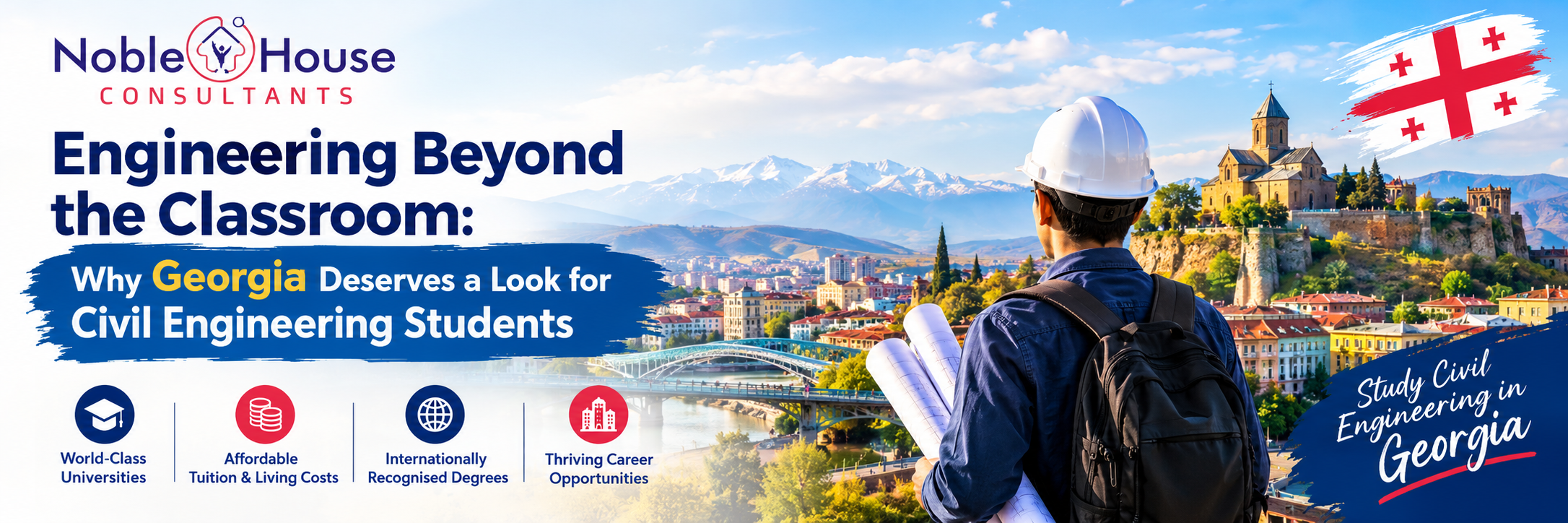
Engineering Beyond the Classroom: Why Georgia Deserves a Look for Civil Engineering Students
Civil engineering is a field that transforms ideas into the infrastructure people depend on every day. From highways and bridges to residential buildings, drainage systems, and sustainable urban developments, civil engineers play a crucial role in shaping modern society. For students planning an international education, choosing the right destination involves more than academic qualifications. Practical exposure, affordability, cultural experiences, and future career prospects also matter. In this context, civil engineering in Georgia deserves attention as a potential pathway for students seeking an international learning experience. Located at the crossroads of Europe and Asia, Georgia offers a distinctive educational environment, a rich architectural heritage, and opportunities to explore how engineering principles apply to real-world infrastructure challenges.
1. An International Learning Experience Beyond Traditional Classrooms
Studying civil engineering abroad allows students to experience different approaches to construction, infrastructure planning, and urban development. Georgia provides an interesting setting because its cities combine historic architecture with contemporary buildings, modern transport infrastructure, and expanding urban areas.
This contrast helps students appreciate how engineering requirements change according to a structure’s age, purpose, location, and environmental conditions. Observing buildings, roads, bridges, and public spaces can encourage students to think critically about construction materials, structural stability, maintenance, and efficient land use.
Beyond academic lessons, living in another country can strengthen communication, adaptability, and problem-solving skills. These qualities are valuable in civil engineering, where professionals frequently collaborate with architects, contractors, government authorities, and multidisciplinary project teams.
2. Affordable Education and Living Expenses
The affordability of studying abroad is a key factor for students and their families when planning higher education. Compared with several destinations in Western Europe, Georgia may offer a more affordable combination of tuition fees and everyday living expenses, although actual costs depend on the institution, accommodation, city, and lifestyle.
For prospective students, annual tuition may range from approximately $1,920 to $7,320, while monthly living expenses can fall between $340 and $785 or more. These figures are indicative rather than guaranteed, so students should confirm current fees, housing costs, insurance requirements, and other expenses before making a decision.
Budget planning should also include visa-related expenses, travel, study materials, and laboratory requirements. By comparing the complete cost of a degree rather than tuition alone, students can make a more informed decision about their educational investment.
3. Academic Programs and Practical Engineering Skills
A strong civil engineering education combines theoretical knowledge with practical application. Undergraduate programs commonly take three to four years, while postgraduate degrees may require one to two years, depending on the curriculum and qualification structure.
Students exploring civil engineering universities in Georgia should examine course content, laboratory facilities, faculty expertise, and opportunities for practical training before selecting a program. Relevant subjects may include structural analysis, construction materials, geotechnical engineering, transportation systems, environmental engineering, and water resource management.
Modern engineering education also relies on digital tools. Computer-Aided Design (CAD), structural modelling, surveying equipment, and simulation software help students understand how technical calculations translate into practical designs. Laboratory exercises and project-based assignments can further develop analytical thinking, accuracy, and the ability to evaluate competing engineering solutions.
However, the availability of particular facilities and courses varies between institutions. Reviewing the curriculum and confirming whether practical placements or industry projects are included can help students identify a suitable academic pathway.
4. Learning from Georgia’s Infrastructure and Built Environment
One of the most valuable aspects of studying engineering is learning to connect classroom concepts with the surrounding environment. Georgia offers a varied built landscape that can inspire students to investigate different infrastructure challenges.
Its mountainous terrain creates interesting considerations for road construction, slope stability, drainage, and transportation planning. Urban areas raise questions about traffic management, public utilities, land development, and the efficient use of limited space. Buildings in older districts also demonstrate the importance of preservation, structural assessment, and adapting existing structures to contemporary requirements.
These examples provide useful starting points for academic research and independent learning. Students can explore how rainfall affects drainage design, how terrain influences transport routes, or how engineers balance construction costs with long-term durability.
Such observations do not replace supervised site visits or formal technical training. Nevertheless, they can help students develop a broader understanding of the relationship between engineering decisions, environmental conditions, public safety, and community needs.
5. International Academic Standards and Global Exposure
Georgia’s participation in the European Higher Education Area through the Bologna Process makes academic structure and qualification comparability important considerations for international students. Some programs may offer English-medium instruction, which can help students pursue technical education without initially needing advanced proficiency in the local language.
When researching civil engineering in Georgia, applicants should verify the language of instruction, accreditation status, degree recognition, and eligibility for further study in their intended destination. Recognition is not automatically guaranteed everywhere; professional licensing bodies and employers may impose additional academic or practical requirements.
International education can also expose students to classmates with different perspectives, learning habits, and cultural backgrounds. This experience may strengthen teamwork and broaden their understanding of how engineering standards, construction practices, and infrastructure priorities differ between countries.
Learning basic Georgian can provide additional everyday benefits, particularly when communicating with local communities or navigating practical training environments.
6. Career Prospects and Professional Development
Civil engineering offers diverse career pathways across construction, transportation, water management, environmental protection, infrastructure development, and project coordination. Students can build a foundation for roles involving structural design, quantity estimation, site supervision, surveying, quality control, and construction planning.
Exploring civil engineering career opportunities in Georgia requires understanding both the local employment market and the conditions for working internationally. Employment prospects depend on qualifications, language proficiency, relevant experience, professional recognition, and prevailing industry demand.
Students should remember that earning a degree does not automatically guarantee employment or permission to work in another country. Researching work authorization rules, internship availability, graduate recruitment practices, and licensing requirements is therefore essential.
Building a professional portfolio can improve career readiness. Academic projects, technical drawings, software proficiency, internships, and documented practical experience help demonstrate capabilities to potential employers. Developing communication, teamwork, and project management skills can also support long-term professional growth.
7. Preparing for a Successful Study Experience
Choosing an international destination requires careful research rather than relying on attractive descriptions alone. Before applying, students should compare course structures, admission requirements, tuition fees, accommodation options, student support services, and available practical training.
It is equally important to review the curriculum for industry-relevant subjects and determine whether internships, supervised site visits, or research opportunities are accessible. Students should check current visa requirements, health insurance arrangements, and the documentation needed for admission.
Planning ahead helps students set realistic expectations and manage their finances. Speaking with current students or recent graduates, where possible, can also provide useful insights into academic workload, campus facilities, and everyday life.
Build Your Engineering Future with the Right Guidance
Planning to pursue your engineering dreams abroad? Noble House Consultants is here to help you take the next step with confidence. We provide personalized education support to help aspiring engineers explore suitable study destinations, course options, and admission pathways. From university selection and application guidance to visa documentation and pre-departure assistance, our team supports you throughout your study abroad journey. With a focus on cost-effective guidance, approachable counselling, and ongoing support, we help you make informed decisions about your academic future. If Georgia is on your list, let us help you explore the possibilities, understand the requirements, and prepare for an international education experience that aligns with your goals. Connect with us today for a consultation and take the first step towards shaping your future in civil engineering!
Conclusion
Civil engineering students need an education that develops technical knowledge, practical awareness, and the confidence to address real-world challenges. Georgia presents an option worth exploring through its international learning environment, potentially manageable education costs, varied built landscape, and opportunities to study engineering from multiple perspectives. However, the value of any destination ultimately depends on the quality and suitability of the chosen program.
For students considering civil engineering in Georgia, the most effective approach is to evaluate academic standards, practical training, financial requirements, degree recognition, and future career goals together. With thorough research and realistic planning, studying abroad can become more than a qualification; it can be an opportunity to develop the skills, adaptability, and professional perspective needed to contribute to the infrastructure of tomorrow.
Frequently Asked Questions
1. Why should students consider studying civil engineering in Georgia?
Georgia offers an international learning environment, potentially affordable education, and opportunities to explore diverse infrastructure and construction practices.
2. How long does a civil engineering degree take in Georgia?
Bachelor’s programs typically take three to four years, while master’s programs generally require one to two years, depending on the course structure.
3. Are English-taught civil engineering programs available in Georgia?
Yes, some institutions offer English-taught programs. Students should confirm the language of instruction before applying.
4. How much does it cost to study civil engineering in Georgia?
Tuition and living expenses vary by institution, accommodation, and lifestyle. Students should check current fees and prepare a complete budget before applying.
5. What practical skills can civil engineering students develop?
Students may develop skills in structural analysis, surveying, CAD software, construction materials, geotechnical engineering, and infrastructure planning.
6. What career opportunities are available after graduation?
Graduates may pursue roles in construction management, structural design, transportation engineering, surveying, project coordination, and infrastructure development, subject to local requirements.
7. How can students prepare to study civil engineering in Georgia?
Students should research admission criteria, course accreditation, tuition fees, visa requirements, degree recognition, and practical training opportunities before choosing a program.
About Author

Post a Comment