- M-floor, Al Makhawi Building. Umm Hurair Road, Oud Metha, Dubai – UAE
- advisor@noblehouseconsultants.com
- +971508759073 +971508758925


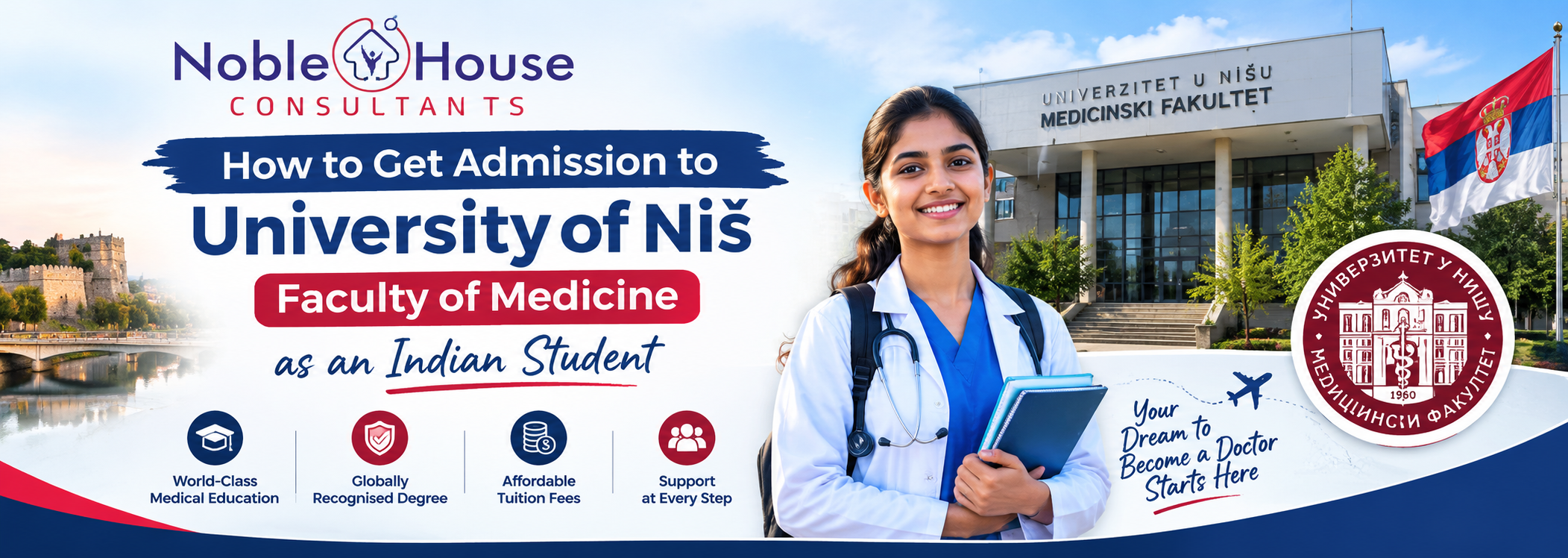
How to Get Admission to University of Niš Faculty of Medicine as an Indian Student
Studying medicine abroad is an important decision for Indian students who want to pursue a medical career in an international academic environment. Serbia has become one of the European destinations considered by students looking for medical education in English. The University of Niš Faculty of Medicine offers medical education and provides opportunities for international students who meet the university’s admission requirements. Before applying, students should understand the eligibility criteria, entrance examination, documentation, tuition fees, visa process, and other practical requirements involved in studying medicine in Serbia.
Why Consider Medical Education in Serbia?
Serbia offers students the opportunity to study medicine in a European country with established higher-education institutions and medical training facilities. International students can find programs designed specifically for students who do not speak Serbian, including English-medium medical education.
The medical education system combines classroom-based learning with practical and clinical training. Students generally study subjects such as anatomy, physiology, biochemistry, pathology, pharmacology, microbiology, and other core medical disciplines before progressing toward clinical subjects and practical experience.
When researching university of Nis Serbia medicine, students should look beyond tuition fees and consider the complete admission process, language of instruction, academic structure, living expenses, accommodation, clinical exposure, and the requirements for practicing medicine after graduation.
Eligibility Requirements for Indian Students
Indian applicants should first verify whether they satisfy the academic requirements for the medical program. Generally, students are expected to have completed their higher secondary education or equivalent qualification with the relevant science subjects.
Physics, Chemistry, and Biology are particularly important for applicants seeking admission to a medical degree. Students should have their 10th and 12th-grade academic records available when preparing their application.
Age is another consideration. Applicants are generally expected to be at least 17 years old by the applicable deadline or December 31 of the year of admission, depending on the requirements applicable to their admission cycle.
Indian students should also pay attention to the National Eligibility cum Entrance Test (NEET-UG). Indian citizens intending to pursue medical education abroad should check the latest rules issued by the National Medical Commission and other relevant Indian authorities. NEET qualification may be required for Indian students who plan to study medicine abroad and subsequently pursue medical practice in India.
Because admission regulations can change, applicants should verify the requirements applicable to their particular academic year before submitting an application.
Entrance Examination
One of the important stages of the admission process is the university’s entrance examination. Applicants may be required to take a written examination covering subjects such as Biology and Chemistry.
The examination is intended to assess whether an applicant has sufficient foundational knowledge for medical studies. Students should therefore revise their senior-secondary Biology and Chemistry syllabus carefully before taking the examination.
Preparation should include important concepts, definitions, biological processes, chemical principles, equations, and commonly tested topics. Students should also familiarize themselves with the examination format, duration, marking system, and any instructions provided by the university.
The entrance examination may be conducted in English for applicants applying to an English-medium medical program. Students should therefore be comfortable reading and understanding scientific terminology in English.
English-Language Requirements
Students applying for an English-medium medical program need sufficient proficiency in English because lectures, study materials, examinations, assignments, and academic communication may be conducted in English.
Depending on the admission requirements for the relevant year, applicants may be asked to provide evidence of English-language proficiency. This could include an internationally recognized English-language test score or another acceptable certificate demonstrating English competence.
Students should check the university’s current requirements rather than assuming that a particular test is always mandatory. If proof of English proficiency is required, applicants should arrange the examination early enough to receive their results before the application deadline.
Application Process
After confirming eligibility, students can begin preparing their application. The first step is to gather all the necessary documents.
Commonly requested documents may include:
- Class 10 certificate and marksheet
- Class 12 certificate and marksheet
- Valid passport
- Passport-size photographs
- NEET-UG scorecard or qualification evidence, where applicable
- Proof of English proficiency, if required
- Application form
- Other documents requested by the university
Educational documents may need to be legalized, authenticated, translated, or otherwise certified depending on the university’s requirements and Serbian regulations.
Applicants should make sure that their names, dates of birth, passport information, and academic details are consistent across all documents. Any discrepancy can create unnecessary delays during admission or visa processing.
Applications should be submitted through the official admission channel specified by the university. Students should also check the applicable application fee and payment instructions before submitting their forms.
Tuition Fees and Other Expenses
Tuition is one of the most important factors for Indian families planning medical education abroad. The exact amount can vary according to the academic year and the university’s current fee structure.
For planning purposes, students may come across figures of approximately €6,000 per year for an English-medium medical program. However, applicants should confirm the current official tuition fee before making financial arrangements.
When researching Serbia MBBS fees for Indian students, it is important to consider more than tuition alone. The overall cost of education can include accommodation, food, transportation, health insurance, study materials, residence-related expenses, visa costs, travel between India and Serbia, and personal expenses.
Students should prepare an annual budget that includes both university expenses and living costs. They should also understand when tuition payments are due and whether the university permits payment in installments.
Admission Confirmation and Enrollment
After completing the required admission stages and securing a place, students may receive official documentation confirming their enrollment or registration.
Applicants should carefully review the admission letter and related documents to ensure that their personal details, program, academic year, tuition information, and other important conditions are correct.
Payment of the required tuition installment may be necessary before the university issues certain documents needed for the next stage of the process. Students should retain receipts and official correspondence related to all payments.
At this stage, University of Niš Faculty of Medicine applicants should also organize their documents for immigration and residence procedures. Keeping digital and physical copies of important documents can make the process easier.
Student Visa and Travel to Serbia
Indian students normally need the appropriate visa or authorization to enter and stay in Serbia for their studies. After receiving the necessary university documentation, students can begin the visa application process through the relevant Serbian diplomatic or consular authorities.
Visa requirements can include proof of admission, passport, financial documents, accommodation information, health insurance, photographs, and other supporting documents.
Students should apply well in advance because processing times can vary. They should not make non-refundable travel arrangements until they understand the applicable visa requirements and have received the necessary approval.
After arriving in Serbia, students may also need to complete residence registration or other formalities required for international students.
What Should Students Check Before Applying?
Before submitting an application, Indian students should create a checklist covering every major requirement. This can help prevent missing documents or deadlines.
Students should verify:
- Academic eligibility
- Minimum marks requirements
- NEET requirements for Indian applicants
- Entrance examination subjects and format
- English-language requirements
- Application deadline
- Application fee
- Tuition fee and payment schedule
- Required document legalization or translation
- Visa and residence requirements
- Accommodation options
- Health insurance requirements
- Estimated living expenses
- Recognition and licensing requirements relevant to their future career
It is particularly important to distinguish admission to a foreign medical university from eligibility to practice medicine in India. Indian students planning to return to India after graduation should understand the latest rules governing foreign medical graduates, including applicable licensing examinations, internship requirements, and other conditions established by Indian authorities.
Preparing for Medical Studies Abroad
Getting admitted is only the beginning of the journey. Students should prepare themselves academically and personally for studying in another country.
Medical education requires consistent study, time management, laboratory work, practical training, and eventually clinical responsibilities. Students should be prepared to communicate with classmates and teachers from different cultural and educational backgrounds.
Learning a few basic Serbian phrases can also be useful for everyday situations, even when the academic program is delivered in English. During clinical training, familiarity with local language and communication practices may become particularly valuable.
Students should also research accommodation and living arrangements before departure. Understanding transportation, banking, mobile connectivity, food options, healthcare facilities, and emergency contacts can make the transition to a new country easier.
Noble House Consultants: Your Trusted Guide to Medical Admission in Serbia
Planning to study medicine in Serbia? Noble House Consultants guides students throughout their admission journey, from university selection and application preparation to document assistance, entrance exam guidance, visa support, and pre-departure planning. With personalized counselling, cost-effective services, and onsite support, students can navigate international medical education with greater confidence, clarity, and peace of mind.
Final Thoughts
Applying to a medical university abroad requires careful planning rather than simply comparing tuition fees. Indian students should verify eligibility, prepare for the entrance examination, organize academic documents, meet language requirements, understand the complete cost of education, and complete visa formalities on time. Most importantly, they should verify current regulations directly with the relevant university and Indian authorities before making a final decision.
For students who meet the academic and admission requirements, University of Niš Faculty of Medicine can be explored as one option for pursuing medical education in Serbia. A well-organized application, early preparation, accurate documentation, and a clear understanding of post-graduation requirements can help students approach the admission process with greater confidence.
Frequently Asked Questions
1. Can Indian students apply for medical studies in Serbia?
Yes. Indian students who meet the academic, entrance examination, NEET, and other applicable admission requirements can apply for eligible medical programs in Serbia.
2. What subjects are required for medical admission?
Students generally need to have studied Physics, Chemistry, and Biology (PCB) in their 10+2 education.
3. Is NEET required for Indian students?
Yes, Indian students should qualify for NEET-UG as required under the applicable regulations for studying medicine abroad.
4. Is an entrance exam required for admission?
Yes. Applicants may need to pass a university entrance examination, generally covering Biology and Chemistry.
5. Is the medical program available in English?
Yes. English-medium medical programs are available for international students, subject to the university’s current offerings and admission requirements.
6. What documents are generally required?
Common documents include academic certificates and marksheets, a valid passport, photographs, NEET documentation, and proof of English proficiency where applicable.
7. How can Noble House Consultants help with admission?
Noble House Consultants provides guidance throughout the process, including university selection, application preparation, document assistance, visa support, and pre-departure guidance.
About Author

Post a Comment