- M-floor, Al Makhawi Building. Umm Hurair Road, Oud Metha, Dubai – UAE
- advisor@noblehouseconsultants.com
- +971508759073 +971508758925


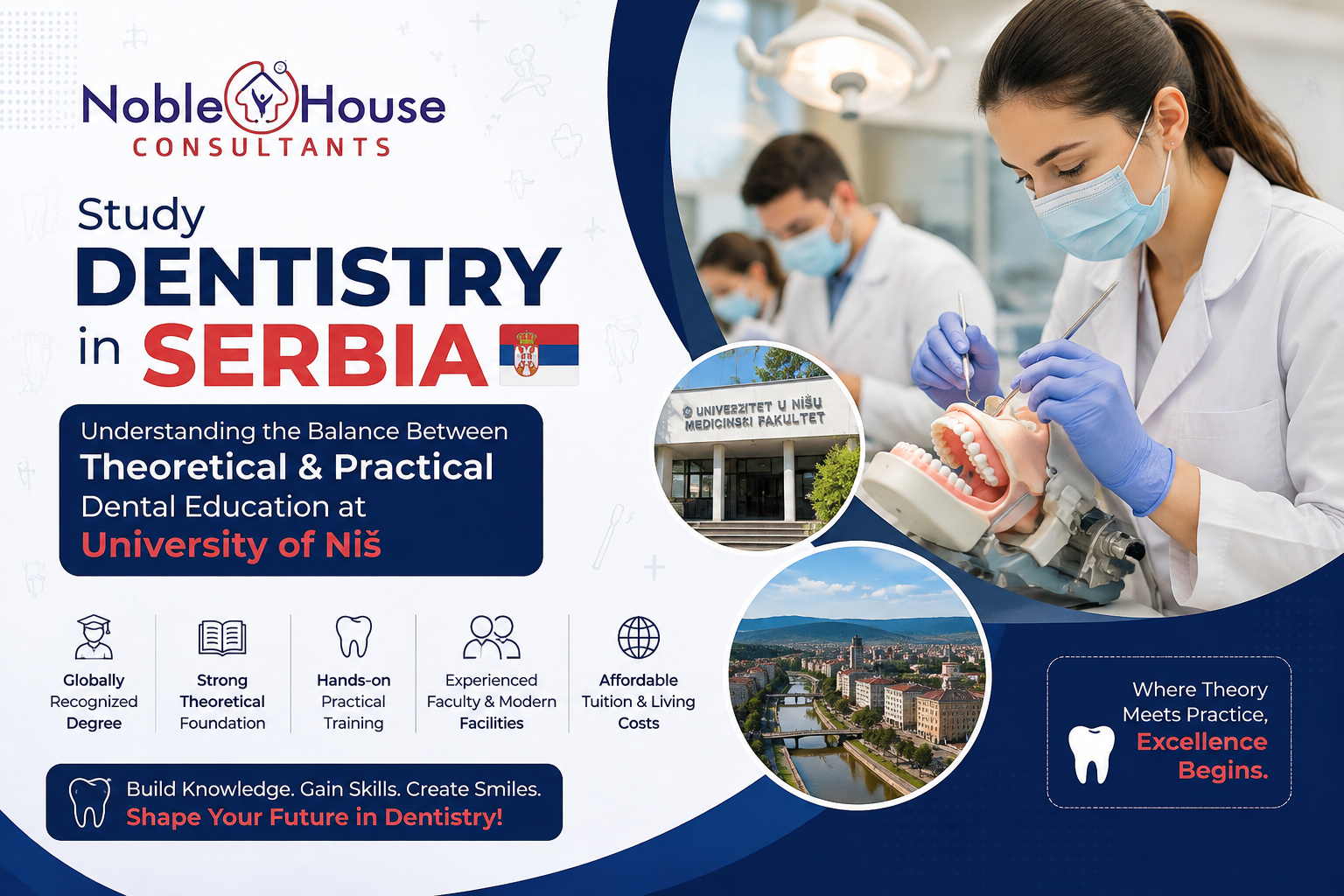
Study Dentistry in Serbia: Understanding the Balance Between Theoretical and Practical Dental Education at University of Niš
Choosing the right dental school involves more than looking at rankings, location, or degree duration. Students need an education that combines strong scientific knowledge with practical training so they can gradually develop the skills required for professional dental practice. For students planning to study dentistry in Serbia, the Integrated Academic Studies in Dental Medicine at the University of Niš offers a structured six-year program that brings theoretical learning, practical education, research and professional practice together. The program spans 12 semesters, includes 360 ECTS credits and comprises 5,760 hours of total student engagement.
A Curriculum Built Around Theory and Practice
The dental program at Niš follows a progressive structure. Students begin with fundamental medical and scientific subjects before moving into preclinical dental disciplines and eventually more advanced clinical areas. This approach is important because dental procedures require an understanding of anatomy, biological processes, disease mechanisms, materials and the overall health of the patient.
The program includes 4,755 hours of active teaching. Of these, 1,920 hours are devoted to theoretical instruction and 2,505 hours to practical instruction. A further 315 hours cover seminars, consultations, colloquia and pre-examination exercises, while 45 hours are allocated to scientific research. Another 1,005 hours are dedicated to professional practice and the final thesis.
The distribution shows that practical education is a major part of the program. Students are not expected to rely solely on lectures and textbooks. Instead, theoretical knowledge is progressively reinforced through practical activities and professional training.
Building the Scientific Foundation in the First Year
The first year focuses heavily on establishing the scientific foundation needed for future dental studies. Students encounter subjects including Molecular and Human Genetics, Anatomy, Histology and Embryology, Biochemistry and Oral Biochemistry, Tooth Morphology, Medical Statistics and Informatics, Epidemiology and Hygiene.
These subjects may seem primarily theoretical, but they have direct relevance to dentistry. Anatomy helps students understand the structures involved in dental procedures, while histology explains tissues at a microscopic level. Biochemistry provides insight into biological processes, and Tooth Morphology introduces students to the characteristics and structure of teeth.
For anyone looking to study dentistry in Serbia, this foundation is important because clinical competence depends on understanding the science behind diagnosis and treatment.
From Preclinical Learning to Dental Application
The second and third years gradually introduce students to preclinical dentistry. Dental Materials and Preclinical Prosthodontics appear in the second year, while the third year includes Preclinical Restorative Dentistry and Anesthesia in Dentistry.
At the same time, students continue their medical education through subjects such as Internal Medicine, Surgery, Pediatrics, Radiology, Neurology, Pharmacology with Toxicology and other disciplines.
This combination creates an important connection between general medicine and dentistry. Dental professionals need to understand how systemic health, medications and medical conditions can influence oral health and treatment decisions.
Preclinical training also allows students to move beyond simply understanding concepts. Through demonstrations, practical exercises and independent performance of laboratory and clinical skills, students begin developing the technical abilities required for later clinical education.
Why Practical Training Matters
Dentistry is a profession where theoretical knowledge must eventually be translated into precise physical skills. Students need to learn how instruments, materials and techniques are used, while also developing coordination, accuracy and confidence.
The program’s 2,505 hours of practical instruction demonstrate the emphasis placed on hands-on education. Practical sessions are conducted alongside theoretical learning rather than being treated as an afterthought.
The teaching methods include interactive communication, small-group work, skill demonstrations and independent laboratory and clinical performance. Practical groups generally consist of five to ten students, allowing learners to work in a more focused setting.
Students planning to study dentistry in Serbia should pay close attention to this aspect when comparing dental programs. The number of practical hours, timing of preclinical education and progression toward clinical training can significantly influence the overall learning experience.
Years Four and Five: Developing Clinical Skills
The fourth and fifth years represent a major shift toward specialized clinical dental education. Students in Year 4 study areas such as Oral Surgery, Clinical Prosthodontics 1, Restorative Odontology, Oral Medicine, Preclinical Endodontics, Gnathology and Preventive Dentistry.
In Year 5, the curriculum expands into Clinical Prosthodontics 2, Clinical Endodontics, Orthodontics, Periodontology, Pediatric Dentistry and Oral Hygiene.
This progression gives students exposure to different areas of dental medicine and helps them understand how various disciplines connect. For example, knowledge of oral disease and prevention supports periodontal care, while an understanding of dental materials and tooth structure becomes important when studying restorative procedures.
The clinical focus also reinforces the importance of combining theory and practice. Knowing the principles of endodontics is necessary, but students also need to understand how those principles are applied during clinical work.
Advanced Dental Education in the Sixth Year
The sixth year builds on the knowledge and skills acquired during the previous stages. Students study Otorhinolaryngology, Implantology and Maxillofacial Surgery. During the twelfth semester, the program also includes Forensic Medicine and clinical practice in Restorative Dentistry and Pediatric Dentistry.
This stage exposes students to advanced areas while allowing them to reinforce existing clinical knowledge. Implantology and maxillofacial surgery, for instance, require students to draw upon anatomical, medical and surgical knowledge developed during earlier years.
For students who study dentistry in Serbia, this progression illustrates how the program moves from basic science to increasingly specialized clinical education instead of introducing advanced subjects without sufficient preparation.
ECTS, Research and Independent Learning
The program consists of 360 ECTS credits, with 60 ECTS allocated to each academic year. One ECTS credit represents an average of 27 hours of student workload. This means students’ academic responsibilities extend beyond scheduled lectures and practical sessions.
They must prepare for assessments, complete pre-examination activities and engage in independent study. This is particularly relevant in dentistry, where students need to repeatedly review theoretical concepts while developing practical competencies.
Research is also incorporated into the program. Students complete scientific research activities and eventually prepare and defend a final thesis. This provides an opportunity to develop academic skills such as information gathering, analysis and scientific communication.
Elective courses offer another element of flexibility. Students select one elective during the first year and two electives annually in subsequent years, giving them opportunities to explore specific interests alongside compulsory subjects.
How the Teaching Approach Benefits Students
The combination of lectures, practical exercises, demonstrations and small-group activities creates multiple opportunities for students to learn. Lectures can establish the theoretical framework, while demonstrations show how knowledge is applied. Practical sessions then allow students to develop skills through active participation.
Interactive communication also encourages students to ask questions and engage with instructors and peers. This can support critical thinking and a deeper understanding of complex scientific concepts.
For prospective students, the important point is that theory and practice are not competing components. Each supports the other. Scientific knowledge provides the reasoning behind treatment, while practical education develops the ability to apply that knowledge accurately.
What Prospective Students Should Evaluate
When choosing a dental program, students should look beyond the course title. Important factors include the overall curriculum, practical teaching hours, progression from preclinical to clinical education, teaching methods, professional practice and opportunities for research.
The University of Niš Faculty of Medicine provides a curriculum in which students progress from foundational subjects such as anatomy and biochemistry to specialized areas including prosthodontics, restorative dentistry, endodontics, orthodontics, periodontology, pediatric dentistry, implantology and maxillofacial surgery.
Students should also consider whether the program’s teaching approach matches their learning preferences. Those who value hands-on education may find the significant practical component particularly relevant.
Turn Your Dentistry Dream into Reality
Noble House Consultants supports aspiring dental students throughout their study-abroad journey, from choosing the right university and course to admission guidance, documentation, visa assistance, and travel preparation. With cost-effective, tailor-made support and dedicated counselling, we help simplify each step. Our onsite assistance also ensures students receive continued support after reaching their destination and beginning their academic journey.
Conclusion
For students planning to study dentistry in Serbia, choosing the right academic environment can shape their future professional journey. The University of Niš offers a structured dental education that combines scientific foundations, preclinical learning, extensive practical training and advanced clinical disciplines. With progressive learning across six years, students can build both theoretical understanding and practical competence. The program’s focus on clinical skills, research and professional practice makes it a compelling option for students seeking comprehensive dental education in Serbia.
Frequently Asked Questions
1. How long is the Dental Medicine program at the University of Niš?
The program lasts six years and consists of 12 semesters.
2. How many ECTS credits does the program offer?
Students complete 360 ECTS credits over the six-year program.
3. How much practical training is included?
The program includes 2,505 hours of practical instruction, plus professional practice.
4. What do students study in the first year?
Subjects include Anatomy, Histology, Biochemistry, Tooth Morphology, Genetics, Epidemiology and Hygiene.
5. When does clinical dental education begin?
Preclinical dental education begins in the second year, with extensive clinical disciplines introduced in later years.
6. Which advanced dental subjects are taught in the sixth year?
Sixth-year studies include Implantology, Maxillofacial Surgery and clinical practice in Restorative and Pediatric Dentistry.
7. Does the program include research opportunities?
Yes. Students undertake scientific research activities and complete a final thesis.
About Author

Post a Comment