- M-floor, Al Makhawi Building. Umm Hurair Road, Oud Metha, Dubai – UAE
- advisor@noblehouseconsultants.com
- +971508759073 +971508758925


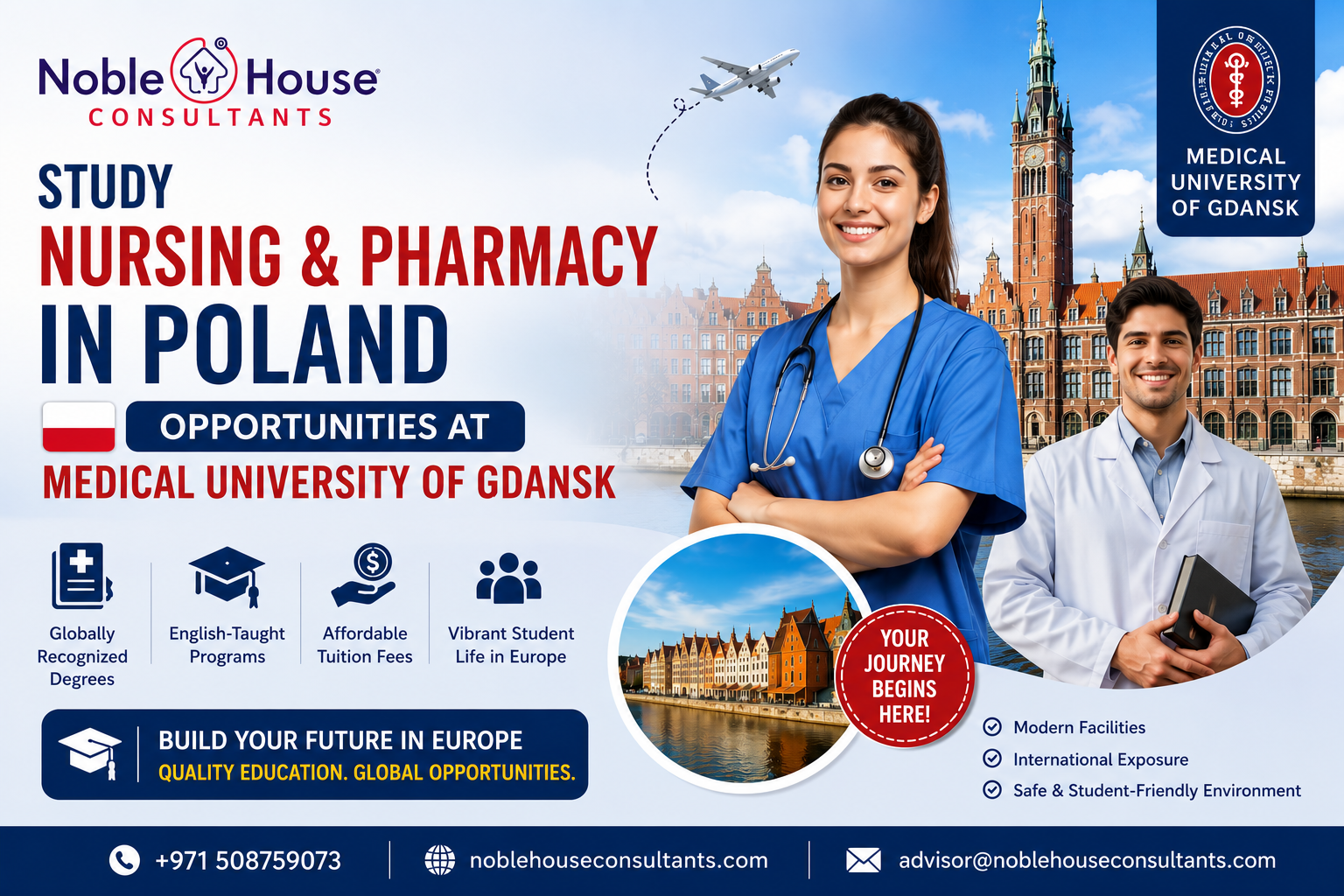
Study Nursing and Pharmacy in Poland: Opportunities at Medical University of Gdansk
Poland has steadily emerged as one of the preferred destinations for international students seeking quality medical education in Europe. Among the growing academic opportunities available, healthcare-related programs have gained significant popularity because of their international recognition, practical exposure, and affordable tuition structure. Students looking to study Nursing and Pharmacy in Poland are increasingly exploring universities that combine modern medical training with globally accepted educational standards.
One of the notable institutions attracting international applicants is the Medical University of Gdansk, known for its English-taught healthcare programs, multicultural learning environment, and strong academic reputation. Located in the historic coastal city of Gdańsk, the university provides students with access to advanced laboratories, simulation centers, and clinical training opportunities that prepare them for professional healthcare careers worldwide.
Growing Demand for Healthcare Education in Europe
The global healthcare sector continues to expand rapidly, creating a high demand for qualified nurses and pharmacists. European countries, including Poland, are investing heavily in healthcare infrastructure and education to address workforce shortages and improve patient care standards. As a result, international students are now considering European healthcare degrees as a pathway to stable and rewarding careers.
Poland, in particular, offers several advantages for aspiring healthcare professionals. Compared to many Western European countries, tuition fees and living expenses are relatively affordable, while the quality of education remains aligned with European Union academic standards. This balance of affordability and quality makes Poland an attractive study destination for students from Asia, Africa, and other parts of the world.
Nursing Education with International Standards
Students who wish to pursue nursing studies in Poland can benefit from structured academic programs designed according to strict European educational requirements. Nursing curricula generally combine theoretical knowledge with practical clinical experience, enabling students to develop both technical and interpersonal skills essential for patient care.
The bachelor’s nursing program offered in English typically spans three years and includes comprehensive subjects such as anatomy, physiology, pathology, microbiology, genetics, pharmacology, radiology, psychology, sociology, ethics, public health, and patient care management. Students are also introduced to specialized areas of nursing, including pediatrics, surgery, psychiatry, geriatrics, emergency medicine, rehabilitation, and palliative care.
Practical training remains one of the strongest aspects of nursing education in Poland. Students participate in clinical rotations and hospital-based learning experiences that help them understand real-world healthcare environments. Such hands-on exposure strengthens professional confidence and prepares graduates for diverse healthcare settings.
International applicants planning to study Nursing and Pharmacy in Poland often appreciate the emphasis placed on communication skills, ethics, patient-centered care, and evidence-based medical practice. These components are increasingly important in modern healthcare systems across the globe.
Pharmacy Programs Focused on Innovation and Patient Care
Pharmacy education in Poland is designed to produce professionals who possess deep knowledge of medicines, drug development, pharmaceutical sciences, and patient safety. Pharmacists today play a crucial role within healthcare systems by collaborating closely with doctors, nurses, and healthcare specialists.
The pharmacy program generally extends over five years and includes extensive academic and practical training. Students gain knowledge in pharmaceutical chemistry, biology, biochemistry, toxicology, pharmacology, drug formulation, clinical pharmacy, and patient counseling. Many programs also include mandatory practical internships or pre-registration training in approved pharmacies.
Students enrolled in pharmacy programs learn not only about medicines themselves but also about how patients react to medications, how treatments are developed, and how pharmaceutical care contributes to public health outcomes. This multidisciplinary approach helps graduates adapt to evolving healthcare technologies and medical advancements.
The demand for qualified pharmacists continues to rise globally, making pharmacy education a strong career option for international students. Those who choose to Study Nursing and Pharmacy in Poland benefit from European academic exposure while gaining qualifications that are recognized in multiple countries.
Admission Requirements and Eligibility
Admission to healthcare programs in Poland is generally competitive but accessible to academically strong international students. Most universities require applicants to have completed high school education with good academic performance in science-related subjects.
For nursing and pharmacy programs, students are usually expected to demonstrate proficiency in Biology and English, along with one additional science subject such as Chemistry, Physics, or Mathematics. Some universities may also conduct interviews or oral assessments to evaluate English language skills, motivation, communication abilities, and aptitude for healthcare professions.
International students applying through different educational systems, including IB or advanced-level curricula, are often assessed according to equivalent academic standards. Universities also pay close attention to applicants’ motivation for entering healthcare professions, as these careers demand responsibility, compassion, and dedication.
The application process commonly opens several months before the academic session begins, with orientation programs taking place in late September. Early preparation of academic documents, transcripts, passports, and supporting certificates is essential for smooth admission processing.
Advantages of Studying in Gdańsk
The city of Gdańsk offers an ideal environment for international students pursuing healthcare education. Situated on the Baltic coast, the city combines historical architecture, modern infrastructure, and a vibrant student atmosphere. International students often find Gdańsk welcoming, safe, and culturally diverse.
Modern healthcare universities in the city provide advanced simulation laboratories, digital learning technologies, and clinical partnerships that enhance professional training. English-medium instruction further supports international students in adapting comfortably to academic life.
Another important advantage is exposure to multicultural classrooms where students from different countries study together. Such diversity helps future healthcare professionals develop cross-cultural communication skills, which are increasingly valuable in international healthcare systems.
Students searching for high-quality Pharmacy and Nursing Courses in Poland are often attracted by the combination of academic excellence, practical learning, and international exposure available in cities like Gdańsk.
Career Opportunities after Graduation
Healthcare graduates from Poland benefit from qualifications that align with European educational frameworks. Nursing and pharmacy degrees obtained from recognized Polish universities can open pathways to professional opportunities across Europe and other international healthcare markets.
Nursing graduates may pursue careers in hospitals, rehabilitation centers, community healthcare facilities, emergency care units, long-term care institutions, and specialized clinics. Similarly, pharmacy graduates can explore opportunities in community pharmacies, hospital pharmacies, pharmaceutical industries, research organizations, and healthcare consulting.
In many cases, graduates may also seek professional registration or licensing within European Union countries, depending on local regulatory requirements. This international mobility significantly increases the long-term career value of healthcare education in Poland.
Students who study Nursing and Pharmacy in Poland often appreciate the balance between academic affordability and global career potential. With healthcare remaining one of the world’s most essential industries, qualified professionals continue to enjoy strong employment prospects and professional stability.
Student Experience and Academic Environment
Healthcare education requires discipline, dedication, and continuous practical engagement. Universities in Poland support students through orientation programs, mentorship opportunities, academic workshops, and student organizations that help international students adjust to university life.
Interactive teaching methods, laboratory training, simulation exercises, and hospital-based learning contribute to a comprehensive educational experience. Students are encouraged to participate actively in research activities, healthcare discussions, and interdisciplinary learning environments.
The Medical University of Gdansk is widely recognized for offering an academically rigorous environment supported by modern educational facilities and internationally oriented programs. Such institutions continue to attract students who aspire to build successful careers in nursing and pharmaceutical sciences.
Turn Your Study Abroad Dreams into Reality
Noble House Consultants is committed to helping students build successful international careers through trusted education support services. Based in Dubai, we provide personalized guidance for admissions, visa assistance, course selection, and university applications in healthcare, engineering, management, and more. With our experienced counsellors, cost-effective services, and dedicated student support, we help you confidently take the next step toward a brighter global future.
Conclusion
Choosing the right destination for healthcare education is a major decision for aspiring medical professionals. Poland continues to stand out as a reliable option because of its affordable education system, internationally aligned curriculum, practical training opportunities, and growing reputation in healthcare studies.
For international students aiming to build successful careers in nursing or pharmacy, studying in Poland offers both academic and professional advantages. Those planning to study Nursing and Pharmacy in Poland can benefit from modern medical education, multicultural exposure, and globally relevant qualifications that support long-term career growth in the healthcare sector.
Frequently Asked Questions
1. Why should international students choose Poland for nursing and pharmacy studies?
Poland offers affordable tuition fees, globally recognized degrees, modern healthcare education, and strong practical training opportunities for international students.
2. What are the eligibility requirements for nursing and pharmacy programs in Poland?
Students generally need a high school diploma with good grades in Biology, English, and one science subject such as Chemistry, Physics, or Mathematics.
3. Is the Medical University of Gdansk suitable for international students?
Yes, the university provides English-taught programs, multicultural classrooms, advanced laboratories, and practical clinical exposure for international students.
4. Are nursing and pharmacy degrees from Poland internationally recognized?
Many healthcare degrees from Poland follow European Union educational standards, allowing graduates to explore opportunities across Europe and other countries.
5. What career opportunities are available after graduation?
Graduates can pursue careers in hospitals, clinics, rehabilitation centers, pharmaceutical industries, community pharmacies, and healthcare research sectors.
6. When does the admission process usually begin for healthcare programs in Poland?
Applications commonly open between March and July, while orientation programs and academic sessions generally begin in late September.
About Author

Post a Comment