- M-floor, Al Makhawi Building. Umm Hurair Road, Oud Metha, Dubai – UAE
- advisor@noblehouseconsultants.com
- +971508759073 +971508758925


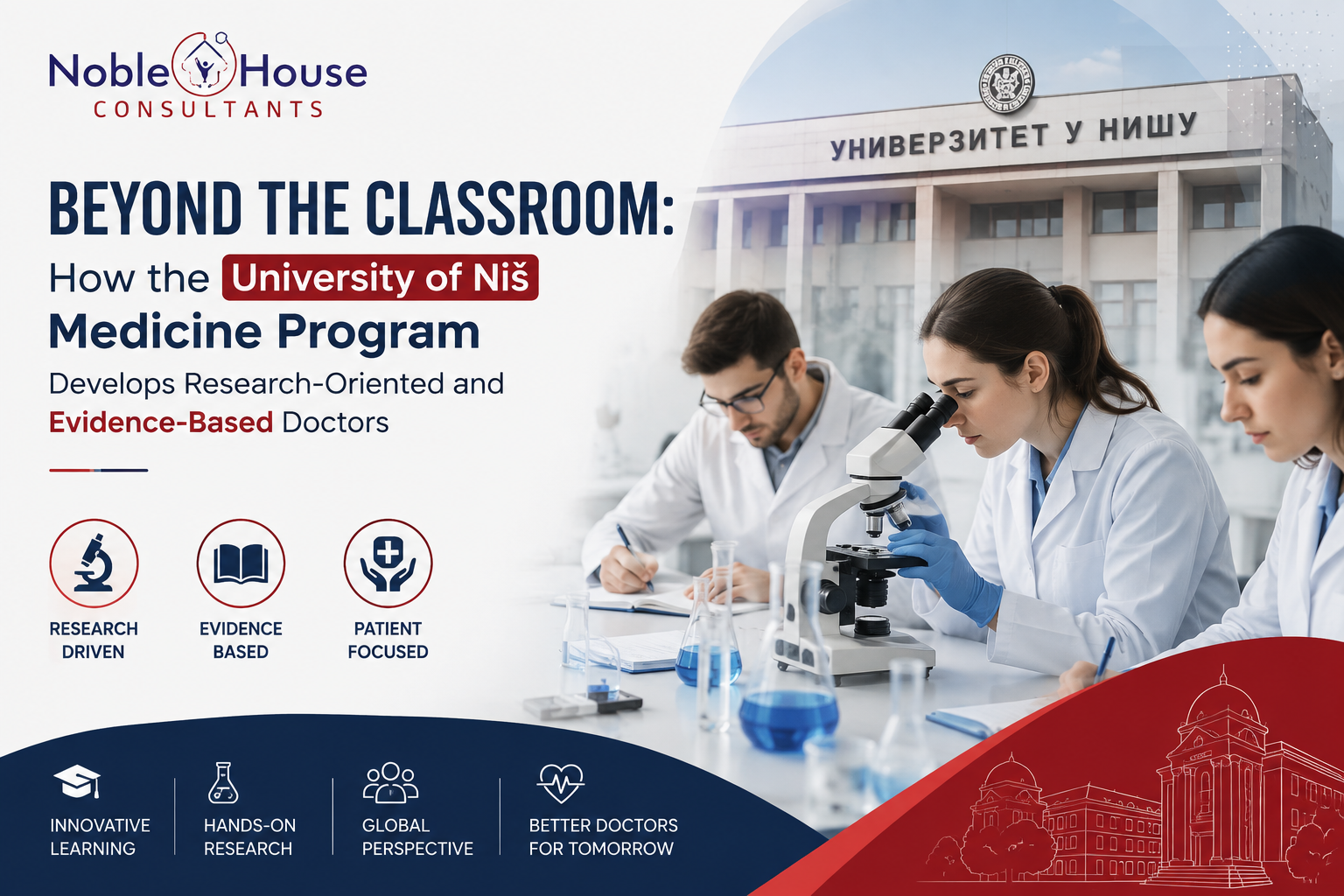
Beyond the Classroom: How the University of Niš Medicine Program Develops Research-Oriented and Evidence-Based Doctors
Medicine is no longer limited to memorizing textbooks or mastering clinical procedures. Today’s healthcare professionals are expected to think critically, interpret scientific evidence, and continuously update their knowledge to provide the best possible patient care. This shift has transformed medical education across the world, encouraging institutions to prepare students for a career that combines academic excellence with practical decision-making. For aspiring doctors who want to study medicine in Serbia, understanding the value of research-oriented learning is just as important as learning anatomy, physiology, or clinical medicine.
Why Research Matters in Medical Education
Modern healthcare evolves rapidly as new discoveries, technologies, and treatment approaches emerge every year. Doctors who rely only on outdated knowledge may struggle to provide the most effective care for their patients. This is why research has become a cornerstone of contemporary medical education.
A research-oriented curriculum encourages students to ask meaningful questions, evaluate scientific findings, and apply evidence to real-life clinical situations. Rather than accepting information at face value, future physicians learn to examine the quality of research, compare treatment options, and make informed decisions based on reliable data.
These skills are valuable throughout a doctor’s career, whether they pursue general practice, specialized medicine, surgery, or academic research.
Understanding Evidence-Based Medicine
Evidence-based medicine has become one of the most important principles in healthcare. It combines the best available scientific research with clinical expertise and patient preferences to support effective medical decisions.
Instead of relying solely on tradition or personal experience, doctors trained in evidence-based medicine evaluate scientific studies before recommending treatments. This approach helps improve patient safety, reduce unnecessary interventions, and promote better health outcomes.
Medical students who are introduced to evidence-based thinking early in their education develop habits that continue throughout their professional lives. They become lifelong learners who regularly assess new information and adapt to advancements in healthcare.
Building Strong Scientific Foundations
Research-oriented medical education begins long before students enter hospitals or clinics. A strong understanding of scientific principles forms the basis of critical thinking and informed decision-making.
Courses in medical statistics, genetics, and health informatics help students understand how medical research is conducted and interpreted. These subjects teach future doctors how to analyze data, recognize research limitations, and evaluate whether published findings can be applied in clinical practice.
Such knowledge enables graduates to distinguish between high-quality evidence and unsupported claims, making them more confident healthcare professionals.
Students planning to study medicine in Serbia often benefit from programs that emphasize these scientific foundations alongside traditional medical sciences, creating a balanced educational experience.
Learning the Research Process
Medical education extends beyond reading published studies. Students also gain an understanding of how research itself is designed and conducted.
Learning how to formulate research questions, review scientific literature, collect data responsibly, and interpret findings develops valuable analytical skills. Ethical considerations are equally important, ensuring that future healthcare professionals understand the responsibilities involved in conducting research involving human participants.
Exposure to research methodology also prepares students for future academic opportunities, including postgraduate education, clinical fellowships, and specialized training.
Whether graduates pursue careers in hospitals, universities, or public health organizations, research skills strengthen their professional capabilities.
Connecting Classroom Knowledge with Clinical Practice
One of the greatest strengths of modern medical education is the integration of classroom learning with clinical experience.
As students begin clinical rotations, they observe how theoretical concepts translate into patient care. They witness healthcare teams making decisions based on current scientific evidence, diagnostic findings, and established treatment guidelines.
This practical exposure helps students appreciate why evidence-based medicine is essential in everyday healthcare. Instead of viewing research as a separate academic subject, they recognize its direct impact on diagnosis, treatment planning, and patient outcomes.
For those who wish to study medicine in Serbia, clinical learning environments that emphasize evidence-based practice provide valuable preparation for future medical careers in diverse healthcare settings.
Developing Critical Thinking Skills
Critical thinking is one of the defining characteristics of an effective physician.
Medical students frequently encounter complex cases where multiple treatment options exist. Rather than relying on assumptions, they learn to evaluate available evidence, consider patient-specific factors, and choose the most appropriate course of action.
This structured approach develops confidence while reducing the likelihood of medical errors. Students also become comfortable questioning existing practices when new evidence suggests better alternatives.
These habits encourage continuous improvement throughout a doctor’s professional journey.
The Role of Collaboration in Academic Growth
Medical education is rarely an individual effort. Collaboration among students plays a significant role in developing research and communication skills.
Group discussions, academic presentations, peer learning, and collaborative writing projects encourage students to exchange ideas and solve problems together. Working with peers also exposes students to different perspectives, strengthening their ability to analyze complex medical issues.
Participation in academic activities beyond regular coursework further enhances research experience. Students often improve their scientific writing, presentation abilities, and confidence while preparing for future professional opportunities.
These collaborative experiences also help build leadership, teamwork, and communication skills that are essential in multidisciplinary healthcare environments.
Preparing for Future Specialization
Research experience often becomes an advantage for graduates seeking residency positions and advanced medical training.
Residency programs increasingly value applicants who demonstrate analytical thinking, scientific curiosity, and academic involvement. Students who understand research methodology are often better prepared to contribute to quality improvement projects, clinical audits, and scientific publications during their postgraduate training.
This preparation not only strengthens residency applications but also supports long-term career development in clinical medicine, academic research, and healthcare leadership.
Students interested in MBBS in Serbia frequently look for programs that combine clinical education with opportunities to develop research competencies, as these experiences contribute to stronger professional profiles.
Lifelong Learning as a Medical Professional
Graduating from medical school marks the beginning—not the end—of a doctor’s education.
Healthcare continues to evolve through scientific discoveries, new treatment protocols, and technological innovations. Doctors must regularly update their knowledge to provide high-quality patient care.
A research-oriented education fosters curiosity and encourages graduates to remain engaged with scientific literature throughout their careers. They become comfortable reviewing clinical guidelines, interpreting new research findings, and incorporating evidence into daily practice.
This commitment to lifelong learning benefits both healthcare professionals and the patients they serve.
Students exploring medical universities in Serbia for international students often consider how well institutions prepare graduates for continuous professional development in an ever-changing healthcare landscape.
The Global Value of Research-Oriented Medical Education
The demand for competent, evidence-based physicians extends across healthcare systems worldwide.
Doctors who possess strong research literacy can adapt more effectively to different medical environments, collaborate with international healthcare teams, and contribute to improvements in patient care.
Their ability to critically evaluate medical evidence allows them to respond confidently to emerging health challenges while maintaining high professional standards.
Research-oriented education also supports innovation by encouraging future physicians to participate in clinical studies, improve healthcare practices, and contribute to scientific advancement.
As medicine becomes increasingly data-driven, these competencies will continue to grow in importance.
Turn Your Medical Dream into Reality with Noble House Consultants
Planning to study medicine abroad? Noble House Consultants supports students throughout the admission journey with personalized counselling, university selection, application assistance, visa guidance, travel support, and onsite assistance. With a student-focused approach and reliable services, the consultancy helps make your dream of pursuing an international medical education a smooth and well-guided experience.
Conclusion
Medical education today extends far beyond lectures, textbooks, and examinations. Developing future physicians requires a balanced approach that combines scientific knowledge, ethical responsibility, clinical experience, critical thinking, and research literacy. By learning how to evaluate evidence, apply research to patient care, and remain committed to lifelong learning, medical students become better equipped to meet the evolving demands of modern healthcare. For aspiring doctors who plan to study medicine in Serbia, choosing a program that emphasizes evidence-based practice and research-oriented learning can provide a strong foundation for a successful and impactful medical career.
Frequently Asked Questions
1. Why should I study medicine in Serbia?
Serbia offers internationally recognized medical education, affordable tuition fees, practical clinical training, and research-oriented learning opportunities.
2. What is evidence-based medicine?
Evidence-based medicine is the practice of making clinical decisions using the best available scientific research, clinical expertise, and patient needs.
3. How does research improve medical education?
Research develops critical thinking, analytical skills, and the ability to evaluate medical evidence, helping students make informed clinical decisions.
4. Is MBBS in Serbia a good option for international students?
Yes. MBBS in Serbia is popular among international students because of its quality education, clinical exposure, and globally relevant curriculum.
5. What skills do students gain from research-oriented medical programs?
Students develop scientific reasoning, research methodology, ethical decision-making, problem-solving, teamwork, and lifelong learning skills.
6. How does Noble House Consultants help students?
Noble House Consultants provides end-to-end support, including counselling, university selection, admission assistance, visa guidance, travel support, and onsite assistance.
7. Can Noble House Consultants assist throughout the admission process?
Yes. The consultancy supports students from choosing the right medical program to completing admissions, visa formalities, and preparing for their study abroad journey.
About Author

Post a Comment