- M-floor, Al Makhawi Building. Umm Hurair Road, Oud Metha, Dubai – UAE
- advisor@noblehouseconsultants.com
- +971508759073 +971508758925


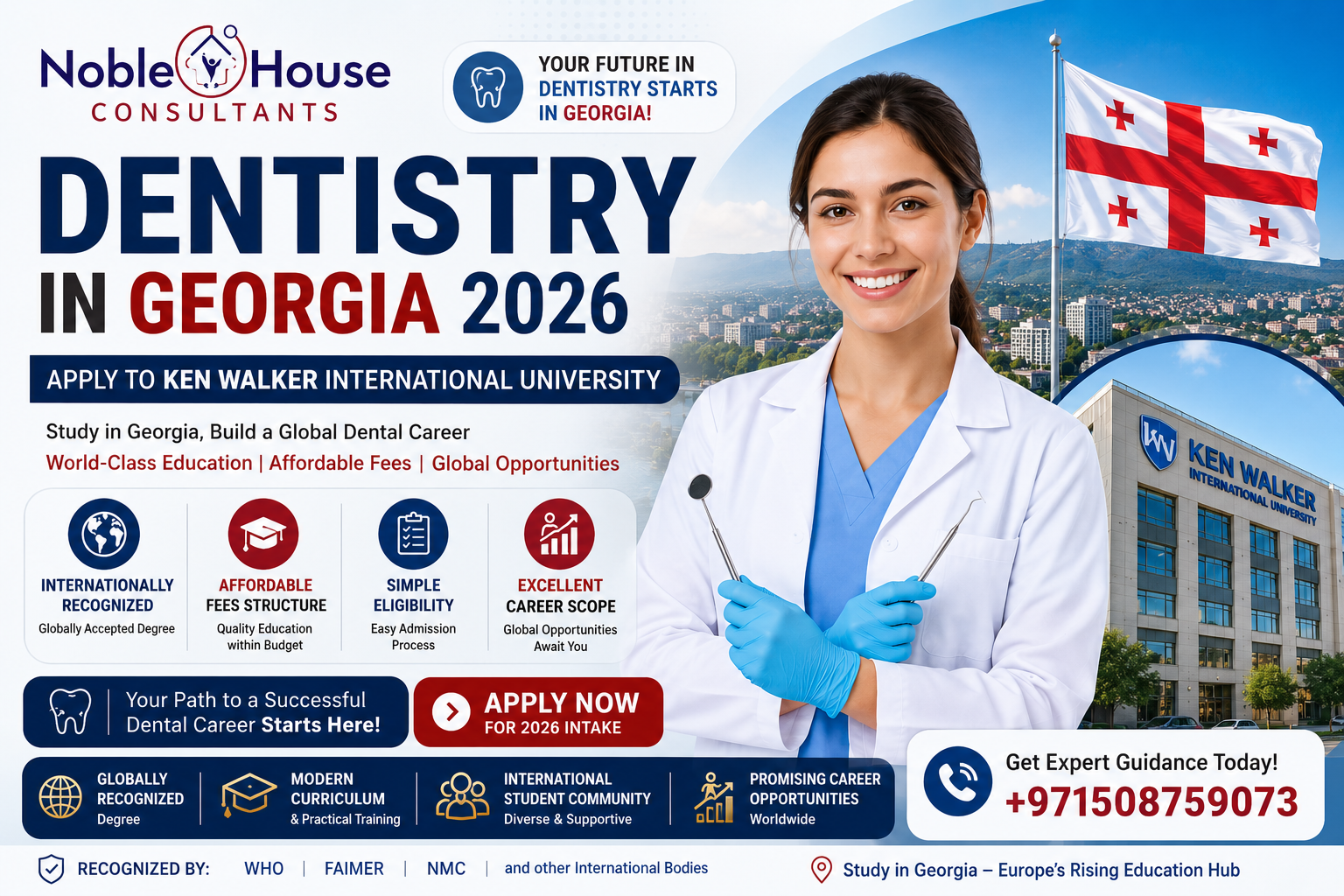
Dentistry in Georgia 2026: Apply to Ken Walker International University – Eligibility, Fees & Career Scope
Choosing to pursue a dental degree abroad has become an increasingly practical option for students seeking affordable education, global exposure, and internationally aligned medical training. One of the emerging destinations in Europe is Georgia, which offers structured dental education programs taught in English and designed for international students. Many aspirants planning to study dentistry are now considering Georgia due to its accessible entry requirements and globally oriented curriculum. In this context, dentistry in Georgia represents a growing academic pathway for students aiming to build a professional career in oral healthcare with international mobility.
Program Overview: Doctor of Dental Medicine in Georgia
The dental program offered in Georgian medical universities is structured as a unified, one-step professional degree in Stomatology, culminating in the award of a Doctor of Dental Medicine (DDM). The program is typically completed over five years and is designed to integrate both theoretical foundations and extensive clinical training.
Students accumulate around 300 ECTS credits during the course, where each credit represents approximately 30 hours of academic workload. This ensures that learners gain a balanced combination of classroom education, laboratory practice, and real-world clinical exposure.
The medium of instruction is English, making it accessible for international students from various regions. This removes language barriers and allows learners to focus entirely on academic and clinical development. The program is structured to meet international standards in dental education, ensuring that graduates are prepared for both local and global career opportunities.
Eligibility Criteria for Admission
Admission to dental programs in Georgia is relatively straightforward compared to many other countries, but certain academic and foundational requirements must still be met.
Applicants are generally expected to have completed their 10+2 education or an equivalent qualification with Physics, Chemistry, and Biology as core subjects. A minimum aggregate score of around 50% in PCB subjects is commonly required for general category students.
Students must also be at least 17 years old at the time of application. This ensures that candidates have completed basic secondary education before entering professional medical training.
Since the program is conducted in English, applicants are expected to have a reasonable level of English proficiency. However, standardized tests like IELTS or TOEFL are not always strictly mandatory, depending on institutional evaluation methods. This flexible approach allows more students to study dentistry abroad without facing excessive language certification barriers, while still maintaining academic readiness standards.
Tuition Fees and Academic Investment
Studying dentistry in Georgia in 2026 is quite reasonable. The cost of dental education in Georgia is considered more affordable compared to many Western countries, while still maintaining high academic quality. The annual tuition fee for the Doctor of Dental Medicine program is approximately 7000 USD or 10000 GEL, depending on the currency structure and applicable student category.
This fee typically covers academic instruction, access to university laboratories, and clinical training facilities. Additional living expenses such as accommodation, food, and transport are separate and vary depending on lifestyle and city.
Despite being a professional medical degree, the overall financial investment remains relatively moderate, making it a viable choice for international students seeking cost-effective options without compromising on quality education.
Curriculum Structure and Clinical Training
The dental curriculum in Georgia is designed to develop both academic knowledge and practical competence. In the initial years, students focus on foundational medical sciences such as anatomy, physiology, biochemistry, and oral biology. As the program progresses, more emphasis is placed on dental-specific subjects including prosthodontics, orthodontics, oral surgery, periodontology, and preventive dentistry.
Clinical training plays a crucial role in shaping student skills. From mid-program onward, students begin working in supervised clinical environments where they observe and later participate in patient care. This gradual exposure ensures confidence-building and skill development in real-world scenarios.
Students who choose to study dentistry in Georgia benefit from modern simulation labs and clinical setups that allow them to practice procedures before treating actual patients. This hands-on learning approach strengthens diagnostic abilities, technical precision, and patient management skills, all of which are essential in professional dental practice.
The academic framework also emphasizes research exposure and case-based learning, helping students develop analytical thinking and evidence-based decision-making in clinical dentistry.
Career Scope and Global Opportunities
A degree in Doctor of Dental Medicine from Georgia opens a wide range of career opportunities across multiple regions. Graduates can pursue professional licensing and practice in various countries, depending on local regulatory requirements.
In India, graduates are eligible to appear for licensing examinations such as FMGE or the upcoming NEXT exam, which are required for registration with the national medical authority to practice dentistry or pursue further studies. This pathway makes it possible for students who study dentistry abroad to return and build a career in their home country.
Internationally, graduates may also prepare for exams such as USMLE for the United States or PLAB for the United Kingdom, as well as licensing requirements in Gulf countries like the UAE. These options create strong global mobility for dental professionals.
The degree is also aligned with international academic and professional standards, often recognized in global medical education directories and frameworks. This allows graduates to explore postgraduate specialization options such as oral surgery, orthodontics, endodontics, or pediatric dentistry. Many also choose to enter private clinical practice or join hospitals and dental clinics in different countries.
Get a Clear Guidance for Your Admission with Noble House Consultants
Noble House Consultants is dedicated to guiding aspiring students through every step of their international education journey, especially for those aiming to pursue dentistry abroad. From selecting the right university to completing documentation and admission formalities, we ensure a smooth and stress-free process. Our team provides personalized support, helping students make informed decisions about their academic future. With us, you gain reliable guidance, transparent assistance, and continuous support, making your dream of studying dentistry abroad achievable and well-structured.
Conclusion
Georgia has steadily emerged as a promising destination for dental education due to its structured curriculum, affordable tuition, and internationally aligned medical training system. The Doctor of Dental Medicine program offers a comprehensive pathway for students aiming to build a long-term career in oral healthcare.
For students planning to study dentistry, Georgia provides a balanced combination of academic quality, clinical exposure, and global career opportunities. With a five-year professional structure, English-medium instruction, and strong practical training, it equips graduates with the skills required to succeed in diverse healthcare environments.
Overall, pursuing study dentistry in Georgia can be a strategic choice for aspiring dental professionals who are seeking international education with broad career mobility and modern clinical training standards.
Frequently Asked Questions
1. What is the duration of the Doctor of Dental Medicine (DDM) program in Georgia?
The DDM program typically lasts 5 years and includes both theoretical learning and clinical training.
2. What are the eligibility criteria to study dentistry in Georgia?
Students must complete 10+2 with Physics, Chemistry, and Biology, usually with at least 50% marks, and be at least 17 years old.
3. Is English proficiency required to study dentistry in Georgia?
Yes, the medium of instruction is English, but IELTS or TOEFL is generally not mandatory for admission.
4. What is the annual tuition fee for dentistry programs in Georgia?
The average tuition fee is around 7000 USD or 10000 GEL per year, excluding living expenses.
5. What career options are available after completing dentistry in Georgia?
Graduates can practice in India after FMGE/NEXT, or pursue licensing exams like USMLE, PLAB, and work globally or specialize further.
About Author

Post a Comment