- M-floor, Al Makhawi Building. Umm Hurair Road, Oud Metha, Dubai – UAE
- advisor@noblehouseconsultants.com
- +971508759073 +971508758925


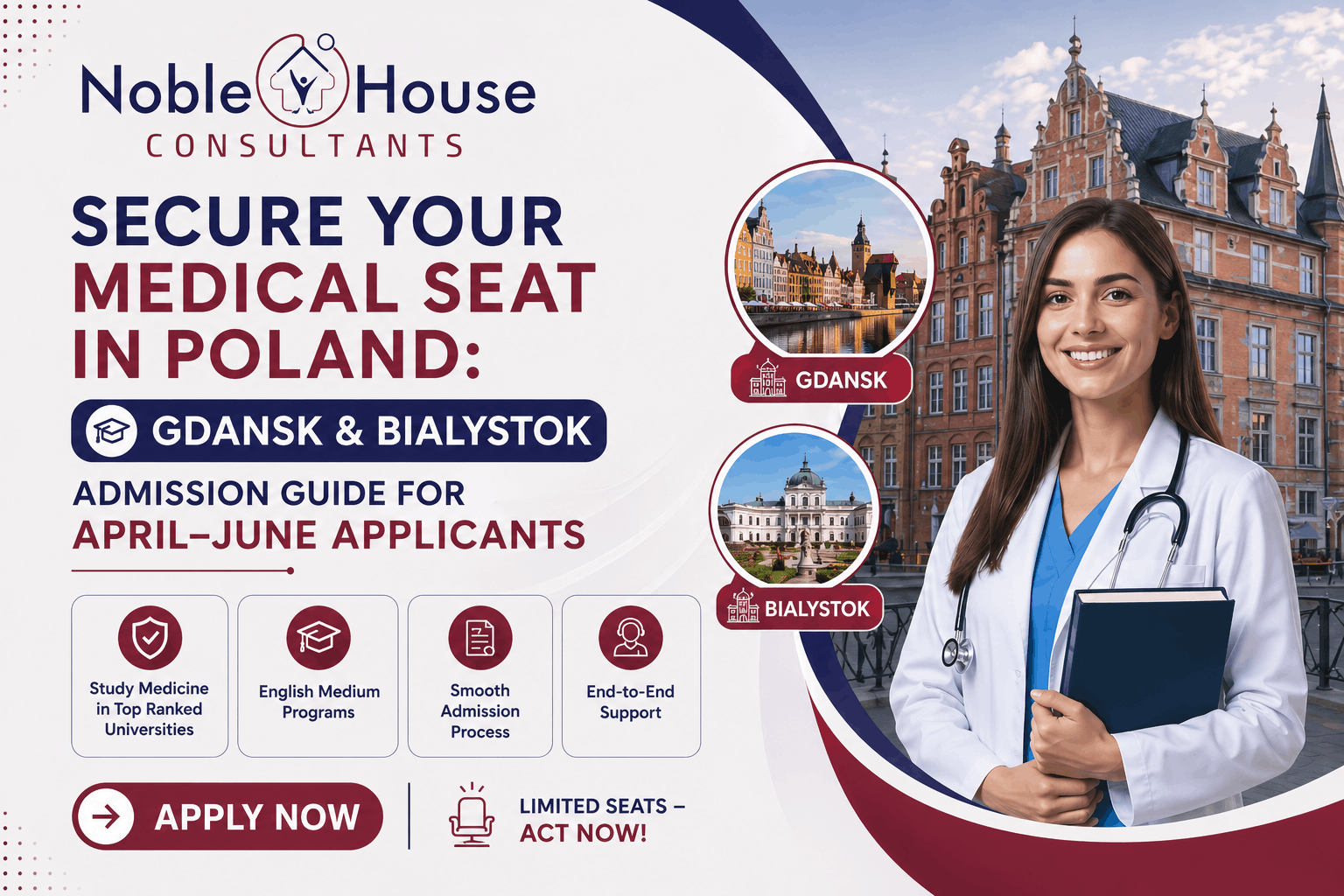
Secure Your Medical Seat in Poland: Gdansk & Bialystok Admission Guide for April–June Applicants
Pursuing a medical degree in Europe has become a structured and highly competitive pathway for international students, especially those aiming for globally recognized qualifications and English-taught programs. Among these destinations, Study medicine in Poland has gained strong attention due to its internationally accepted MD curriculum, public university standards, and clinical exposure integrated into early years of training. For students targeting the October 2026 intake, the April–June period is not just another timeline—it is the most critical preparation phase that determines the strength and completeness of the application.
During this time, applicants must align academic documents, understand university-specific requirements, and prepare for entrance assessments and interviews at institutions such as the Medical University of Gdańsk and the Medical University of Białystok.
Medical University of Gdańsk (MUG): Admission Structure and Timeline
The Medical University of Gdańsk is one of Poland’s leading public medical universities, offering a 6-year Doctor of Medicine program fully taught in English. The institution follows a well-defined admission cycle, and for the 2026/27 intake, online registration begins on March 18, 2026, with the final deadline set for July 15, 2026. However, the actual preparation phase begins much earlier, particularly during April–June, when applicants must ensure all academic and eligibility requirements are fully met.
The selection process typically includes:
- Online registration through the official university portal
- Submission of academic and identity documents
- Possible entrance exam (MCQ-based in Biology and Chemistry) or interview
- Evaluation of English language proficiency
Applicants are expected to have strong academic performance in Biology and at least one additional science subject such as Chemistry, Physics, or Mathematics.
Gdansk medical university admission
The Gdansk medical university admission process is designed to evaluate both academic readiness and conceptual clarity in core science subjects. Instead of relying only on grades, the university places importance on subject understanding, communication skills in English, and motivation toward medical studies, making the process competitive yet structured.
The tuition fee is approximately 62,000 PLN per year, reflecting the university’s advanced infrastructure, clinical exposure, and international teaching environment.
At this stage, Study medicine in Poland becomes more than just a career choice—it transforms into a strategic academic plan where timing, documentation, and subject preparation directly influence admission success.
Medical University of Białystok (MUB): Admission Pathway and Evaluation System
The Medical University of Białystok offers another strong opportunity for international medical aspirants. Located in a historic academic environment, the university provides a 6-year MD program designed to combine theoretical knowledge with clinical practice. Registration opens on December 1, 2025, and remains active until August 31, 2026. However, early applicants are often given priority consideration due to rolling interviews conducted between January and August.
The admission process includes:
- Online candidate registration system submission
- Virtual interview (Zoom-based evaluation)
- Academic document verification
- Health and eligibility confirmation
The interview plays a central role, assessing knowledge in Biology and one additional science subject such as Chemistry, Physics, or Mathematics. Unlike purely exam-based systems, this format emphasizes clarity of concepts and communication ability.
Applicants must also submit secondary school certificates and medical fitness documentation, ensuring they meet the academic and physical requirements for medical training.
Bialystok medical university application process
The Bialystok medical university application process focuses on continuous evaluation through interviews rather than a single entrance test. This structure allows the university to assess consistency in academic understanding and the applicant’s long-term motivation for pursuing medicine.
Tuition fees are approximately €15,100 for the first year, making it an accessible option within European medical education while maintaining strong academic standards.
At this stage, Study medicine in Poland becomes particularly relevant for students seeking a balance between affordability, global recognition, and structured admission systems that reward preparation over last-minute application attempts.
April–June Action Plan: Documentation and Preparation Phase
The April–June period is the most decisive stage for applicants targeting the 2026 intake. During this time, students must focus on compiling and verifying all required documents while strengthening academic readiness for interviews and assessments.
Essential documents include:
- High school transcript or maturity certificate with strong Biology and science subject scores
- Valid passport copy
- English proficiency proof (IELTS, TOEFL, or B2-level certification)
- Medical fitness certificate
- Recent passport-size photograph
This stage is also ideal for reviewing core science subjects, especially Biology and Chemistry, as they form the foundation of both entrance exams and interviews.
Additionally, applicants should ensure that all documents are properly formatted, translated if required, and ready for submission well before deadlines. Delays during this phase often reduce chances of securing preferred seats due to limited intake capacity.
If you want to study medicine in Poland, you need to have early strategic planning because universities follow strict intake limits and highly competitive selection ratios, especially in top-tier institutions like Gdańsk.
Key Factors That Influence Admission Success
Success in Polish medical university admissions is not determined by a single factor but by a combination of academic consistency, preparation timing, and interview performance. Students who begin preparation during April–June gain a significant advantage in terms of readiness and confidence.
Some of the most important success factors include:
- Academic Strength in Core Sciences
Strong performance in Biology and at least one additional science subject is essential for both universities. - Communication and Interview Readiness
Candidates must demonstrate clear scientific understanding and articulate motivation effectively during interviews. - Early Application Strategy
Submitting applications early improves visibility and increases chances of securing interview slots. - Document Accuracy and Completeness
Missing or incorrect documentation is one of the most common reasons for delays or rejection.
At this stage, Study medicine in Poland becomes a practical roadmap where disciplined preparation and early submission significantly enhance admission prospects.
Additional Preparation Insights for Competitive Intake
Competition for medical seats in Poland has increased steadily over recent years. For example, institutions like the Medical University of Gdańsk operate with limited intake capacity, making early application essential. Applicants are often evaluated not only on academic results but also on their motivation and long-term career clarity.
Students who aim to succeed should also consider optional preparatory pathways such as premedical courses if direct admission is not achieved. These programs help strengthen foundational knowledge and improve future admission chances.
From Aspiration to Admission: Structuring Your Medical Journey Abroad with Expert Guidance
Noble House Consultants is committed to transforming the dream of becoming a doctor into a structured and achievable journey. With Noble House Consultants, we support students through every step—from choosing the right country and course to completing applications for programs like medicine, engineering, and management across destinations such as Poland, Georgia, Turkey, Serbia, and the UK. Our team ensures smooth guidance for admissions, interview preparation, and documentation, while also assisting with visa-related processes and providing reliable support throughout the journey. At Noble House Consultants, we focus on making global education affordable, accessible, and stress-free for every aspiring student.
Conclusion
Securing a medical seat in Poland requires more than academic eligibility—it demands structured preparation, timely action, and clarity of purpose. The April–June period serves as the backbone of the entire admission cycle, allowing students to align documents, strengthen subject knowledge, and prepare for interviews with confidence.
Ultimately, Study medicine in Poland represents a long-term academic commitment that rewards discipline, preparation, and consistency. Students who understand university timelines, follow structured preparation plans, and approach admissions strategically are significantly more likely to secure a seat in reputed institutions like Gdańsk and Białystok for the October 2026 intake.
Frequently Asked Questions
1. When should I start applying for medical universities in Poland?
The ideal time to begin preparation is between April and June, as this period is crucial for completing documents, checking eligibility, and preparing for interviews.
2. What is the admission process for the Medical University of Gdańsk?
It involves online registration, submission of required documents, and either an entrance exam or interview, along with assessment of Biology, Chemistry, and English proficiency.
3. How is admission conducted at the Medical University of Białystok?
Admission is based on online application followed by a Zoom interview that evaluates knowledge in Biology and at least one additional science subject.
4. What documents are required to apply?
Applicants generally need academic transcripts, a valid passport, English proficiency proof, medical fitness certificate, and recent passport-size photographs.
5. Are interviews difficult for Polish medical universities?
Interviews are moderately challenging and focus on core science understanding, clarity of concepts, communication skills, and motivation for studying medicine.
6. Why is early application important for studying medicine in Poland?
Early application improves chances of securing interview slots, ensures timely document verification, and helps avoid issues due to limited seat availability.
7. What subjects are most important for admission?
Strong knowledge in Biology and at least one additional science subject such as Chemistry, Physics, or Mathematics is essential for both universities.
About Author

Post a Comment